Oral History
Gaard Moses
One 120 minute (two 60 minute tapes – C144 A&B) oral history interview with Gaard Moses by Larry Fredrick on January 9, 1996. The subject of the interview is the Brand building and other buildings in Aspen. It is part of the Architectural Survey Oral History Project.
Gaard Moses
Interviewed by Larry Fredrick
January 9, 1996
C144_1996.017.0001
Larry Fredrick [00:00:02] Today, continuing the project of Aspen’s Architectural Survey. Today we’re with Gaard Moses. It’s January 9th, 1996. And first of all, Gaard, I’d like to thank you for participating in this, and we’d like to get a brief biography and when you came to Aspen and just a simple biography, if you could.
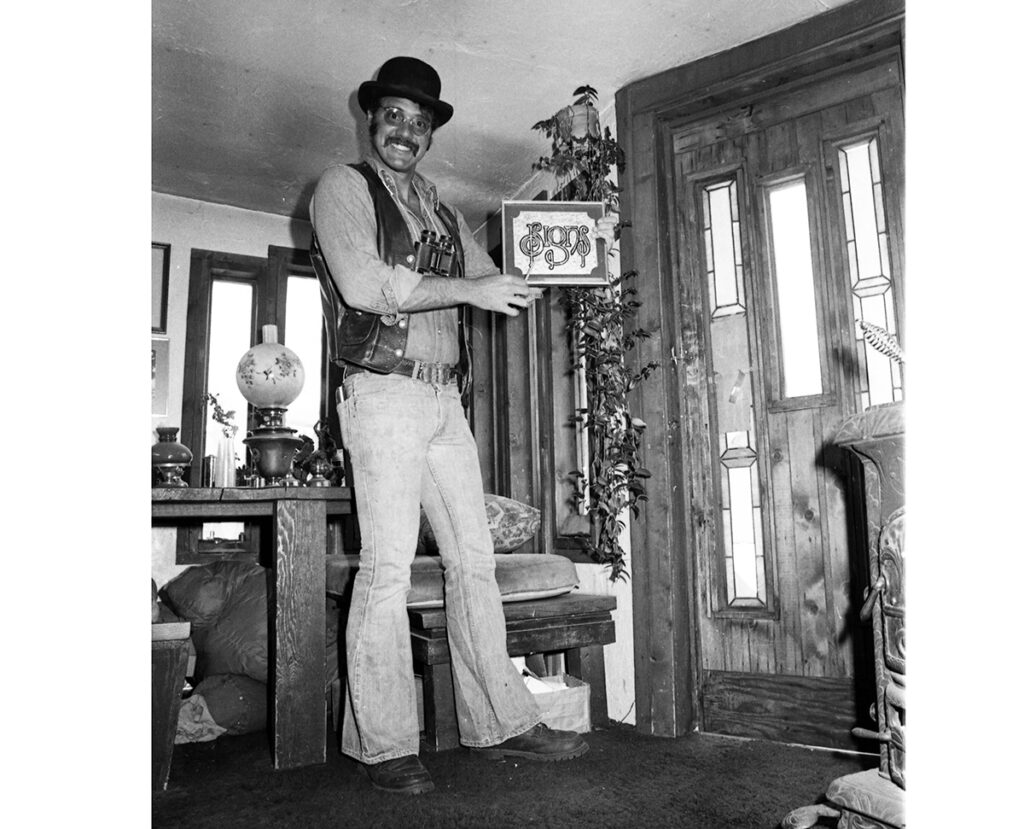
Gaard Moses [00:00:29] Okay. First time I saw Aspen, I was just a sprout, probably 21 or so. And that would have been 1966, I guess. Came out here on a break from college and loved the place and always wanted to live in a ski resort, although I didn’t know what that meant at that time. And I came out here and spent about a month or so in ’66. In ’67, went back to school, actually went to school in Europe, and returned in ’68 for good. So I’ve been here since 1968 and lived, let’s see… worked…my first job… I think I’ve held seven jobs in town, including a maître d’, if I can use that lofty expression, at Pinocchio’s, and worked as a dog sled driver for the Stuart Mace enterprise out in Toklat and Ashcroft, and various other short-term jobs around town. I continued, I lived out in Ashcroft for a while, which was an experience. I worked as a chef at the Merry-Go-Round restaurant and came back into town in the spring and got myself a great apartment, as it were, above I guess what was called the old annex of the Hotel Jerome, which overlooked the old swimming pool, which was a beehive of activity during the summertime. That was where all Aspen went and did their summertime activities. The Aspen municipal pool, I guess it was, had closed several years earlier, which was on the corner of, let’s see, Galena and Durant, where the Double Diamond is now, that building. But that was a great, fun summer. And I think in the fall, I updated my living situation to a house about two miles out toward Difficult. And my landlord was Jim Smith’s daughter, Jim Hopkins Smith that owned the… what is that? North Star Ranch?… and lived out there with, for about two years, with various other roommates. Harley Baldwin was one of them, who now owns the Brand Building and the Caribou Club, and lived there for a couple of years. And then Harley bought the Brand Building in the meantime, and I guess I was one of his first tenants or the first flock of tenants that… he used our rent money to lay off some of the initial mortgage payments on it, or maybe the downpayments, more specifically, probably the downpayments on that building. And so I was right in on the ground floor of the Brand Building. I say ground floor, I was actually on the second floor, and I can remember moving in there in 19–… I moved in right after he had bought that, which would have been 1970, I think. I could be wrong on that date, maybe ’71. But in 1967, if I’m not mistaken, they had the artists’ conference there and had brought in seven artists of international fame, including, let me see… There was Lichtenstein and De Haven {may mean De Wain Valentine} and… you might go back into some of the records there, but they had left… this is on the upper floor, the second floor of the Brand Building, the north section of the Brand. And that was, they had… the artists had left their signatures and paint drippings and stuff all over the floor and on the walls and whatnot. The walls, of course, were lath and… plaster and lath. And so it was hard to take various signatures off of the walls other than, you know, creating a huge chunk of plaster and lath that might have weighed a couple of hundred pounds or so to get this stuff off the wall. So we just painted the stuff over, and that was that. We continued to build on the Brand Building, each one of us. It was myself and Gleed Thompson and… let me see… there was about 4 or 5 of us up there, and we all built our own little niches and cubbies and artist studios and whatnot. I built and built and built. I had started a sign shop at various other locations. I guess the first part of it was in the annex of the Hotel Jerome, and then had continued out on, continued my sign shop out in this house that we had built, that we had worked on, Jim Smith’s daughter, that we rented, Harley and I, from Jim Smith’s daughter, and then coming back into the Brand Building. So that was the third… fourth location. I guess I had another location out on Hopkins Street that we’d run the sign shop out of. But at any rate, the Brand Building, I lived there for 7 or 8 years until the rents became prohibitive, or Harley’s mortgage became prohibitive, and he upped my rent from, I think it was $285, a little more than that, like from 285 to something outrageous, like $320 or something. And at that time, I said, “Okay, I’m moving out.” And in ’74, I had purchased this place from which we’re speaking now, which was called the Little Nell claim. And I bought that from Jim Blanning, which had gone through a number of various ownerships. In fact, if I’m not mistaken, the Little Nell claim, which was originally a ten-acre claim, by the time I got a hold of it in ’74, it had been whittled down to 2.3 acres. And I bought it, as I said, from Jim Blanning, who had bought it from, I guess his title came from Charlie Bolte, who had originally built his house here. I remember Charlie telling me at one point that he had never gone more than 100 feet from the house to get the materials to build the house. And it was fairly obvious; there was lots of rocks and old mine parts and one thing or another. But so, at that time, I started building here on the Little Nell claim. I was about to say the Little Nell, if I’m not mistaken, has the longest abstract of any piece of property in Pitkin County. I think I’m the 101st and 102nd name on the abstract of title. It was never, the Little Nell itself was never a huge producer of ore, but it sat between two huge ore bodies and in order to get from A to C, you had to go through B, and it changed… I think I’ve gone back on the abstract, and it had changed three times in one specific week. It may have just been a card game that went sour or something, but… So when I first came here, there was… the old railroad tracks came through here that serviced the mountain. I’m talking about the mountain railroad tracks that went up and serviced from the central tunnel of the Durant down here to the Upper Durant. And that flat space was where Charlie had originally built the house and where I continued building without a hint of a building permit. And eventually down the line, I got busted and hired big time, you know, $50 an hour lawyers and brought it into the 20th century. And so I’ve moved my shop and my whole thing into this house from which we’re speaking now. And this house was built in 1987 or ’88, I guess. And it’s all very legal-schmegal right now. {laughter}.
Larry Fredrick [00:10:20] Well, that’s a great background, especially on the Brand Building. We’ll get back to that. When you came in ’66 or permanently came in ’68, what do you remember about the downtown area, the buildings? What kind of businesses were here then?
Gaard Moses [00:10:37] I recall in off-season, there were, I’ll always remember, my first off-season, there was like two places to eat. The choices were not huge. And you could go to the Red Onion for dinner. In fact, I worked at the Red Onion my first year here as a wine steward, which was… that was pushing the envelope fairly seriously. But as long as I knew more than the guy I was selling wine to, and occasionally did, but more often not, that seemed to work out. So there was the Red Onion and the White Kitchen on what’s now the Hyman Street Mall. Let’s see, I can’t remember whether… well, the Steak Pit was always open during the off-season as well. So it was, for dinner, it was like the Red Onion and the Steak Pit. Toro’s, I think, closed for a couple of weeks, so that was off. So there were two choices for dinner and one for breakfast. We did a lot of cooking at home.
Larry Fredrick [00:12:02] Were the buildings generally abandoned or were they fully used at that time?
Gaard Moses [00:12:08] I think when I got here, most of the buildings were in use. I think that in some of the photographs from the ’60s, it would look, I don’t know, I always compared it to a pretty girl, but when she smiles, there’s a few teeth missing. And I look back at the photographs now and think there are, you know, gaps, like across from where the Red Onion is now, where… not Stein Eriksen, but… yeah, I guess Stein’s shop was there. And there were vacant lots where the first Popcorn Wagon location was in the, I guess you’d say to the west of, do you call it the Kobey Block? In the middle of the Hyman Street Mall now. There was a gap in there, and that’s why they put the Popcorn Wagon there. There was a gap right across the street from that next to the… where the Paragon is now, the vacant lot between the Paragon and Louie’s Spirit House, I guess it was. And so there were a number of gaps in town. I think that if you had, if there were vacant spaces in town, you could probably have rented them for $100, you know, pick your space and give, if you could find the landlord, give them a hundred bucks or maybe 150 bucks and you could move right in, some of the second floors of the buildings.
Larry Fredrick [00:13:59] Was there any sense at that time of the former heritage, the history of the community, or the glory of the mining era?
Gaard Moses [00:14:14] I think that in Aspen, in my tenureship in Aspen, there has always been a feeling of the heritage of Aspen, certainly in my mind. I think almost universally, as you go back… I served on the Historical Preservation Society from… it would have been, I think, ’74 to ’79. And I remember Larry Groen was the head of the committee at that time and was… I think we had formed the committee, I could be wrong on the dates, maybe it was a little later than that, maybe ’76. But we had looked at… there were several new buildings being built in town, including the North of Nell atrocity and the one across from the Red Onion now. And I think it was decided almost universally that those buildings should not have been built. Not necessarily not built, but the design of them was pretty terrible and probably should have gone through a review committee. And since then, all the buildings, after the HPC was formed and the zoning tightened up, the newer buildings were a little bit more cognizant of the mining history and looked a little more like Aspen does, or what we thought Aspen should have looked like then, and what Aspen probably does look like now.
Larry Fredrick [00:16:01] Did we lose any structures that you particularly remember as being significant that you’d like to see…?
Gaard Moses [00:16:10] Yeah, I think that there was… seems to me I remember a great house, which was quite a large Victorian house on the corner of… boy, I can never get the streets straight, whether it’s a Hunter or Spring and Hopkins, where the professional building, I guess it’s the Alpine Bank building, it’s called the Alpine Bank building now. It was a wonderful old house with a nifty veranda going around the front of it, and that was more or less just bulldozed. It seems to me there was some nice but probably less than significant miners’ cottages, I guess is the term we use now, from whence Cap’s Auto Supply operated out of. And that was on Main Street, just to the east of the Jerome, next block up from the Jerome where the Central Bank is now. And those were all moved. It seems to me there were three of those, right across from Whale of a Wash, which is where the Chitwood Plaza stuff is now. I think the Historical Society of the ’70s, and in combination with the zoning, put the clamps on a lot of these old houses that probably would have been destroyed, you know, the wonderful, the cat and dog house or the dog and cat house that… some of the old good examples. And certainly I’ve looked at… from Berko’s pictures of the mid ’50s, and I mean, some of those old, wonderful old Victorians that were essentially torched, I guess, or fell in on themselves. Obviously, if those are around today, they would be pretty significant. Yeah. I’d sure like to… I came here after the old hospital was taken down, and I see pictures of that. I’m not even sure exactly where that was, but boy, I’d like to see that back.
Larry Fredrick [00:18:40] Yeah. What about buildings that are historic today that might not be used to their best potential? Are there any of those that you think of offhand?
Gaard Moses [00:18:58] That’s a critical judgment that… I like to think of myself as a capitalist, and there’s obviously a certain amount of emotion that comes to pass when you think of, “Well, this is the way it should be, but this is the way it is.” And usually there’s a dollar and cents figure somewhere between those two goals. And I can’t say that, specifically, that… you know, I’d sure like to see fewer t-shirt shops along the malls. I think those really trash things up, even though we’ve probably got a higher degree or better caliber of t-shirt shops than most other towns, we’ve still got t-shirt shops. The reason is because they can afford to pay $80-$90 a foot for rent, and the boutiques and chains and whatnot can also, whereas the little mom and pop organizations can’t, and that’s the situation, pure and simple. And I think it’s a matter of economics versus what we’d like to see.
Larry Fredrick [00:20:12] What about the new buildings that have infilled around some of the historic structures? Are there any of those that you feel will be significant, say 100 years from now, that we would think are historic in nature?
Gaard Moses [00:20:27] In thinking on that question, I think there’s a couple of standouts. I’m not particularly enthralled with some of the… I guess every age calls their age of architecture modern. I tend to look back… I really like the library. I think they did a real good job with that. It fits in well. I like the massiveness, the feeling of it. I think it was said by some architects of note that we will probably never get some of the great public buildings that we did in the Carnegie era, the courthouses and libraries and various seats of government that we had, that were built in the first part of the century. But I think the library is a nice building. And one or two others that don’t come immediately to mind, but I think one of the best buildings in town, private buildings, is the Richard Kent house on… I guess that’s the corner of Cleveland and Cooper. And he’s certainly thrown a lot of money at that house with the beautiful brick and a turret house in some of the peachblow sandstone in it. And, I mean, every time I go by there… certainly great stained glass. I mean, there’s a house that’s got to come in at 600, 700 or $800 a foot. It’s a beautiful house. I like that one.
Larry Fredrick [00:22:21] Okay. Do you think that the general residents, and especially the new residents and the visitors have any perspective on the history of the community?
Gaard Moses [00:22:33] Obviously, I would hope that there would be a little bit more credence paid to that by people coming and going here. I think that one of the things that sets Aspen apart from many other towns is that we do have a background, and we have tried audaciously in some connotations to press that forward, to maintain what we’ve got, and to hold certainly builders and developers to that position. And I hope that continues, I really do. I certainly like to show visitors, particularly on their first trip or if they show any interest certainly, give them my own perspective on the old buildings and on the history of Aspen in general. I think it enhances the visitors’ view of this part of the country and of Aspen specifically.
Larry Fredrick [00:24:01] When you bring visitors here, what particular buildings do you show them?
Gaard Moses [00:24:07] Well, if there’s time, I certainly take them to the Wheeler Opera House. I think that is a wonderful addition, and both the inside and the outside are great. Certainly the courthouse, the various public buildings that we’ve brought in. And… we doing okay there?
Larry Fredrick [00:24:38] Yeah. Okay. I think what we’ll do is we’ll move on to the specific buildings that we’ve pointed out, and we’ll talk about those. The first one, we’ll start on Main Street, and the first one is the Sardy House. How do you remember that when you first came to Aspen? Has it changed any or..?
Gaard Moses [00:25:02] I think, other than the trees growing a little bigger, they’ve done a real good job on the Sardy House of keeping it as it was. Of course, all of the stuff in the back has been rebuilt on it, and I think even the furniture inside, in the front sitting room is remarkably… I was only in the Sardy House once. I think I came by once and talked to Tom about one thing or another and came in to the front room there, and as I recall, it was very, very similar as to how it is now. A little mustier perhaps, but I think a lot of things, other than the sign in the front yard, I think the aspect of it, the south facing front of it is a real good holding of the old, the way it was.
Larry Fredrick [00:26:10] Were there any old-time stories about that house, or do you know of any?
Gaard Moses [00:26:16] I sure don’t. That’s one… I did a watercolor of that house. As a matter of fact, I think it was sitting on the wall here at one point. We change our art around here quite a bit. But I don’t think I’ve got any stories on that one.
Larry Fredrick [00:26:35] It’s currently a bed and breakfast inn. Do you see that use changing any in the course of the years, as many of our buildings have changed a lot post war years? Is this one going to change any?
Gaard Moses [00:26:51] I hope it doesn’t become t-shirt shop. I think they’ve done a real good job on the renovation of that and the extending use of it as a bed and breakfast… it’s as high a priced bed and breakfast as you’re probably going to find just about any place in the world. But I think it works out pretty well and has certainly become very popular.
Larry Fredrick [00:27:21] Great. Well, let’s move on down Main Street to the Lincoln-Chitwood, which is really the… today it’s known as the Cantina. Was that always the Cantina or how do you remember that?
Gaard Moses [00:27:35] Well, certainly not. I remember having breakfast at the Epicure there, which was THE place to have breakfast when the Epicure was open, which was most of the year. That may have been another one that was open, along with… so you had your choice of the Epicure or the White Kitchen. I think the Epicure was a little bit more expensive and probably a little better. At the White Kitchen, you got white bread; at the Epicure, you got homemade brown bread. It seems to me I remember the walls of the Epicure were painted in… not terribly professionally, but there were some murals of a kind that were painted on the walls. It was a great, warm, cozy place to come and have breakfast or lunch there, and certainly a meeting place. Now, my association with the Epicure was several years after Freddie the Fixer had moved out from right next door. But, you know, it still had a lot of the feeling of old Aspen in there.
Larry Fredrick [00:28:58] Was there any other use that you remember besides the Epicure? What about the rest of the building?
Gaard Moses [00:29:02] Well, I remember… I think, am I right? The radio station KSNO first put their studios in right behind there. Remember John Busch? I can remember having a conversation with John Busch as they were building back there. And that was, I think, the second probably modern use of the area behind the Epicure, behind the Epicure’s kitchen, going along Mill Street. I can remember… I do not recall what the original shop was, but KSNO moved in there. I think I’m right… or was KSPN there? I can’t remember which radio station it was, but that was, I think, their first studio in town.
Larry Fredrick [00:30:04] It’s now known as the Cantina. What about the transition between the Epicure and the Cantina? Do you remember anything in between?
Gaard Moses [00:30:15] Well, I’m drawing a blank on that. I guess there was. I’m drawing a blank on that.
Larry Fredrick [00:30:24] Okay. It’s currently… the exterior has been changed a little bit. It’s painted now. How do you feel about the paint on the exterior?
Gaard Moses [00:30:33] Given the quality of the brick that was used on a lot of the buildings in town, the old Atkinson brick, and I presume that was also Atkinson brick that went into that, I think the way to save a lot of these old buildings is to paint them, because if you don’t, the brick starts deteriorating from the weather. It’s not great brick, it’s a low-fired brick. And I think the Jerome… {break in recording}
Larry Fredrick [00:31:11] …continuing on side B with Gaard Moses, we’re going to move to Hopkins and Mill Street, to the Collins Block, referred to commonly as the Sardy Hardware Store. What about the Sardy Hardware Store? Any memories about that?
Gaard Moses [00:31:29] Lots of memories. That was, to me, my favorite store. As a sign painter in Aspen and a commercial artist, I was in there almost every day buying nuts and bolts and one thing or another. And to me, that was the embodiment of old hardware stores with creaky floors and high, high racks and certainly the exclusive back room where you got in… There were two back rooms in there: one where you got more specific with the nuts and bolts part of the operation, and then the far rear where you went and got glass cut and some of the real nitty gritty of the hardware business. And once I was even taken into the very inner sanctum, we went down into the basement itself, which was like some of the Midwest tornado cellars, you know, which was… I don’t believe that the foundation of that building was ever really massive or what you would call a foundation in and of itself. I believe it just sat on the dirt, and they had hollowed out wherever they needed to go underneath there. And that was the real inner sanctum. If you wanted a nut or a bolt or a fastening or a part that somebody like Bernie Popish, who had worked there for 30 years, had stashed something away down there in the ’40s or ’30s, you know, you were invited down there and got to take the trip down the rickety back stairs and somehow figure out, you know, where this stuff had been stashed. And lo and behold, there it was. It was a great hardware store, that and the Western Hardware Store in Leadville, I think, are two of the West’s great hardware stores. And I think I came as close to crying over the loss of that store, as any updated use of any building in Aspen.
Larry Fredrick [00:33:59] Well, now it has gone through some pretty radical changes as far as retail space. It’s much different now. How do you feel about… how have they changed it? Have they changed the integrity of the building any or…?
Gaard Moses [00:34:13] Sure. Sure they have. You know, now we’ve got four boutiques where there was once one store. Fortunately, there’s no t-shirt shops in there still. But, you know, when you sell Italian clothes and San Francisco leathers out of a place that was a great hardware store, you’re going to get a certain amount of emotion, particularly from people like myself, that continue to have dirt under their fingernails and dress in denims. Yeah. And I’m sorry to see that go, but there again, that’s the economic structure of the society in which we live. And that’s how things happen to move.
Larry Fredrick [00:35:07] Now, you’ve already referred to the Brand Building, which is just east of the Sardy Hardware on Galena Street and Hopkins. Why don’t you tell us a little bit more about it? What was it like, and how has it changed over the years?
Gaard Moses [00:35:25] When we first got in there, when Harley first bought the building, the downstairs had been converted to some of the uses that I believe were happening in the ’30s. It was obviously no longer a gas station. The corner that is opposite the… kitty-corner, I should say, to the Armory building and City Hall, had been squared off. You used to be able to drive through that corner, I think, as a gas station. The whole footprint of the building downstairs was used as Stan’s Body Shop and was all open, with pillars coming down holding up the rest of the structure. The only business that was in there at that point were Stan and Briggs’ ski rental. And Briggs had kind of mushroomed out beyond, I think, the limits of his… what he had originally rented. And there were old skis, I mean, even then they were old skis. I’m talking about skis with bear trap bindings and probably some skis without metal edges even. For the most part, they were old Kastles and Northlands, and things that you would go in and rent for a buck a day or something like that. And if you were lucky, both skis matched each other. And if not, maybe not. And that was under the terms of Harley’s purchase, I’m sure, Briggs moved out and Stan moved out. And let’s see… Marge Wilcox from upstairs, who was running an artist studio, and another older lady whose name doesn’t come right now, were using the studios or the rooms in the upstairs on the south side. And they continued on for some time when I moved in there. We started… I remember we painted the first Popcorn Wagon, when Camilla Sparling bought the Popcorn Wagon, and we brought it in there and refurbished a lot of it and painted it for the first time. I think it’s probably undergoing its 15th paint job now. I did some research on some of the glue chip processed glass that was done in the original Popcorn Wagon, and at that time, there was still a guy in Denver who knew the glue chip process, which was almost lost. Glue chip is kind of a fragmented background of glass, with the letters remaining intact and then gold leafed and whatnot. It’s a beautiful old process and was almost lost. I remember going to Denver at one time trying to look up this process with one of the old, retired sign painters in Denver, and he said, “You know, I can’t tell you this process because what I’ve got, what I know, I owe first to my son and second to the union.” His son couldn’t have cared less, and then the union went out of business shortly thereafter. So what he knew was lost. I did come up with the process later on through another source in Kansas City.
Larry Fredrick [00:39:17] Now your studio was upstairs. Did you paint that upstairs or was there enough space downstairs?
Gaard Moses [00:39:22] No, no, the Popcorn Wagon was done downstairs, actually, before any of the stores that were, that Harley later rented, which was, it was Georgia Taylor’s kitchenware shop. And she may have been Georgia Herrick when she put that together and then married Monty Taylor and became Georgia Taylor. There was a mountaineering shop and certainly Poppycock’s restaurant, Poppycock’s crepe bar, I should qualify that, which was definitely a favorite in town. Sorry to see that move on. There were seven stools of which my dog Wagner was a… he was a charter member on one of those stools, and he used to come charging down the stairs, hop up on the stool, and they would feed him half a crepe or leftover ham or something. And he was definitely the Brand Building dog. My studio was upstairs and had been built, poked through the roof to some extent. I got a lot of flak from the building inspector at the time. That was my first introduction to building… “Oh, you need a building permit to do this?” And they informed me you definitely do need a building permit to do this, and we’re probably going to have to tear this all down. And this was my life at the time. This was my house, my studio, my life. And when Clayton Meyring came around and said, “You can’t poke through the roof like this. You’ve changed the integrity of the building, and…” et cetera, et cetera, et cetera. And I said, “Well, I’m going to fight with you tooth and nail to keep what I’ve built there” and did. And finally, through a lot of tenacity and 7 or 8 months of wrangling with the politicos, finally was able to hold on to what I had got because I had poked through the roof and used the roof as a kind of a playground. And I’m a little sad to see that roofs in Aspen aren’t used as much as they could be. We used to have parties out there on the roof and looking across the street at the Elks Building. It was a great outdoor situation, winter and summertime. One of the things that, one of the old views of Aspen that I will always remember was looking out, on the roof, across at the Elks Building, and the Elks had decided to… I think it was the first step that they had taken since the ’30s to spiff up the building. And the first thing they did was to paint out the wonderful cornice work which had been done around the Elks Building. Right now it is… well, I can’t say specifically right now, but in the… this would have been the mid ’70s, I think, they decided to paint all of this tin cornice work which had been put in, I’m sure, at no small expense in the early part of the century. That had been painted up in wonderful earth tones: yellows and oranges and browns. And the Elks decided to go in there and just paint it all out this puke yellow, and I made an objection. I was serving on the HPC at the time and made an objection. And they said, “Well, you know, there’s no accounting for taste. And the Elks guys are old guys, and they got more pull than you do, and it’s going to be exactly what it’s going to be unless you’d like to kick in some money to refurbish it.” I wasn’t an Elk and never have been, and that was a little part of old Aspen that I’m sorry to see go.
Larry Fredrick [00:43:50] Let’s move on down to Hyman Avenue. On the west end of Hyman Avenue business area is the Crystal Palace today. It’s known as the Crystal Palace, originally the Clark Commissions House. Has that always been the Crystal Palace or do you remember it?
Larry Fredrick [00:44:11] It’s always been the Crystal Palace. I think Mead put that in in the mid ’50s. So it’s always been the Crystal Palace while I’ve been there. I believe he told me that the painting, mural if you will, billboard on the side which had been repainted several times since. I think I even did some touch up on it at one point, but that has lasted very well. There may have been a lot more money put into that when it was originally done, and perhaps the brick is a little better in that building than in some of the others around town. But that has lasted and has become a landmark in town, the Commission Company.
Larry Fredrick [00:44:59] Are there any changes that you’ve seen in the exterior of that building?
Gaard Moses [00:45:04] Yeah. He’s changed… I’m a sign painter, so I always, you know, I can tell you about what the signs have changed. I think originally that was, when he put it up there, he had… I think he probably cut out some of the original letters out of old half inch plywood and slapped a coat of paint on them and let it go. That sign has been updated several times since, and now I think is…
Larry Fredrick [00:45:38] You’re referring to the Crystal Palace sign?
Gaard Moses [00:45:39] The Crystal Palace sign, yeah. Yeah. And that was, I think, metal letters. I think he’s added a lot of stained glass. I think he redid the building and put a lot of the second floor stuff on there, and that would have been late ’70s or early ’80s. I remember he went to no small expense to get some of the original tin work, of the tin work that I was talking about on the Elks Building, Mead put a lot of great tin work on the top, cornice work, and painted it very well. Mead has always had a great feeling for the old Aspen, and I think he put his money where his mouth was.
Larry Fredrick [00:46:38] That’s been the Crystal Palace for any number of years. Do you see that as changing in the future? In use? How would that building adapt in the future?
Gaard Moses [00:46:53] Here again, I guess my standard line in this interview is I hope it doesn’t become a t-shirt shop. And you know, Mead will probably live forever, and as long as Mead lives, I think that building will probably still be a dinner theater, which is a great use for it. I think it’s a wonderful experience for a tourist that comes in and sits down and sees the show and sees some of the wonderful old stained glass and whatnot. I don’t know how much of that stained glass is actually from Aspen itself. I suspect that the cars, the old model A’s and T’s in the front room were… I’m not sure where they came from, but I know he hauls them out, sticks them in the parade every now and then.
Larry Fredrick [00:47:51] Let’s move down to the Hyman Avenue Mall, the big corner, Galena and Hyman. The Aspen Block, which is the painted stone structure on the southeast corner of that intersection. How has that building changed over the years? Have you seen any major changes?
Gaard Moses [00:48:14] Yeah. They’ve added awnings. Now, originally there may have been awnings on there, but I remember when it was sold to the California fellow that owns it now, and Don Fleischer took over some of the administration of that. Don, who has a real sense for real estate in town… I can remember when it was painted, he had the painters going gaga for 2 or 3 weeks over painting that building, what the color should be. And they’d paint a whole section, and he’d come in and ask his friends and get a lot of input on what the colors should be. And then he’d go back to the painters and said, “This is nice, we’ll keep this, but we’ll change this around a little bit.” And so the colors that are there now, the two earth tone tans and the deep, rich blues that are on there now have been, are there for a reason. There’s been a lot of public input into those colors. And I think they work. I think they work very well. I would assume that originally that block was not painted and was, in fact, brick. And there again, I think the brick seems to be holding up better because it was painted than if it’s not been. I’ve driven a couple of nails into those bricks, and they seem to be a little harder than some of the other bricks around. Also, I think that was probably peachblow sandstone that’s in the major columns of that building. And that seems to be holding up pretty well. I like the colors on that building. I can remember when Mason & Morse was in the corner of the… that would be the Hyman and Galena corner… and that was the office that was there. I can always remember Wendy Morse sitting in the corner and holding court in the corner office. It was a beautiful corner office. And I think if you were to control the town, you would put your cannons in… one cannon right there in Wendy Morse’s office and the other in Ed Smart’s office on the second floor of the old Elks Building right on the corner. And that would pretty much control the whole town, two of the great offices in town, in my opinion, and great views from both of them and great people watching.
Larry Fredrick [00:51:22] That’s no longer office space. It’s now retail space. Any businesses that you remember specifically in there over the years?
Gaard Moses [00:51:37] Let’s see, I guess, the photo shop, the Walnut House has been in there. Oh, yes. Sure, I can remember. I got my teeth, four wisdom teeth, if you want to call them that in my case, pulled from the dentist’s office, which was on the alley side of the building. That would be the south side, along the alley. And that was Doctor Comcowich and my particular dentist, Massucco. And that was quite a long office. It was several… waiting room in front and secretarial office and various offices going back, the dentist’s office going back into it. I remember they had moved in there, this would have been early ’70s, and you used to pay your gas… the gas company had been in there just before, and they had remade it into a dentist’s office, and I think that remained such until probably the mid ’70s when Andre came to town and took over the whole space, that and the next door to it, as Andre’s restaurant, which was definitely a meeting and greeting place. And it was a wonderful restaurant, and Brigitte ran it with Andre before they went across the street to the old Eagles Club and then performed Andre’s nightclub across the street.
Larry Fredrick [00:53:30] Uh, directly across, on the north side of that street is the Keene Block, which is better known as Aspen Drug. It occupies quite a large area. What was that like when you first came?
Gaard Moses [00:53:43] Well, that was Aspen Drug. It was still the blue drugstore. And it had not been… the second and third floors had not been fleshed out as they were by… I believe his name was Colonel Woods or something like that. And let me see. There were still offices up… Albie Kern’s office was up above there, and… I’m trying to think what else was right on the Galena Street side of that. The drugstore… was it Richard Long that ran the drugstore there?… and there again, that was, it was kind of the same vintage as Sardy’s with the creaky floors and the back rooms and whatnot. I believe that butted right against Toro’s, which was downstairs and which had been… let me see, I believe there was something there right before I came to town, before it was Toro’s. I guess you’d assume that Toro’s was in the same block, the Keene Block. It may have been a jazz club there. I can’t say for certain. Sunnie’s, I guess, was up on the next corner up, but, yeah, that was always been a drugstore, and that has not changed a whole lot. We did the… were hired by, I guess it was Dick Long to do the mural on the side there, which is the cigar mural or graphic. And we had researched that particular mural with some others. Actually, we came up with four examples of that particular brand of cigars, one which is still existent, although barely so, in Leadville along… I think it’s on the Tabor building in Leadville. And we had taken some of the design from that. I can’t say that it’s the best design in the world. Even then, we didn’t think it was great, but that was what was historically presented in the various examples that we had been able to come up with. It seems to me we researched four different very old murals or billboards in Colorado. And the one that I specifically remember was on the side, I believe it is the Tabor building in Leadville. And myself and Mick Franta, who worked for me at the time, who’s a third-generation sign painter and whose name is still on that, did that particular mural. After Mick quit, we did the mural on the on the Brand Building, which was hired by Harley. And we researched that one quite a bit as well, with the Patriotic Order of Pioneers, is it? Or American…?
Larry Fredrick [00:57:33] Sons. Sons of America.
Gaard Moses [00:57:34] Sons of America. Yeah. And that was kind of an amalgam that covered another graphic that was behind there that had listed, I think, eight different shops that were there in the ’30s, along with… I can come up with pictures of that. It seems to me there was a stationery shop and… boy, I’d have to go back and look at these pictures of it. But that could have been the stationery shop that was moved from, I think it’s called the Wheeler Block, which is right behind the Keene Block, which I’ve just recently done some research on, that was owned by Buzz Cooper’s dad, Cooper Stationery. I’ve done some research on that for a client that’s just moved in there, which is now called the Roaring Fork Tavern, and went back… Is it okay if I talk about that particular building?
Larry Fredrick [00:58:46] Sure. Go ahead.
Gaard Moses [00:58:47] I’m not sure if that’s on the list, but it’s fresh in my mind because we’ve just gone back over and done some research. Scotty Farrell, who just bought that, wanted to do a list of signs of the old buildings, of the old companies that were in there. And we went back… of course, right before Scotty moved in, it was the Downtown Sports Center, and then Mark Justin was the store above, which was a menswear store. Before that, it was Staats, which was a tavern, and downstairs was the Aviemore Arms, which was a place that you could get good Scottish whiskeys and all that. Before that, it went back to… I’ve got a whole bunch of notes here that I’m reading from, and it seems to me it was originally, as I say, it was Cooper’s. This would have been in the ’30s and ’40s. It was Cooper’s Stationery. Then it went to the Silver… let me see… Silver… boy, I just can’t… oh, Silver Grill, that was it. And then it went to the Abbey of various different persuasions. Let’s see, there’s one in between, before it came to the Abbey, it was the… Mario’s. That was it. Then the Abbey, and then it was Jake’s Abbey, and then went into the present, into the ’70s and ’80s when it became Staats and the Aviemore Arms. So it has an interesting history. As a matter of fact, one of the guys that was in there who used to run his office out of the upstairs told me that there was a ghost that lived upstairs, an old prostitute that had been shot, apparently, in the mining days. And he swears that this ghost came to him while he was doing his books upstairs. And he said he turned around, and he had a bed set up there, kind of a day bed with a pillow on it, and that he had just made up before he came in to do the books, and there was a dimple in the pillow, as though somebody had leaned their head up against there. And he said, this is Adrian Van Hoff (?), who ran… oh boy, I’m losing my mind here as to which bar he was in. But he has some great old stories of this ghost that haunts the building. She still may be there. Who knows?
Larry Fredrick [01:01:57] Well, with that in mind, let’s move a little closer to the red-light district then. The Brown and Hoag building, which is better known today as the Banana Republic or {break in recording}
Larry Fredrick [01:02:17] Continuing… we’re going to do this on two tapes with Gaard Moses on January 9th, 1996. We finished up with the Keene Block, and we’re moving down to the Cooper Street, to the Independence Building, which was originally known as the Brown and Hoag Building. And you left off… you lived in this building at one time?
Gaard Moses [01:02:40] Yeah. When I came in the mid ’60s, the first winter I spent here, I went looking for cheap lodging, and I think probably the first night I spent in town, I rented a… boy, you can’t really say rooms… there were large rooms in the Brown and Hoag Building, as you call it, which was Independence Lodging at the time. And you went up the stairway on the… that would have been Galena Street, up some rickety old stairs and came up on the second floor of a quite large room with old beater… they probably used to be old chandeliers that hung down from the ceiling that had either fallen or been trashed, or somebody had swung on them and they had broken apart, were at the time that I was there, they consisted of just light bulbs. And it seems to me it was like $25 a month to get a room there. And I rented only, oh, a couple of days. There was a restaurant down underneath, whose name escapes me. But that, again, was a cheese sandwich style restaurant that was operated out of the back of the drugstore. It was part and parcel of the drugstore. So there again, you know, for lunch in town, it was a cheese sandwich there or at Carl’s Pharmacy or at King George’s, across the street from Pinocchio’s, where the Cooper Street Pier is now. So I remember that was Independence Lodging or Square. It was one of two places in town where you, if you wanted to be a burgeoning ski bum and we all were, you could either stay there… It seems to me that was slightly cheaper than the Paragon lodging, which was run by Stormy Mohn, and I ended up at the Paragon, and there I think it was $25 a month. I think the rooms housed three. There was the men’s floor, and then the third floor of the Paragon was the women’s side. And the men’s side, a room went for $75 a month. So I was in there with three other guys, and it was $25 a whack. There were big rooms, and I think they took those rooms and made apartments, the single studio apartments that are in there now as… {pause} Hi, Marilyn. We’re doing some taping here with Larry. {break in recording}
Larry Fredrick [01:05:59] So you were renting for $75, and you split it three ways?
Gaard Moses [01:06:03] Three ways, and it was “down the hall to the bathroom” kind of thing. I can remember now, speaking of the Paragon, “The Dorms” they were called above the old Paragon restaurant, and I remember I was definitely there in 1969 because I watched the walk on the moon from there. You know, you always remember where you were when Kennedy was assassinated and where you learned of the walk on the moon, and, you know, various other… but that was where I was. So at any rate, I did not… I think I only spent a night or two in the Brown and Hoag, but they were pretty nasty rooms with long, long windows and high ceilings. You could almost make two floors out of a single room. You know, there were 10- or 12-foot ceilings. Terrible to heat, I’m sure.
Larry Fredrick [01:07:11] What… you said there was a drugstore and a sort of a restaurant on the ground floor. Was there any other retail business in that building?
Gaard Moses [01:07:18] Yeah, in the basement, when I came to town, it was Stromberg’s, and that was run by… what was Stromberg’s first name? He went from here down to Denver and opened up… what, the Cadillac Grill, or the Chrysler Grill, I guess it is. Al Stromberg. Sure. Al was gay. He’s probably the first… I’m sure he wasn’t the first gay guy to come to Aspen, but he was notoriously gay and hired a lot of waiters that he thought he could either make gay or not. And I wasn’t, but he thought he could convert me to his way of thinking and hired me on. That was one of my jobs when I first came to town, as a waiter at Stromberg’s. In fact, it was my first silkscreen menu job that I did for Al. He was a great guy, and he closed that restaurant and all the waiters… I don’t think actually any of the waiters were actually gay, maybe 1 or 2 of them, but he made a… that was the first gay place in town, I guess. At any rate, it went through several hands, the basement of that. I can remember… I believe it was Harry Brown’s was a restaurant that… boy, if I go back over some of my signed contracts in the ’70s, because I did the sign for there. It seemed to me it was one of those restaurants that went through new proprietorship every year. I remember when I first came to town, there was the restaurant, which is now Little Annie’s, that had gone through a litany of restaurants, and you were considered a local if you could name each one of the restaurants that had been there in the, one year apiece for the last ten years, and I tried to memorize them and had them down at one point because I wanted to be a local, but… and all I remember was that one of them was Car 54, which was taken from a TV program of the year. But then Little Annie’s got ahold of it and has been Little Annie’s ever since. But the downstairs of the Brown and Hoag building, after Stromberg’s was there, there were several different restaurants down there, and it was kind of a nice place to eat. It was a wonderful basement and certainly no view of the mountain or anything, but it was a good place to eat. And when Stromberg’s was there, other than the Paragon restaurant, that was probably the second-best place to eat. It was the Paragon, Stromberg’s, and the new side, the gourmet side, I guess, of the Red Onion.
Larry Fredrick [01:10:29] That building has gone through a lot of changes. They’ve really cleaned it up from your first description of it. What do you see? Are you pleased with the changes you’ve seen in it? They did change the Galena Street side a little bit recently.
Gaard Moses [01:10:45] Yeah. And taking the drugstore, Crossroads, out of there and putting in Banana Republic, I think they did some of the necessary interior changes. When the drugstore was there, it was… the front end of it, which would have been the Cooper Street side of it, was all drugstore. And then you went through kind of a narrow, narrowing section, which was the liquor store. And that’s where you bought… if you didn’t shop at Louie’s, that’s where you got your liquor. And then you walked through, there was a magazine rack, into this little, sit down, eight booth lunch kitchen. And then they cleared all that out and put Banana Republic in. I don’t, I can’t think of anything specific that stands out there. I think some of the early druggists in town worked there, that you kind of did your tenureship there, and then you went off to… I can think of the drug departments that are… pharmacies that are headed by… their head pharmacists all started working at Crossroads. You know, like the guy down in the Glenwood pharmacy and whatnot… Basalt, you know, all put in their tenureship there, I think.
Larry Fredrick [01:12:22] Let’s move east again on Cooper Street to the Bowman Block, which is where Les Chefs is today. There’s actually three rather old buildings there. That’s why we call it the Bowman Block. When you came in ’66, ’68, in that era, what was in that building at that time?
Gaard Moses [01:12:44] Well, I believe the year before I came, Stein Eriksen bought that building and had put his shop… let me see… Stein, I guess, actually was in across from the, in the small kind of joined log cabins that were across from the Red Onion. I can’t remember whether Stein was in that building as well. I recall there were some wonderful apartments on the second floor, probably still are. And that was… I used to go up… a girlfriend of mine lived up there, and we used to come and go. I thought it was the, one of the greatest views in town, because it looked, the back porch looked south to the mountain, and you looked over the Aspen A’s, which were on the corner where the Ajax Mountain Building is now, and there were six A-frames that somebody had erected there. And that was one of the prime places to live in town. I wouldn’t have… A-frame living is a little tough, but those A-frames were… each one of them and their owner… the owners seemed to change every year, and each one of those A-frames had a scene going on into it. That was right next to the original Chart House as well, which was a house just one down from the corner. That’s where the Chart House, the whole Chart House chain started. Also another great restaurant, the Chart House. And that’s where, let me see if I can come up with those names, of the guys that… the surfer guys that started those… was it Doyle (?) and… I remember skiing with a couple of them, getting caught in an avalanche up on top of the hill. Memory doesn’t serve quite yet, but that’s certainly the owner… they’re still the owners of the Chart House. At any rate, that building overlooked all of this little organic situation that went on down there. At some point, I don’t know whether it was Stein or one of the people that worked for him decided to paint that building pink. And boy, I thought that was just about the worst color that that you could ever paint a building. It was just terrible. I think Chefs went in there a couple of years ago and sandblasted all the pink off of there and went back down to the original wood on it, which I think it probably never was wood. I’m sure… I speak about the frames of the windows and whatnot probably never, had always been painted, but now it’s down to the original wood and probably looks better than… certainly looks better than the pink on the brick that was there originally or during the during the ’80s.
Larry Fredrick [01:16:02] Do you remember them painting it? Was it always pink when you were…?
Gaard Moses [01:16:05] No, no. I can’t remember the color of it before, which it probably tells me… if it had been pink, I would have remembered it. Unfortunately, in this town, I think in the United States, historical preservation committees don’t have a whole lot to say about the color. Color is still one of those things that is left up to the individual. You can’t legislate color. You can legislate architecture and roof height, fenestration and about a million other things. But color is left up to the individual taste. And as I say, I’m not going to lay that color pink on Stein, but, you know, he was the owner of the building at the time. So I don’t know where the color came from, but it was definitely pink.
Larry Fredrick [01:16:55] Okay. Well, that concludes our tour of the buildings. I want to go back a little bit. You came before the mall project. What can you tell me about the “malling” downtown, you’re remembering of it or…? Was it controversial? How did you feel about it? Is it good? Is it bad?
Gaard Moses [01:17:19] “Was it controversial?” is definitely a leading question because it was more than controversial. It split the town in half. And I can remember talking with the owner of the White Kitchen, who lives in Glenwood right now. John Something, who also was in, I think he owned The Abbey, which was the, I guess we’ll call it the Wheeler Block, and moved over to the White Kitchen and ran a wonderful… it was a great place to eat in the morning. It seems to me he just did up to the lunch hour. Kind of a “S,” serpentine style sit down bar with stools, and he had an awful lot to say about the mall. He said, “It’s going to ruin my business. If you can’t drive into here, nobody’s going to come.” And he may or may not have been right, but so now it’s a t-shirt shop and… Yeah, the mall was… I can remember the last time I drove… when I first came to town, I drove down Hyman Street. It was two-way, and I parked right in front of The Dorm, went in and checked the prices on The Dorm, and then went over to the Independence and stayed there, but came back to The Dorm. And I can remember unloading my car right in front of The Dorm, the Paragon. And then in the ’70s, they decided that this was, we were going to “mall” it and ripped up the street down several feet into the terra firma and came up with quite a number of artifacts and whatnot. One of the great stories that you’ll probably hear repeated from various sources around town was as they continued the mall on the east side… well, as the mall ended onto Galena Street, they also tore up Galena Street to go back in to redo the storm drains. And if I’m not mistaken, there is a huge storm drain that runs, or probably two of them that run down underneath Galena Street now, from the mountain, that takes a lot of the spring runoff down Galena Street. And as the story goes, back in the ’50s, some of the miners used to… couldn’t afford the beer at the Red Onion, so they asked the owner of the Red Onion… there was a kind of a little shack out behind the Red Onion, almost in the alley, if they could use the shack to store beer that they would buy from the liquor store and do some drinking and whatnot there. They had an ulterior motive because from the shack, these are miner types, and they had figured out what was in the ground underneath the shack and what it was a… they started moving dirt underneath the shack and went down and hit one of the storm drains that had been put in in the inception of Aspen, went down the storm drain, down the alley to Galena Street and then down the storm drain, the old storm drain, down to the back side of what is now the Ute City Banque in the Cowenhoven Building Block. In the basement of the Cowenhoven Building was an old vault, which… it had been a bank, and the vault backed up to the storm drain. Well, they, in the course of six months’ worth of digging, they went through and got into, down to the storm drain and into the back of the vault where the money was kept. Some of… this was kind of a minor prank and would have been a major prank if they had pulled it off, but what happened was that the sheriff and I’m not sure whether that was Carrol Whitmire at the time or… I guess the guy before Carrol Whitmire knew that they were going to go down and pull this daylight heist out of the Cowenhoven bank and was standing there waiting for them. So when they broke through into the vault, there was the sheriff. And as the story goes, apparently he was standing up above the vault as they broke through, and he looked down and he said, “Hi, boys. What are you doing?” {laughter} And it was one of earlier… I don’t know if any banks have ever been actually ripped off in Aspen, but that was as close as it came to a rip off.
Larry Fredrick [01:22:26] So, after the “malling,” do you think that’s been a good or bad influence?
Gaard Moses [01:22:33] I think the “malling” has been wonderful for Aspen. I would love to see it continue. I sit right now on a, right now and for the past 18 years, on a trolley committee that we have bought the six antique trolleys, Brill trolley cars that now sit out on Six Mile Ranch or whatever they’re calling it these days. And we had originally brought one of the trolleys into town, and it served as a Chamber of Commerce information station behind Guido’s. And we fervently hope that we can put a trolley system through Aspen on a north-south shuttle, what is now being run by the shuttle bus and various other RFTA highly polluting diesel-burning busses. And we hope that we can put this trolley system down, hopefully in… and this is 1996, hopefully, if anybody’s listening to this tape 20 years from now, they’ll be listening to a trolley running up and down Galena Street. If we have our way, certainly that’ll… and hopefully the rest of the Galena Street will be malled around the trolley tracks going east and west… or north and south.
Larry Fredrick [01:24:05] North and south, yeah. Are there any other comments? Is there anything I’ve left out or anything that you’d like to add or put on the tape just for posterity?
Gaard Moses [01:24:15] Oh, I’m sure there’s hundreds of things that’ll come to mind after we shut the tape down. I think this is a wonderful project that you’re doing, Larry, and I hope that posterity will show that it is as well.
Larry Fredrick [01:24:36] Well, thank you very much. I really appreciate your time.