Oral History
Dorothy "Dokes" Kobey Berry
One digital-only oral history of Dorothy Kobey Berry, nicknamed “Dokes,” recorded on July 22, 2002. The interview was conducted by the Rocky Mountain Jewish Historical Society at her home on her 97th birthday. The interviewers are Arlene Galchinsky and Roberta Bolen. Run time is 1 hour, 45 minutes, 27 seconds.
Oral History made possible courtesy of the Beck Archives of Rocky Mountain Jewish History, University of Denver Libraries
2007.030.0001 Dorothy Kobey Berry
Arlene Galchinsky [00:00:02] …July 22nd, 2002, Arlene Galchinsky and Roberta Bolen are going to be having the honor of interviewing Dorothy Kobey Berry, who is also known by her nickname “Dokes.” We are thrilled to be here today, and it’s also her 97th birthday. Dokes, go ahead and tell us all you’d like to tell us about your remembrances of growing up in Colorado.
Dorothy Kobey Berry [00:00:40] Okay. I was born in Aspen, Colorado in 1905, and I am considered a pioneer. In fact, I am in this issue of Aspen Magazine.
Roberta Bolen [00:01:06] Dated 19–…
Dorothy Kobey Berry [00:01:10] Yeah, I’ll show you this… on being Jewish in Aspen is this article, and it has pictures here, but first I want to tell you how we happened to be in Aspen. My mother worked at the Golden Eagle Dry Goods store in Denver, Colorado, and my father and mother, Harris Kobey and Leah Sheffel, were married in Denver in 1898, and he took her to Aspen on their honeymoon. Now Aspen was a thriving mining town. The largest piece of silver ever mined came from the Smuggler Mine in Aspen. And there were three families of Kobeys, plus a fourth uncle who had a store in Marble. Now, my father, Harris Kobey, had what they called the H.K. Trading Company, the Harris Kobey Trading Company. My Uncle Ben and Uncle Mark had the Kobey Shoe and Clothing Company. Now I’ll show you pictures of all these things. Uncle Ike had a store in Marble, Colorado. Now my brother Si used to tell a story that here the Kobey family were in Aspen in the late 1800s, they had the same chance as the May Company who became this chain. But he said the Kobeys, each one had to be the boss, and that’s why they didn’t become, you know. But they all prospered in Aspen. The Marshall Act (meant Sherman Act) took silver from high to low. And that was when Aspen began to dwindle, see? But we always stayed there, and it was a wonderful place to grow up. I never knew such a thing as discrimination. And to show you how well, you know, we did, we went from everything to nothing. This is the house that we moved into in 1910. It was considered a mansion. It was built by the Bulkley family, who made their fortune in Aspen. And then they left, see? This home… there was a sitting room, a parlor, a dining room, a ballroom, and the servants’ quarters were on the third floor. And in the back of the house was built on a laundry room and a two-story playroom, you know, with little stairs and everything. And each room downstairs had a fireplace. But what was unusual and made this a mansion… see, this place had indoor plumbing with a bathroom and a furnace. The furnace burned soft coal. And, you know, you didn’t call it a basement in those days, you called it a cellar, you know. Anyway…
Roberta Bolen [00:05:53] Were you born in Aspen?
Dorothy Kobey Berry [00:05:54] Yes, we were all born in Aspen. I am the fifth of seven children. Anyway, my father believed in religious education, so we went to the Episcopalian Sunday School, and everybody went to the Methodist Church on Sunday night for the young people’s meeting. And I’ll show you pictures of all these things. It didn’t matter whether you were Catholic or what. It was the meeting place for all the young people. And we just had wonderful times in Aspen. You know, I never knew anything different or anything about anti-Semitism or anything like that. The Kobeys were in everything. Nothing that went on was without the Kobeys, you know. And I have a folder here that… when I was in high school, see I graduated from Aspen High School, and I was fortunate enough to get a scholarship for Denver University. Now, my parents… my mother died at the age of 45, and my father was 61. We thought he was an old man, you know. And here were all these kids.
Arlene Galchinsky [00:07:43] Seven children.
Dorothy Kobey Berry [00:07:46] Seven children. My Uncle Ben, who had the Kobey Shoe and Clothing Company, his wife had died, Aunt Hattie. She was the most wonderful person. I’ll have to show you things about her. He took us all in. And that’s when people started stealing things out of this mansion, and finally it was burned down by kids throwing firecrackers. And the neighbors all told me they wept when that house burned. It was on 200 West Main Street, and there is now an inn there. Okay. My Uncle Mark’s house is still standing. It was catty-corner from ours, and my Uncle Ben’s house is still standing. Now, the people that bought my Uncle Ben’s house in 1970 have kept in touch with me all this time. I’ve never had the nerve to ask them what they paid for it, but it is now worth $2.5 million. And here’s the picture of that house.
Roberta Bolen [00:09:21] I recognize that house.
Dorothy Kobey Berry [00:09:22] Yeah. And I’ll show you now with all the shrubbery. In those days, they didn’t shrub around the house, you’ll notice. Now, but we kept the Jewish holidays religiously at home. On Passover, my father had matzah sent from Denver. And let me tell you about Friday nights. We always had white tablecloths, white linen napkins, and I should have… we had brass candlesticks. Every family had a pair of brass candlesticks. And, you know, I meant to have my daughter bring them over. I gave them to my daughter. My mother used to make little braided breads, individual braided breads. You know, you didn’t go to the bakery to buy bread. You baked your bread. And then she made chopped herring, you know, and as I say, my father, you know, said the prayers over the candles and everything. And my mother… and I still remember all of that, you know. Now, my Uncle Ben…
Roberta Bolen [00:11:02] Where did your father come from?
Dorothy Kobey Berry [00:11:05] Oh, my mother was born in Romania, but she came here when they were six months old. My father was born in Manchester, England. And because we were born and brought up in a Gentile community, I never heard Yiddish or Hebrew or anything, you know? And when my grandson takes me to temple… he was educated at Beth Joseph, and he chants the Hebrew with the Rabbi and everything. And they taught me one line over the Friday night candles, and when that line comes up, he would tap me on the shoulder, you know.
Arlene Galchinsky [00:12:15] Dokes, who is your grandson? What is his name?
Dorothy Kobey Berry [00:12:19] Nathan Berry. Yeah. And he still is the one that takes me to services, you know. Anyway, I graduated from Aspen High School, and as I say, I was lucky enough to be able to get this scholarship for DU. My Uncle Ben, his… Aunt Hattie had passed away when he took us all in, you know, and he remarried. Well, we decided we had to do something about that for him, to bring a wife into a family. Uncle Ben had two children, Nathan and Ruthie. And every family then had a Ruthie and a Dorothy. So there was Big Ruth, Little Ruth, our Ruth, your Ruth, you know. And years later, when I asked Uncle Ben’s second wife Bertha, that I dearly loved, what she thought of when he brought her into that house with all these grown children, she said we treated her like a guest, you know. But we decided that we had to… it was time for us to do something about it.
Roberta Bolen [00:14:05] How old were you when your mother died?
Dorothy Kobey Berry [00:14:08] My mother died in 1920, so I was 15.
Roberta Bolen [00:14:16] So all of you were teenagers or older.
Dorothy Kobey Berry [00:14:19] Teenagers when Uncle Ben took us into his home. I had a younger brother, Joseph, that died at the age of 18, but the rest of us, you know, lived all… So we decided to move down to Denver, and we all stuck together.
Roberta Bolen [00:14:50] And your father as well?
Dorothy Kobey Berry [00:14:51] No, this is after my mother and father had passed away.
Roberta Bolen [00:14:55] Oh, your father passed away. You only said your mother. So when did your father pass away?
Dorothy Kobey Berry [00:15:01] Um, he was 61. So let’s see… oh, I’ve got the year written down, but not very…
Roberta Bolen [00:15:10] Not very long after your mother?
Dorothy Kobey Berry [00:15:11] It’s in here.
Roberta Bolen [00:15:13] Okay, I’ll look it up.
Dorothy Kobey Berry [00:15:14] Now, I made a copy of this for you to take.
Roberta Bolen [00:15:19] Thank you so much.
Arlene Galchinsky [00:15:20] Oh great. Thank you.
Dorothy Kobey Berry [00:15:21] And at the end there, I think it tells…
Roberta Bolen [00:15:25] Okay.
Dorothy Kobey Berry [00:15:26] …down here at the end, doesn’t it tell where my father…
Roberta Bolen [00:15:31] It doesn’t have dates there, but maybe it says it in here. Go ahead and talk, and I’ll look for it.
Dorothy Kobey Berry [00:15:35] Okay. Well, when we came down here, and as I say, we all stuck together. We rented a little terrace on 10th and Emerson. And every once in a while, I drive by that place to remember, you know. Now, my sister Rebecca, who was the oldest, taught school here. My brother Phil, who was next, took a job in Old Mexico with a smelter, the American Smelter and Company or something. And he sent our rent check every month. My brother Lee worked for a haberdasher in Denver that no one had been able to work for. And I want to tell you, he stuck it out. My brother Si went to the School of Mines, where he graduated, and my brother Phil, you know, paid his tuition. I went to DU because I had a two-year scholarship, and my younger sister Ruthie is the one that went to school and kept housework. But we all stuck together.
Roberta Bolen [00:17:22] Was it unusual at that time for a woman to get a scholarship to DU? Were there very many women there at that time?
Dorothy Kobey Berry [00:17:32] Well, I was valedictorian.
Roberta Bolen [00:17:35] Yeah. I mean, but were there other women at DU? Very many women at Denver University?
Dorothy Kobey Berry [00:17:40] Oh, sure.
Roberta Bolen [00:17:40] Oh, there were?
Dorothy Kobey Berry [00:17:41] Oh, there was a Jewish sorority.
Roberta Bolen [00:17:43] Really?
Dorothy Kobey Berry [00:17:44] Oh, yes. Delta Phi Epsilon. I was taken into the sorority and I want to tell you something. I noticed the difference, how much more sophisticated the ones that were born here were than I was, you know.
Roberta Bolen [00:18:07] I know exactly what you mean.
Dorothy Kobey Berry [00:18:10] You know, this coffee group I tell you about, one day they were asking me, you know, about DU and everything and how I happened to get a scholarship. And when I told them, you know, I was valedictorian of my class, someone said, “How many were in the class? Two?” I said, “No, there were 50!” But anyway, everybody had wonderful times in Aspen, you know.
Roberta Bolen [00:18:46] Did they ski in those days?
Dorothy Kobey Berry [00:18:48] No, no, that was before skiing days. But we had a toboggan that held eight, and we would toboggan down the mountains, you know.
Roberta Bolen [00:19:02] I’m just trying to get this straight. So your father died while you were still in Aspen?
Dorothy Kobey Berry [00:19:08] Yes.
Roberta Bolen [00:19:08] And then your uncle took you all in, and then after he married, just your sisters and brothers and you decided to move to Denver?
Dorothy Kobey Berry [00:19:18] Yes.
Roberta Bolen [00:19:18] That’s correct. Okay.
Dorothy Kobey Berry [00:19:19] See, he had, you know, two of his own children. But anyway, after I graduated from high school, I took the teacher’s exam and because of the high grade I got, I was offered a school outside of Steamboat Springs at the very high salary of $100 a month. Now, my sister Rebecca had taught the year before on the other side of Steamboat. She got into a very rich farming community. And so she urged me, you know, to take this school. I got into a very poor district and, you know, there was a teacherage, but, you know look, I came from this great big family. No way could I live by myself. And I will never forget… you know, we took the train in those days. We didn’t go by car. But when I got to Steamboat Springs, I was waiting in the station to see who was going to pick me up. And I finally asked a young man there, I said, “Do you know the Hubbards?” And he said, “Yes.” And I said, “Do you know what kind of car they drive?” And he laughed! He said, “Car?” They picked me up in a big lumber wagon, you know. Well, I want to tell you, we had wonderful times. And there was a piece in the paper that no one missed a program or a play that Miss Kobey put on. Don’t forget, it was a country school with all the grades. I had one student that was about this much taller than I was, six months younger than I was. But we had pie socials, we had cake socials. We put on plays, you know, you have one… And I always had a boyfriend. My boyfriend was the mailman. His name was Reuben.
Roberta Bolen [00:22:28] Reuben. Was he Jewish?
Dorothy Kobey Berry [00:22:31] Oh, no. Oh, no. No one was Jewish.
Roberta Bolen [00:22:33] No one was Jewish. How old were you when you came there?
Arlene Galchinsky [00:22:37] I graduated from high school I think when I was 18, and I taught one year in the country.
Arlene Galchinsky [00:22:50] But you went to college for two years.
Dorothy Kobey Berry [00:22:52] But that was after. It was the year after I got home from teaching school that my Uncle Ben remarried, and we all moved down to Denver. That was in 1924 or 1925, you know. Can you imagine going into a poor district, a very poor farming community, when I had been in a family of eight children? I want to tell you, I nearly died of homesickness. Every night… and these people, this young couple that I boarded with were wonderful to me, and we had wonderful times, you know. Every night before I went to bed, I crossed off another day. And when I went up there to teach, I weighed 146 pounds, so you know I was plump. When I came home nine months later, I weighed 115. I didn’t realize I was losing all that weight. I had a little mirror like this. And I thought my nose was getting bigger, you know. My Uncle Ben took one look at me and took me to the doctor, Doctor Twining. My uncle thought maybe I had gotten tuberculosis because, you know, Denver was known for that. Doctor Twining took out my tonsils, and two months after I was home, I weighed 146 pounds. If I ever hear the word homesickness, no one realizes what it is to go from a whole family like that, you know.
Roberta Bolen [00:25:26] I was thinking it was pretty brave too, at that age.
Dorothy Kobey Berry [00:25:29] Well, but the people were all wonderful. You know, they really were. And we had wonderful times. But I just nearly died of homesickness. I mean, I built the fire in the schoolhouse. I cleaned the schoolhouse, I cleaned the…
Roberta Bolen [00:25:56] Lavatories? Washrooms?
Dorothy Kobey Berry [00:26:00] What did they call those outside…?
Arlene Galchinsky [00:26:05] Outhouses.
Dorothy Kobey Berry [00:26:06] Outhouses.
Arlene Galchinsky [00:26:06] Outhouses. Oh, you had to clean that? You did everything.
Roberta Bolen [00:26:10] Were you the only teacher there?
Dorothy Kobey Berry [00:26:12] Oh, sure.
Roberta Bolen [00:26:13] Now, where was your sister who was teaching? Was she already done teaching?
Dorothy Kobey Berry [00:26:16] She had taught the year before.
Roberta Bolen [00:26:18] I see. But in a different area.
Dorothy Kobey Berry [00:26:20] Yes. Now I want you to know I had the highest paid school in the whole area. And now I know why. You know, they probably had trouble getting people there. Across the road from where I lived was a farmer where the chickens and pigs went in and out of the house and everything. Well, see, I was never used to any of that. I nearly died of homesickness. Yeah. In spite of all the wonderful times. And there was one farmer, Mr. Utter, that had five sons. He tried to fix me up with one of his sons, and my boyfriend Reuben wanted me to learn to milk a cow. No way. That’s where I drew the line. No way. But I want to tell you one thing I learned that year. Whenever I hear the name “farmer” and I see how hard they worked, all farmers should be wealthy. You know, at potato time, everybody picked potatoes. The teacher. The school closed. Everybody picked them. That year, potatoes were so cheap, they couldn’t sell them. And here they were, stored in their cellar, and that rotting aroma… I mean, I was so unaccustomed to all of it. I would get so that I would just take an apple for lunch, you know? But, see, I didn’t realize I was losing all this weight.
Roberta Bolen [00:28:35] Dorothy, did you get mail from your family?
Dorothy Kobey Berry [00:28:38] Oh, yes. And listen, Steamboat Springs, at that time, the world skiing took place in Steamboat Springs. Yes. And we would go there, you know, for the skiing. My pupils tried to teach me to ski. We had a hill by the side of the school. And I remembered one time they picked me up… I had gone in, my head in the snow. My hat was buried under my head. Anyway, I never became a skier, you know. But we kept the Jewish holidays religiously in Aspen at home, you know.
Roberta Bolen [00:29:42] But you never had any formal religious education.
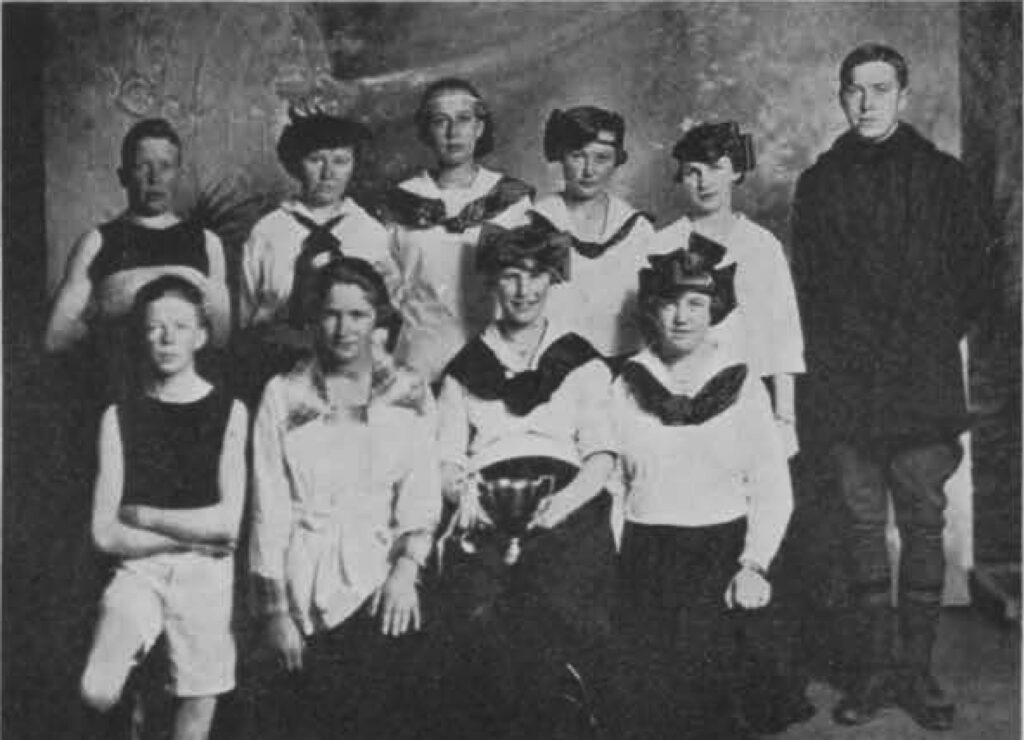
Dorothy Kobey Berry [00:29:45] No. No. Except, you know, and I can remember when I came down to Denver, Jewish people would hear I had gone to the Episcopalian Sunday School, and the young people, they thought that was terrible. But everybody did, you know, that was what was so wonderful about living in Aspen. Well, when I went… oh, I want to show you one more thing if I can find it here. When I was in high school, I told you, the Kobeys were in everything. My brothers were on the basketball team. I was the captain… do you see me right there?… of the girls basketball team. Right there. Holding the…
Arlene Galchinsky [00:30:53] Holding the trophy, in the middle.
Dorothy Kobey Berry [00:30:58] Yeah. We traveled to Glenwood, Rifle, Palisade, Fruita, all by train, you know. But see, you know, we had wonderful times. And my brother… {break in recording}
Dorothy Kobey Berry [00:31:16] Oh, you have to be careful with this. Okay. Here’s a page from my yearbook. “Dorothy Kobey, ‘Dokes.’ She put the ‘pep’ in pepper.”
Roberta Bolen [00:31:33] Oh, isn’t that cute? So I want to get this on the recording, that your father left after your mother died and went to the East to try to…
Dorothy Kobey Berry [00:31:43] To try to recoup his fortune.
Roberta Bolen [00:31:46] And then he died in 1931.
Dorothy Kobey Berry [00:31:48] 1931.
Roberta Bolen [00:31:49] Did he die in the East or did he come back?
Dorothy Kobey Berry [00:31:52] My brother Philip, who had gone from Old Mexico to Austin, Texas, when he lost his job in Mexico and decided to go to the university there. And he, my father was sent to him when he died. Now, let’s see what else…
Roberta Bolen [00:32:27] So now you’re at DU, and you went there for how long?
Dorothy Kobey Berry [00:32:32] Two years. And of course, after my scholarship was up, I couldn’t afford to go, you know, but I was taken into the sorority Delta Phi Epsilon, and I have a picture here of one of our banquets, you know, and I’ll show you all these pictures and everything after we’re off the recorder. So I took a business course at Parks, which is now Parks College. And I taught typing and shorthand at night out at the JCRS {Jewish Consumptives’ Relief Society}, that was the sanatorium, you know. And in the daytime, I was a secretary for the McMurtry Paint and Manufacturing Company. And see, that was my first job as a secretary. And I was so determined to make good that I didn’t take my 15-minute break in the morning and my 15-minute break in the afternoon. Well, the other secretaries got a hold of me. “You take that break, or else.” But, you know, see, I was just trying so hard to do a good job, I didn’t realize I would ruin it, you know, for everyone else. While I was in high school at Uncle Ben’s, my sister Rebecca, who is the oldest in the family, really bore the brunt of all of these teenagers. But you know something that I remember? Everybody had certain things to do. And you did them. My brothers were the breakfast crew. They became experts. My cousin Ruthie Kobey, she and I were the upstairs girls. My sister Rebecca was the one that did the cooking and everything. Now you know…
Roberta Bolen [00:35:24] How many… excuse me, how many brothers? I mean, how many girls and how many boys were in your family?
Dorothy Kobey Berry [00:35:29] Four boys and three girls. Yeah. And I’ve got… I’ll show you pictures of all of us. I could remember watching my mother bake bread, and she would knead that bread and knead that bread, you know. Well, when we were all left on our own, it was up to me to bake the bread, and the first batch of bread I baked, I thought, I don’t know why my mother worked so hard kneading that bread. Well, I soon found out. The loaves were this high.
Arlene Galchinsky [00:36:15] About an inch high.
Dorothy Kobey Berry [00:36:16] I want you to know I became an expert at baking bread. That was one of my jobs. I baked 24 loaves a week. Now, don’t forget, in those days, there weren’t cafeterias in school. We all came home for lunch. When we went to school in the morning, everything was absolutely taken care of. The table was set for lunch because we’d all be home for lunch and then, you know, back to school. But everybody had certain things to do, and there were never any complaints. They did them, you know. That just happens in a big family like that.
Arlene Galchinsky [00:37:09] Who did all the cooking?
Dorothy Kobey Berry [00:37:11] My oldest, Rebecca, my sister. She had the most responsibility because she did the cooking.
Roberta Bolen [00:37:25] This was after your mother had passed on.
Dorothy Kobey Berry [00:37:28] This was when we moved to Uncle Ben’s.
Roberta Bolen [00:37:31] And when you lived, when your mother was still living, did she do all the baking and cooking?
Dorothy Kobey Berry [00:37:36] Oh, in a big family, everybody helps. Yeah. You know.
Roberta Bolen [00:37:42] You have to.
Dorothy Kobey Berry [00:37:44] Well, now, when we were living at Uncle Ben’s, you know… see, I was in high school, you know. One night, Uncle Ben called from the store and said he was bringing a young salesman home for dinner. My sister Rebecca was getting two chickens ready to cook. Now, you know, you didn’t go to the store and buy these chickens all cleaned and everything. And after she had taken the feathers off and cleaned them and had them in roasting, we smelled something strange. Well, she opened the oven and discovered she had forgotten to take the {unintelligible} out. Okay, Uncle Ben was bringing a young salesman. She took it out, put the chickens back in the oven. And that night, when he came to dinner, he didn’t bring one box of chocolates; he brought two boxes, you know, for these eight teenagers and Uncle Ben. Well, I will tell you, I never forgot that. And that young man turned out to be Nat Berry, my future husband. Only he never knew it, you know. Well, when we came down to Denver, I had a cousin, Hannah Shwayder, whose husband had a little shoe store across from Baur’s on Curtis Street. And when I was working at the McMurtry Paint and Manufacturing Company, when Nat Berry would come to… he sold Buster Brown shoes in Rockford, Illinois, and when he would come to visit his brother, who had married Hannah Schwayder, after work I would go and sit in Harry’s store just on the hope that he would come in, you know. Well, the relatives were all kind of pushing this for me, you know? Finally one day, I guess to be nice to me, he took me to a movie, you know. Now, I’ve told you about this coffee that we have every Saturday, and we visit, you know, settle the affairs of the world. Well, one day at the coffee group, one of the women said, she turned to the next one, and she said, “How did your husband propose to you?” Well, we went around the table, see? Everyone was telling how their husband proposed to them. When we got to my neighbor, Grace {unintelligible}, she said, “My husband said, ‘How would you like to have your name on my tombstone?'” Well, we just howled! Well, when they got to me, I said, “I went after my husband,” and I said, “I guess he finally felt so sorry for me,” you know? But I really went after him. And he often said if he had ever thought that he would marry that country bumpkin that he met in high school in Aspen, you know.
Roberta Bolen [00:42:18] Did he move to Denver then?
Dorothy Kobey Berry [00:42:21] He moved to Denver and sold Enna Jettick shoes. Have you ever heard…?
Arlene Galchinsky [00:42:30] I have, I’ve heard of those shoes. I can picture them.
Dorothy Kobey Berry [00:42:35] Old lady shoes, he called them. It was the first shoe, they sold for $5 and $6, that was made in any size you wanted. Didn’t matter how wide or you know… and my husband used to call them old lady shoes.
Roberta Bolen [00:42:59] So, were they custom made for the particular customer?
Dorothy Kobey Berry [00:43:03] No. No. But you could order whatever size you wanted. Triple E or what have you. And that’s why they were so successful, you know, to be $5 and $6 in all those sizes. My husband always made, did very well, did very well. And I could have had so much more than I wanted. He was so generous. He thought money was to be spent and enjoyed, see? And after all, when I married him, my sister Ruthie, who was six years old when my mother died, you know, came right along with us and lived with us. I was like her mother, you know.
Arlene Galchinsky [00:44:05] Did you have a wedding, a big wedding?
Dorothy Kobey Berry [00:44:13] One night… oh, the only thing is, I’m trying to remember what I wanted to tell you. Oh. While my husband was selling these Enna Jettick shoes, you know, his boss and his wife were coming to Denver, and it was up to my husband to entertain them. Now, one of his best accounts in Denver was the Fontius Shoe Company, you know. And so we went to the train to meet Mr. Jones and his wife. I took off my makeup. I put on my Enna Jettick shoes that I never wore except, you know… and we went down to the station to meet Mr. and Mrs. Jones. Mr. Jones was a millionaire, and off the train comes a former beauty that had performed at… what is that place in New York City?
Roberta Bolen [00:45:41] Ziegfeld Follies?
Dorothy Kobey Berry [00:45:42] Ziegfeld Follies. This gorgeous woman with high heels like this. And the straps that ran around her legs, you know. Well, I will tell you, I could have killed my husband. He never could see anything. He never could understand why I was upset about that. Well, we had… they were going to be here for three days, and we had to entertain them. So my husband and Mr. Jones were going to be busy, you know, on business. So it was up to me. I took her to Daniels and Fisher’s Tea Room for lunch. Okay. By that time, I was so upset, you know. I ordered the first thing on the menu. Mrs. Jones ordered a tomato stuffed with chicken salad. They bring my lunch, and it’s a piece of roast beef this big. I want to tell you, I didn’t do anything right for three days. We went to a place in the mountains. I’ve forgotten the name. They were known for their trout one day. That day they were out of the trout! And of course, they stayed at the Brown Palace Hotel. In three days, I saw her in five full coats. And of course, one night we ate with them at the Brown. Then I had to have them for dinner. Well, Joan, at that time, my older daughter, was a baby, you know. And you can imagine, you know, how disturbed I was about this. Mr. Jones…. oh, Mrs. Jones told us to pick her up at 5:30 that day. She would be in the beauty shop at the Brown all day from 8:30 in the morning. I couldn’t figure out… what could a woman do in a beauty shop? I never knew about massages and facials and things like that, you know? Well, when they come to our house, Mr. Jones brings me two dozen American Beauty roses, this long. I don’t have anything to put them in. I want to tell you, it was the most miserable three days of my life. And I always thought, “Oh, if I could have just met her about ten years later,” you know. My husband never could figure out what bothered me, you know? I mean, aren’t men funny?
Roberta Bolen [00:49:21] That’s how men are. That’s exactly right. They just don’t get it.
Dorothy Kobey Berry [00:49:24] Oh, I never will forget that.
Roberta Bolen [00:49:30] That’s great.
Dorothy Kobey Berry [00:49:31] Now let’s see what else.
Roberta Bolen [00:49:33] We were going to talk about your wedding.
Dorothy Kobey Berry [00:49:35] Oh. My Uncle Ben and Bertha had moved down to Denver, and one night, Nat and I were going to have dinner with them. Uncle Ben and Bertha were taking… see, everybody tried to kind of work this out because we didn’t know, but my husband was practically engaged to a Catholic girl in Rockford, Illinois. So of course, they were all pushing the issue. Anyway, Nat told my uncle that he had to go back east for a shoe convention, and Uncle Ben said, “Why don’t you take Dokes with you?” And that’s how it happened. And Uncle Ben and Bertha… we were married by Rabbi Kauvar in his chapel, and Uncle Ben and Bertha took all my family to the Cosmopolitan Hotel for dinner. And as I say, we went back east on our honeymoon. And that’s when I got to meet Nat’s father, who lived in New York City.
Roberta Bolen [00:51:12] And then how soon after that did you have a child?
Dorothy Kobey Berry [00:51:17] I was married at the age of 22 years, and Joan was born in 1930. I was married in 1928, and Joan was born in 1930. Harold was born four years later, and we had only planned on two children. And of course, after we had the two, you know, we were using birth control. Well, the last time, I went to the doctor, I wasn’t feeling very well. And he was the finest obstetrician in Denver. His name was Doctor Cuthbert Powell, and I went to him because I wasn’t feeling well, and he told me there was only one thing wrong with me. I was pregnant.
Roberta Bolen [00:52:30] And how many years after your son was born was that?
Dorothy Kobey Berry [00:52:35] Joan {means Susan} was born in 1936. Okay. I looked at Doctor Cuthbert Powell when he said the only thing that was wrong with me was that I was pregnant. And I said, “I can’t figure out how it happened.” I want to tell you, I don’t know what I’d do today without my daughter Susan. And I’m going to show you a picture of my children. Joanie lives out of town. Harold lives out by… what is that reservoir? Way, way, way out.
Roberta Bolen [00:53:27] Cherry Creek?
Arlene Galchinsky [00:53:28] No, the other one. I can’t think of the name of it either. You know, the one out west.
Dorothy Kobey Berry [00:53:34] I want to keep saying Chautauqua, but…
Arlene Galchinsky [00:53:36] Yeah, it’s like that. I know, I’ll think of it.
Dorothy Kobey Berry [00:53:39] Okay. And Susan lives at 501 Albion, the house where they grew up.
Roberta Bolen [00:53:48] Oh.
Dorothy Kobey Berry [00:53:49] See, she is the kind of daughter you don’t ask. She does. Just always is doing things for me. She’s just been that way all her life. And that really is the reason that I am able to live independently. Now you know, just yesterday she called me and said, “Mother, meet me… Are you dressed?” And I said, “I have on my brunch coat.” “Meet me down in the garage.” She drove into the garage. She brings me egg salad. She brings me grapes. Saturday night she had a birthday dinner for me. She sends me home with enough food for a week. You know, she’s just… she just does things for me. She’s just… and here she.. you know, I told you, you know, she wasn’t planned.
Roberta Bolen [00:55:01] She was an extra bonus.
Dorothy Kobey Berry [00:55:03] Yeah. Yeah.
Roberta Bolen [00:55:04] And how many grandchildren do you have?
Dorothy Kobey Berry [00:55:07] Four. Harold has a boy and a girl. Susan has a boy and a girl. And I have my first great grandchild. Yes. And, you know, I’ve been putting everything in albums. I think I’m on about my eighth album now. But I have a friend that got me started. But she puts them according to year, but I don’t. I just put things in as they come along.
Arlene Galchinsky [00:55:41] Chatfield, that’s the reservoir.
Roberta Bolen [00:55:43] Chatfield.
Dorothy Kobey Berry [00:55:44] Chatfield Reservoir. When he comes in here to pick me up, it takes him an hour. See, I don’t drive at night.
Roberta Bolen [00:55:55] But you still drive, though.
Dorothy Kobey Berry [00:55:56] In the daytime. Listen, when they take my car away, that is going to be devastating. Oh, I have to tell you something funny. My grandson Nat, you see he was named after my husband. See, my husband was only 54 when he died.
Roberta Bolen [00:56:20] When did he die?
Dorothy Kobey Berry [00:56:22] He was 55. And he died in 1954. I was 48 when he died. Anyway, Nat works for a computer company, and he said one day they were talking about scary things. He said, “I’ll tell you something scary. I have a 97-year-old grandmother that still drives!” And listen, let me tell you what is unusual about him. He takes me to all the IMAXes. We’ve never missed a one. He takes me to all the Disneys He takes me to all the high holy days and the yahrzeits, you know.
Roberta Bolen [00:57:16] How old is he?
Dorothy Kobey Berry [00:57:17] Nat? He just turned 45. But I have to tell you, one day at our coffee, I had… the night before, Nat had taken me to an IMAX. Now, if his girlfriend wants to come, fine. If she doesn’t, he goes with me. One day at the coffee… I had seen an IMAX, it was so wonderful… and I said, “I just can’t understand why none of you go to these IMAXes. They’re so wonderful.” I said, you know, “My grandson takes me all the time. We’ve never missed one.” And someone pipes up, “How old is your little grandson?” And I said, “45,” you know. And when they would tease him at work, he’d say, “Got a hot date tonight,” you know. They’d say, “Your grandma!” But do you realize that most grandchildren that would embarrass them? He has a bread machine. He bakes Susan, his mother, and me a loaf of bread every two weeks. His girlfriend a loaf, and himself a loaf. He is the only one I know who has a bread machine that really uses it, you know. Now, my daughter Joan, when they moved into their new house…
Roberta Bolen [00:59:02] Where do they live?
Dorothy Kobey Berry [00:59:03] In Henderson, Nevada. It’s a suburb of Las Vegas. A friend of hers brought her a bread machine as a housewarming gift. Do you know when she uses it? When she’s having those friends over. That’s the only time. I’m telling you, Nat is the only one… this Wednesday night, he brought me a loaf of cinnamon and raisin bread. He brings me different ones all the time.
Roberta Bolen [00:59:45] That’s great. So, and…
Dorothy Kobey Berry [00:59:49] Oh. And then I want to tell you, my husband, you know, was selling Enna Jettick shoes. My brothers, Leon and Silas Kobey had a potato chip plant here in Denver called Tasty Foods. Nat would take a bag of potato chips with him… my husband traveled Arizona, Colorado, Utah… he would take a bag of potato chips with him and open an account for them when he sold them shoes.
Roberta Bolen [01:00:35] Shoes and potato chips. {laughter}
Dorothy Kobey Berry [01:00:36] Do you know those accounts stayed with my brothers till they sold the plant? Well, they finally convinced my husband he should stop traveling and join them in the potato chip plant. So he was their star salesman. So we got to entertain the customers, take them to Central City for the operas, all these things, you know.
Roberta Bolen [01:01:09] Do you have any other questions, Arlene?
Arlene Galchinsky [01:01:21] Well, would you like to continue or do you want to take a break for a few minutes?
Dorothy Kobey Berry [01:01:28] Well, when you turn that off, I’d like to show you the pictures.
Arlene Galchinsky [01:01:34] Okay, let’s stop it now.
Dorothy Kobey Berry [01:01:37] All right. {break in recording}
Arlene Galchinsky [01:02:06] We’re looking now at pictures with Dokes Berry, and she’s showing us some pictures out of Aspen Magazine of the history of her family. And she’ll continue with reminiscing.
Roberta Bolen [01:02:24] We’re also looking at the Lifestyle magazine from December of 2000 that has a write up on her.
Dorothy Kobey Berry [01:02:39] That’s my sister Rebecca, and that’s me, and my sister Ruthie.
Roberta Bolen [01:02:48] That was taken in Aspen in 1910. That’s a beautiful picture.
Dorothy Kobey Berry [01:02:54] And then this is our magazine here, in this complex. So I’m in that too, you know. Okay. Now, this reunion was held at Gordon Rosenblum’s. He was the host. There were 200 people. I was the oldest one there. His living room is the size of a basketball court. And up around is the balcony around this room where he has his art collection. Can you imagine when I walk in there and see this sign up there. “Dokes Kobey Berry, 79 years old, and still driving.” And during the evening they had all the group gathered, you know, and they had me sit in front and my children, Joan, Harold and Susan stood behind me, and they paid this tribute to me. {an answering machine records a message in the background}
Roberta Bolen [01:04:29] That’s your grandchild saying happy birthday.
Arlene Galchinsky A granddaughter.
Dorothy Kobey Berry [01:04:33] Oh, my phone rang all morning and everybody… I’ll call her back soon. And they made this wonderful tribute to me. And I said I didn’t know who they were talking about, but you know what was so wonderful? See, he had this all catered. All the children were invited. There was swimming for the children. He has his own swimming pool, covered, his own tennis court, films for the adults, and an open bar. The invitation was from 12 to 6. He had an open bar that whole time, and outside he had grilled hot dogs and all kinds of things for the children. Oh, and the ones who didn’t want to go swimming rode around all his grounds in his electric golf cart. It was wonderful. But you know, what was exceptional was… as I say, they had this big sign, and my daughter had another sign right next to it. It said, “Congratulations to a host extraordinaire,” and it was his 70th birthday.
Roberta Bolen [01:06:16] Now which Shwayder is that? What’s his name?
Dorothy Kobey Berry [01:06:19] Gordon Rosenblum. Gordon Shwayder Rosenblum. Jesse Shwayder was his grandfather.
Roberta Bolen [01:06:31] So we were back at when your husband died. And then what happened?
Dorothy Kobey Berry [01:06:41] My husband was the youngest in his family. Now he was born in Brooklyn, New York, and they lived in New York. One of his brothers, Morris Berry, had a lung collapse at the age of 15. So they moved the children out to Denver because, you know, Denver was known as the TB center. Now, I want you to know, my husband was the youngest in his family. Nothing wrong with him. He died at the age of… he wasn’t quite 55. His brother that had this collapsed lung at the age of 15 lived to 86. So you see there isn’t any rhyme or reason.
Roberta Bolen [01:07:49] And how did your husband die?
Dorothy Kobey Berry [01:07:54] He had extremely high blood pressure. And they didn’t have blood pressure medication then. And he finally had a cerebral hemorrhage.
Roberta Bolen [01:08:13] And so, were your kids already married or…?
Dorothy Kobey Berry [01:08:19] No. Oh. Let’s see.
Roberta Bolen [01:08:21] You were 48.
Arlene Galchinsky [01:08:22] I was 48. And… let’s see, how old were the children? Well, it was 1954. Joanie would have been, what, twenty-…? She was born in 1930.
Roberta Bolen [01:08:43] Yeah. So she was 24.
Arlene Galchinsky [01:08:47] She was 24.
Dorothy Kobey Berry [01:08:48] Yeah. And Harold would be four years younger, and Susan six years younger.
Roberta Bolen [01:08:58] And so then did you go to work?
Dorothy Kobey Berry [01:09:01] My brothers told me to come out to the office, and I said, “I have to go back to school.” And I’ll never forget, my brother said, “Do you know how much two and two is?” And I said, “Yes.” He said, “Okay, be out at the office.” So I went in the afternoon, and they had to put up with me because I was the bosses’ sister, you know. But they were all wonderful. Our office manager still keeps in touch with me.
Roberta Bolen [01:09:43] And what did you do? Were you the bookkeeper there?
Dorothy Kobey Berry [01:09:46] They had me do certain things. No, I wasn’t the bookkeeper, but they had me do certain things. There were several other CEOs, and Joyce was one of them.
Roberta Bolen [01:10:03] So how long did you work there?
Dorothy Kobey Berry [01:10:09] Until my brothers sold it. I’m trying to think. A big company out of Chicago…
Arlene Galchinsky [01:10:20] Was it Beatrice Foods?
Dorothy Kobey Berry [01:10:21] Beatrice Foods bought them out. And my brothers said, “Dokes, it’s time for you to take it easy.”
Arlene Galchinsky [01:10:33] What did you do then, Dokes?
Dorothy Kobey Berry [01:10:34] Nothing.
Roberta Bolen [01:10:36] You took it easy. So how many years did you work there? Do you know?
Dorothy Kobey Berry [01:10:44] You know, there’s certain things I don’t remember.
Arlene Galchinsky [01:10:52] Dokes, what do you think accounts for your longevity?
Dorothy Kobey Berry [01:10:58] The strange thing is… don’t forget, I came from a very short-lived family. Look it. My mother was 45. My father, we thought he was an old man. He was 61. Out of seven, only one got past the age of 80, and that was my brother Si. And he was a year older than I was, and he died several years ago. So there really isn’t any rhyme or reason for it. Because, look, I’ve always eaten all the things you’re not supposed to, you know.
Roberta Bolen [01:11:51] Just not too much of it.
Arlene Galchinsky [01:11:53] Are you smoking cigars? {laughter}
Dorothy Kobey Berry [01:11:58] Listen, I used to smoke two packs a day. It’s a good thing I quit. I would have burned myself up because I used to even smoke in bed. These are wonderful. Just put them in your mouth and let it melt, the whole thing.
Arlene Galchinsky [01:12:25] Toasted coconut? Yes.
Dorothy Kobey Berry [01:12:27] Just put the whole thing in, and let it melt.
Roberta Bolen [01:12:35] So you’ve been living in this apartment for 30 years?
Dorothy Kobey Berry [01:12:48] We bought a home at 501 Albion. The children all grew up there. When my daughter Susan was divorced, the judge ordered the house she was in sold. And she had two little children, see, Nat and Hillary. So that was when… see, Joanie wasn’t home here anymore… that was when I decided to move and turn over the house to her. And she bought it from me. No way would she take it, you know. She paid so much a year, you know. And she’s still there.
Roberta Bolen [01:13:51] Abd she’s still there. And that’s when you moved here? So you’ve stayed here all these years?
Dorothy Kobey Berry [01:13:56] About 34 years ago.
Roberta Bolen [01:13:59] Were you in any organizations along the… Jewish organizations or other organizations?
Dorothy Kobey Berry [01:14:10] I belonged to Delta Phi Epsilon.
Roberta Bolen [01:14:19] Right. That was at University of Denver
Dorothy Kobey Berry [01:14:29] Oh. You know, I told you we were into everything in Aspen. This is one of the plays we were in. I was Madame {unintelligible}. And there’s Nathan Kobey and Si Kobey. We were always in everything, you know. Oh, listen, I do have to tell you something interesting. One day when I walked down to the office, there was a man sitting in the office, one of the investors. He lives… his name is… his last name is Mansfield. I’ve forgotten his first name. As I walked in the office, he said… he was here on a visit. He said, “Someone told me that your maiden name was Dorothy Kobey.” And I said, “Yes, it was.” He said, “Would you by chance ever have known someone by the name of Nathan Kobey?” I said he was my twin cousin. He was 36 hours older than I was. That was Uncle Ben’s son, you see. We celebrated our birthdays together till the day he died. And this Mike Mansfield said to me, “Well, I want to tell you about Nathan Kobey.” Mike is Italian. He lived over on the West Side, and he said his mother was widowed. He had… he and his brother… Nathan and his wife Gloria lived over on West Moncrief Place. He said, “Nathan befriended our family.” He bought them their… you know when you go into the YMCA…
Roberta Bolen [01:17:10] Membership.
Dorothy Kobey Berry [01:17:11] Their memberships. He bought them their memberships in the YMCA. And when his brother needed the bicycle for his paper route, Nathan bought him a bicycle. And he said, “The only way my mother could ever repay them was to occasionally cook an Italian dinner for them,” you know. And I said to Mike, I said, “Well, I’ll tell you something about Nathan.” I said, ‘We were close,” you know, all our lives. I have a picture someplace, the two of us, taken when we were babies, one year old, you know. I said, “One time I was having a dinner party, and Nathan and his wife were invited over to the dinner party, and a little dog had strolled into our yard, and the children were having a fit over it. Nathan, he didn’t care I was having a dinner party. He took them out to a dog breeder and bought them this black cocker spaniel.” It was actually a show dog! One time he took all our family to Omaha for a basketball game that he was interested in. We thought he was a millionaire. I said, “Mike…” Oh, one time, my daughter Joan was going to Antioch College in Yellow Springs, Ohio. He took her to a convention, a Democratic convention in Chicago, where she rode in the car with Governor {Walter Walford} Johnson. You know, he did these fabulous things. I said, “Mike, would it surprise you if I told you that Nathan died penniless?” I said, “We thought he was a millionaire the way… the things he did.” His wife supported him the last ten years of his life. And I want to tell you, I will never forget what Mike said to me. He said, “Look what a heritage he left.” And I want to tell you, that was a way to describe my Uncle Ben too. It’s strange. All the Kobeys prospered, and they all ended up without anything. We went from everything to nothing.
Roberta Bolen [01:20:25] And that’s why your father left town and went to the East.
Dorothy Kobey Berry [01:20:29] Yes. See Aspen became a ghost town. These houses up there that are selling for $2 million, at that time, you could buy them for $10. Now our home, even if it had survived, we were never able to hold on to it. We wouldn’t have been able to pay the taxes on it because we went from everything to nothing. But just think, when my brothers became so successful, if that house had been there, how wonderful that would have been, you know? Now, if you turn that off, I’d like to show you something. {brief pause in recording} It’s a picture of the Kobey Shoe and Clothing Company.
Roberta Bolen [01:21:21] Oh. That’s amazing.
Dorothy Kobey Berry [01:21:23] His wife bought this at an auction.
Roberta Bolen [01:21:29] Really?
Dorothy Kobey Berry [01:21:29] When my grandson Nat saw that, he had a fit. He told Mr. Hodgson he had to leave that to him. Now, this house next door to Uncle Ben is the Elders’. It’s on the corner. It was put up for sale for $9 million. Can you imagine? Yeah. Now you see this house? That is next to the Hodgsons’ {unintelligible}. That house is called the Half House. We called it the Short House because Mrs. Short, the county superintendent, lived there. Uncle Ben bought that house for $750. It sold for $750,000. Here’s the Methodist church where the young people’s meeting all the time. See?
Roberta Bolen [01:22:46] And it’s still there. It’s a beautiful building.
Dorothy Kobey Berry [01:22:50] This was taken in 1996? Yes. Here’s one of the fixtures. Oh, there was a Harley convention.
Arlene Galchinsky [01:23:08] Have you ridden on a Harley?
Dorothy Kobey Berry [01:23:10] No.
Arlene Galchinsky [01:23:11] Dokes, you would, though, huh? If the right man asked you? {laughter}
Dorothy Kobey Berry [01:23:16] But there was a convention here at the time. These are all pictures. This is in the Opera House. Pictures in the Opera House. This house is on Main Street. It was Manford Smith’s house. He was a widower. Portly, handsome. You never saw him that he wasn’t in a suit, you know. It is now called the… it’s a bed and breakfast. Oh, now what did they call it? And here’s the… it’s written on the back. The Sardy House. And here is the interior.
Roberta Bolen [01:24:34] It’s gorgeous.
Dorothy Kobey Berry [01:24:35] And look at… there. And here’s another view. Here’s the inn. That was where our house was.
Roberta Bolen [01:24:52] I know exactly where that is, yeah.
Dorothy Kobey Berry [01:24:54] Do you? 200 West Main Street. There it is again. This… we are standing in front… now Uncle Mark’s house was catty corner. We’re standing in front of that house.
Roberta Bolen [01:25:13] It’s still there.
Dorothy Kobey Berry [01:25:14] Still there. But see, it’s almost covered with shrubs, shrubbery now. This is Redstone, the Castle. Nat tried to get reservations. They were sold out for the whole summer.
Roberta Bolen [01:25:36] Have you been there before?
Dorothy Kobey Berry [01:25:39] Haven’t stayed there. We’ve never been able to get reservations. I guess you have to get them so far ahead.
Arlene Galchinsky [01:25:47] I stayed there for my honeymoon for two days.
Dorothy Kobey Berry [01:25:50] You did? Oh!
Arlene Galchinsky [01:25:54] 41 years ago.
Dorothy Kobey Berry [01:25:57] Oh, can you imagine? Oh, wouldn’t that…? We’ve never been able to get reservations. This is the place next to it. When we went to Aspen, we went over Independence Pass. But coming back to Denver, we’d go to Glenwood so we can swim in the pool, see? And Nat had rented a Cadillac Seville, and he took Susan and Joan and me to… he takes me about every other year. Now, these are buildings there, you know, the downtown.
Arlene Galchinsky [01:26:49] In Aspen?
Roberta Bolen [01:26:50] Yeah.
Dorothy Kobey Berry [01:26:51] See, you know. Oh, and the Maroon Bells and stuff like that.
Arlene Galchinsky [01:26:59] Beautiful pictures there.
Dorothy Kobey Berry [01:27:01] You know, and Mike Kobey… where the Kobey Shoe and Clothing company was, Mike Kobey got in touch with the Historic Society in Aspen, and they said if we raised $1200, they would restore this sign on the side of the building. And it took me one half hour to raise $1200. I called Ruth Kobey. I said, “I’m putting in $200.” I called Rosalie Kobey. I said, “I’m putting in $200. Mike is putting in $200,” and the Historical Society… we did $1200, and they did the rest.
Roberta Bolen [01:28:11] That’s great. Is that on Main Street, too?
Dorothy Kobey Berry [01:28:13] No, no. The Kobey Store? No, it’s downtown. Now, this is the front of the Jerome Hotel. Now the Jerome Hotel is on Main Street, but at one end of Main Street. And listen, when Nat and I were married and lived here in Denver… and see my Uncle Ben and Bertha were still living in Aspen… we’d go up and get the bridal suite for a dollar and a half a night.
Roberta Bolen [01:28:58] At the Jerome?
Dorothy Kobey Berry [01:28:59] At the Jerome.
Arlene Galchinsky [01:29:00] Oh my gosh.
Dorothy Kobey Berry [01:29:01] But see, my best… here’s the manager greeting you. Do you know how much the bridal suite is now? He told us. $750 a night out of season, $1500 a night in season. And of course, you know, we called the Hodgsons and we all had lunch. Here’s my grandson. We had lunch, you know, at the Jerome.
Arlene Galchinsky [01:29:35] Great picture.
Dorothy Kobey Berry [01:29:37] We always see the Hodgsons when we go up there, and see here’s that sign. And that sign you see, was richly painted there in the 1890s.
Roberta Bolen [01:29:59] And it was still enough that they could restore it?
Dorothy Kobey Berry [01:30:01] Yes.
Roberta Bolen [01:30:02] That’s great.
Dorothy Kobey Berry [01:30:03] But I’m surprised that they wanted to restore it.
Roberta Bolen [01:30:08] Well, people like to have history showing. It’s nice.
Arlene Galchinsky [01:30:12] Sure. Especially where so many people can see it at once. Dokes, would you mind reading this nice poem, this birthday poem, that your daughters made for your 97th birthday? Would you read that for us?
Dorothy Kobey Berry [01:30:27] Oh, well now, let me tell you what they did. You know, they gathered everybody, and I told you they had me sit down. Then Joan, Harold and Susan stood behind me, and they each one had a color to read. You. You want me to…?
Arlene Galchinsky [01:30:48] Why don’t you go ahead and read it for us?
Dorothy Kobey Berry [01:30:52] You won’t recognize me. “Here’s to our mother, Dokes, on her 97th birthday. Her enthusiasm about everything attracts people of all ages. She bubbles. She’s really fun to be with. When I was dating, some of my discarded boyfriends kept coming back for Sunday brunch just to visit mom and the family, not me. She belongs to clubs, bridge, Mahjong, sewing clubs, that met for 40 years. And when she lost those longtime friends, she just made more and younger friends. To this day, she’s up at 6 a.m. every Sunday to prepare for her condo’s weekly coffee klatch that has met for 25 years. Without her, there would be no coffee klatch. She has an incredibly positive attitude that comes from looking at life through rose-colored glasses, our father used to say. She has no room for negatives in her life. If someone does something unpleasant, she believes he or she didn’t mean it. If someone takes advantage of her, she doesn’t really care, like putting her neighbor’s TV satellite on her patio so neighbors would have better reception. When Susan came over one day…” they moved out of town… “when Susan came over one day and saw that satellite sitting there, she said, ‘Mother, what is wrong with you? Can’t you say that no?'” {break in recording} Now, do you want to take…?
Arlene Galchinsky [01:33:23] Do you want to go ahead with the second page again?
Dorothy Kobey Berry [01:33:37] Oh… “She is quick to forgive. Holding a grudge is just too much trouble. She has enjoyed remarkably good health. She doesn’t recognize illness and has been known to declare herself fit just minutes before losing consciousness. She just never had time to be sick. She is an accomplished candy maker and baker and has always provided her family with a balanced diet of the five food groups: fudge, maja, divinity, pinochi, peanut brittle, and every kind of cookie, and her famous schnecke. When we wanted to impress someone or curry favor, especially with a boss, we would take them a box of Mother’s goodies. It always worked. Cookies and candy are always in the freezer. Her grandson has asked her to be sure the freezer is stocked before she departs this world. She keeps up to date and reads at least one book a week.”
Arlene Galchinsky [01:35:06] Oh that’s amazing.
Dorothy Kobey Berry [01:35:07] Sometimes I read two books a week, you know. See, I used to belong to two bridge clubs every week. I still belong to a Mahjong club, every Thursday, but in my two bridge clubs…. and, you know, they were all younger. In both clubs, a couple of them got macular deterioration, and I still keep in touch with them, but they couldn’t see the cards anymore. “She has a reservoir of information about Aspen, her birthplace, and has been interviewed by newspapers, magazines, students and Jewish historians because her memory is excellent. She’s like Melanie in “Gone with the Wind,” but with the will of General Patton. Most importantly, she has given us the gift of unconditional love in spades throughout life. It goes without saying that she’s there 100% of the time for children, grandchildren, spouses, friends, and so forth. One of the reasons for her longevity is that we can’t let her go. So here’s to you, Dokes, at 97. Our inspiration, our role model, and our very best friend. We love you. Hang around a while.”
Arlene Galchinsky [01:36:50] That’s great. Beautiful.
Roberta Bolen [01:36:52] How did you get the name Dokes?
Dorothy Kobey Berry [01:36:54] Do you know, no one knows. Even my teachers in Aspen. We figure that someone along the line maybe couldn’t say Dorothy or something, but Dokes is such a different nickname. But as I say, even the teachers in Aspen called me that.
Roberta Bolen [01:37:24] Really? It was always your nickname.
Dorothy Kobey Berry [01:37:27] Yes, always.
Arlene Galchinsky [01:37:31] Well, this has been a wonderful afternoon, spending time with you.
Dorothy Kobey Berry [01:37:37] Well, listen, I have to tell you something. You know, the day after the reunion, Ted and Jesse Harshon that are doing this, working so hard on the family tree, and a Barry Silver, who was at the…
Roberta Bolen [01:37:52] That’s the one we met.
Arlene Galchinsky [01:37:53] Yes.
Roberta Bolen Fascinating man.
Dorothy Kobey Berry [01:37:54] Oh you did? He’s doing the Rachofsky thing. They asked if they could come over, you know, they wanted to see some Aspen pictures. They came over at 2:00. Susan had taken some time off while Joanie was here, so Susan was with us. We sat around here, I thought it’d take about an hour you know. We stopped to go out for dinner, came back, I fell into bed at midnight. Oh, I want to tell you, we just talked and talked and talked…
Roberta Bolen [01:38:35] It would have been nice if they had a recorder on that night, huh?
Dorothy Kobey Berry [01:38:37] …and had such a wonderful time. And that was why, I guess one of them thought that…
Arlene Galchinsky [01:38:47] Yes.
Roberta Bolen [01:38:48] It’s perfect. It’s perfect.
Dorothy Kobey Berry [01:38:50] But listen, I want to tell you, my daughter Susan gave me the most wonderful compliment I have ever had. She said, “Mother, it’s your attitude.” Anyway…
Roberta Bolen [01:39:15] That’s what it is.
Dorothy Kobey Berry [01:39:16] But I have to show you what Ted Harshon sent me. Look.
Arlene Galchinsky [01:39:27] Oh, beautiful.
Roberta Bolen [01:39:29] Oh, that’s nice.
Dorothy Kobey Berry [01:39:31] With pictures that I had given him to take. They’re just old family pictures.
Roberta Bolen [01:39:42] And he made an album for you.
Dorothy Kobey Berry [01:39:45] Yes. See? These are all real old pictures. This picture, that was our housekeeper. I told you we went from everything to nothing. This is my Uncle Ben and Aunt Hattie and their son Nathan, the one that I said we were twins.
Roberta Bolen [01:40:16] Yeah.
Dorothy Kobey Berry [01:40:17] They adopted a little girl from the Denver Asthmatic Corps when she was five years old. Her name was Becky {unintelligible}, and she had relatives in the East, but no one wanted her. Uncle Ben and Aunt Hattie adopted her and named her Ruth Kobey. You know, I told you we had Big Ruth, Little Ruth? Oh, and I want to tell you something, my sister Rebecca told me… now, don’t forget, there were seven of us… that Uncle Ben and Bertha… see, they just had the one son, 1 to 2 adopted. But my parents wouldn’t, you know… my Uncle Ben, whenever he got anything special for Ruthie, his adopted daughter, when he bought her a wristwatch, he bought me one. Whatever he did special for her, he did for me. And listen, I have to tell you something, when I was captain of the girls basketball team, they all had red sweaters with the initial “A,” Aspen, in black, you know, but me. Uncle Ben bought me a McGregor. Do you know that company is still in business? The best on the market. That’s… I mean, he was just wonderful. He died of heart failure. I was the only one he had Gloria inform that he wanted to see me. As I say… look it, here’s my sister Becky. Here I am, and Ruthie. Oh, and listen, I have to tell you something about my sister, Ruthie. I told you she was six years old, you know, when my mother died. So I was like her mother. And that’s why I say I had such a wonderful husband. I was the only one that had an established home. So here he just took Ruthie in. My brothers were there every night for dinner. One night, he came home from a trip a day early. There wasn’t a place for him to sit at the table to eat. You know, my brothers… He used to say, if you shake out the sheets, a Kobey will fall out. {laughter} But he was just so, you know, he felt that money was to be spent and enjoyed. But Ted Harshon put these all in this… you know, I had them in a box, but they’re all old pictures. Oh, this is when I belonged… oh, no, that’s the play I was in in high school. Now, here’s where Nathan and my brother Si and I graduated together.
Roberta Bolen [01:44:17] Oh, you all graduated high school together?
Dorothy Kobey Berry [01:44:18] Yeah. They actually were a year ahead of me, but one year, we had a teacher, a man, that would spit. And one day Nathan and Silas got a spittoon and put it on his desk. They were expelled. And that’s why we all graduated together. See, he was handsome.
Roberta Bolen [01:45:03] Who is this?
Dorothy Kobey Berry [01:45:04] Nathan.
Arlene Galchinsky [01:45:04] Your husband?
Dorothy Kobey Berry [01:45:06] No.
Arlene Galchinsky [01:45:07] Your brother.
Dorothy Kobey Berry [01:45:09] Twin cousin.
Arlene Galchinsky [01:45:09] Your twin cousin. Okay.
Dorothy Kobey Berry [01:45:12] This is Hannah Shwayder Berry. Anyway…
Roberta Bolen [01:45:26] That’s great.
More Oral Histories
Oral History
Conversation between Elizabeth Paepcke and Bruce Berger, circa 1988
Oral History