Oral History
KSNO Interview of Mary Moyer by George
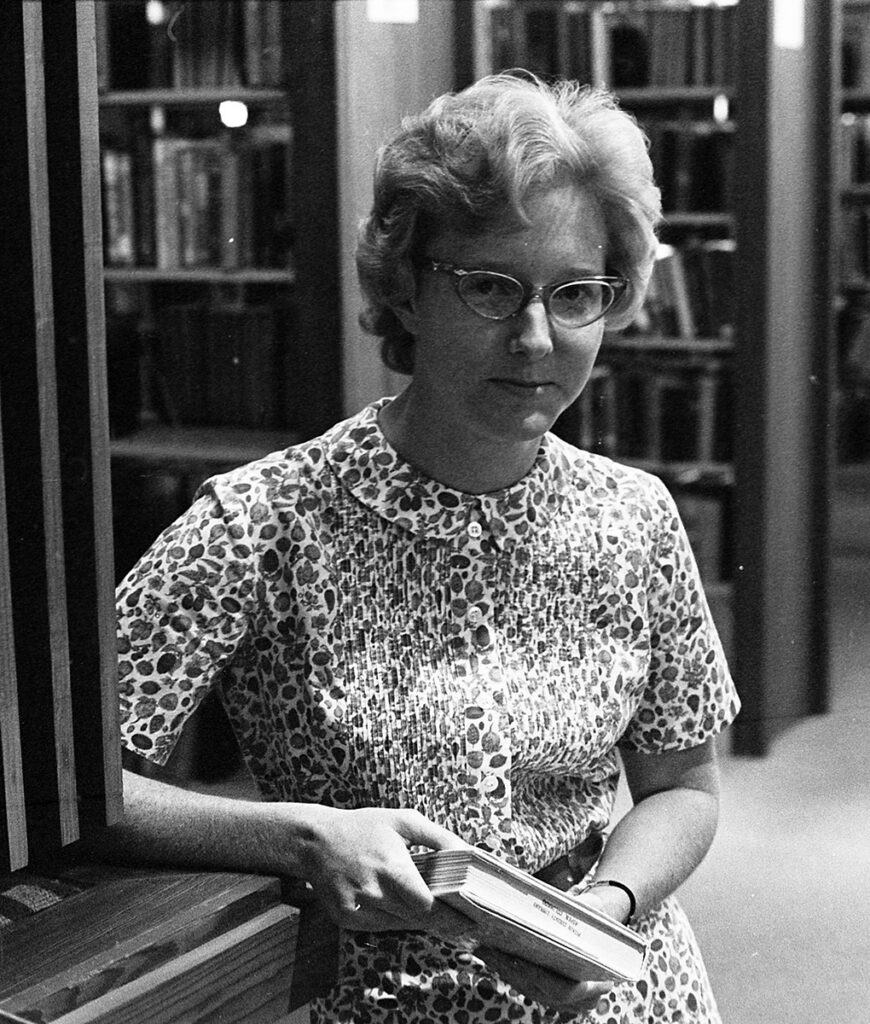
One oral history with Mary Moyer, Pitkin County Librarian, as part of George Madsen’s KSNO Commentary program on December 6, 1967. They talk about the “new” library on Main Street (opened 1966) and what services and programs they offer, as well as plans for the future.
Mary Moyer_KSNO
Interviewed by George Madsen
December 6, 1967
T141_2012.026.0317
George Madsen [00:00:03] I’ll frankly admit that I’m guilty of a number of things. One of them is not making enough use of the new Pitkin County Library. True, last year I did go down to the library and borrow a couple of hockey books, three of them, I think. Incidentally, they weren’t there, but they got them for me. Simply located the volumes from around the state. And I’ll be frank to admit that I haven’t been back to the library since. In fact, I suspect that many residents aren’t taking full advantage of the Pitkin County Library’s great facilities. My guest today should know. She’s Mary Moyer, Pitkin County Librarian. As I was mentioning, these hockey books, Mary, they were gotten from, I think, Denver in this case. You must do quite a business in retrieving volumes or at least finding them around the state.
Mary Moyer [00:00:51] Yes, we do, George. We are part of a statewide reference service, which means that we can get books for people from almost anywhere in the state, including places like the Air Force Academy Library, Colorado University, Denver Public Library, Grand Junction. And this has been a big boon because it is a great help in supplementing our resources.
George Madsen [00:01:11] Is this something that’s unique to Colorado, or do most states have a reciprocal policy like this?
Mary Moyer [00:01:16] Well, this is one of the coming things in librarianship now, because the big thing now is to cooperate, to join library systems. And by doing so, the smaller libraries such as Pitkin County can really amplify our resources. So this is something that was, I think, started in New York with the New York Public Library and is now extending through the country. And it’s really one of the greatest things that’s ever happened.
George Madsen [00:01:42] Do you actually trade with other states or just within Colorado?
Mary Moyer [00:01:46] Well, most of our business is just within Colorado, but for very serious research, we can, or other libraries, mostly colleges and universities, can get things from places like the Library of Congress and other libraries in the country and even from abroad, if it’s really serious. But you really have to be working on a PhD thesis or something to get this.
George Madsen [00:02:05] If you badly needed, say, a 1958 issue of Playboy magazine, you might be able to find that for a reader, huh?
Mary Moyer [00:02:12] Perhaps. Yes. We’d try.
George Madsen [00:02:14] Mary, you have a rotating book selection or collection down there. What’s that?
Mary Moyer [00:02:18] Well, it’s called the McNaughton Plan. And this is a system whereby we can rent books from a company in Pennsylvania. And then if we want to keep the books, we can buy them at a discount. And this means that we get new books while they’re new; controversial books, while they’re controversial; bestsellers, while they’re bestsellers, instead of waiting 6 to 8 months. And this, again, has really helped our resources.
George Madsen [00:02:42] And there are selections of books within Colorado that are sort of passed library to library too, aren’t there?
Mary Moyer [00:02:47] Yes. These are from the Colorado State Library, and we received 3500 books when we opened so that we wouldn’t look bare-boned. And eventually we will send these books back as we fill up our shelves with our own books.
George Madsen [00:02:59] Do you get a fairly new selection of books every week or month or…?
Mary Moyer [00:03:04] Yes, we get quite a few from this McNaughton Plan, and then we’re continually ordering books as they come in. We’ve just received some of the new Bishop Pike books and things of this sort, which we order ourselves.
George Madsen [00:03:15] Now I’ve never heard of a librarian who thought his collection was adequate.
Mary Moyer [00:03:19] No, I don’t think any librarian ever will. There are always gaps in the collection, in any collection, even places like New York Public and you know, the big ones. And there are many gaps in our collection now, which we do need to fill and are working on filling.
George Madsen [00:03:33] But you loan out paintings, records…
Mary Moyer [00:03:36] That’s right. We have our print collection, which people can check out for a month. We’re getting some new prints in, first part of January. We do have a circulating record collection, which very few people use. For some reason, they just miss this. These records are located in the music room and it’s… I guess we’ve got about 50 or so that can circulate.
George Madsen [00:03:55] Classical?
Mary Moyer [00:03:55] Yes. Classical and some musical shows. Some popular things.
George Madsen [00:04:00] Are the… What do I mean?… the requirements for taking out records just about the same as they are for books?
Mary Moyer [00:04:06] Not quite. The records circulate for just one week, and the books circulate for two weeks. The circulating prints can go out for a month, and there are a limit of two records per card.
George Madsen [00:04:17] But if people had tape recording machines, they could take the records home, tape them, and then bring them back.
Mary Moyer [00:04:22] Certainly.
George Madsen [00:04:23] Sure. Then, of course, there’s the Tuesday and Thursday night music programs, while we’re on music. They’re quite popular, aren’t they?
Mary Moyer [00:04:30] They’re very popular, and they’re getting more popular. More and more people are coming down to listen to them. We’re getting a lot more people from the community in to give a program on some music specialty that they have, and they’re working out very, very well.
George Madsen [00:04:41] Do the Kettering’s handle these programs? Mr. and Mrs. Kettering?
Mary Moyer [00:04:45] They are there as attendants. They don’t always present the program, but they are almost always there.
George Madsen [00:04:52] Is there a presentation, Mary?
Mary Moyer [00:04:53] Yes. There’s usually some sort of introduction explaining what kind of music it is. Usually this is given from the record jacket or from some notes that someone has made. But there is an introduction and an explanation of the music that’s being played.
George Madsen [00:05:07] When do they start and how long do they last?
Mary Moyer [00:05:09] They start at 7:30 pm. They usually end around 9:00. Sometimes they run a little over. The library opens at 7:00, so there is half an hour of just any, you know, just music playing down there. But the official program starts at 7:30.
George Madsen [00:05:22] So next to the top ten program on KSNO, this is the best free music program in Aspen.
Mary Moyer [00:05:27] Oh, by a long shot, certainly.
George Madsen [00:05:28] You’re not going to go down to rock and roll one of these days, are you?
Mary Moyer [00:05:31] Not immediately. No.
George Madsen [00:05:32] I see. I imagine many Aspen residents and, in fact, visitors to this area are interested in Western history. Aspen history, and the West in general.
Mary Moyer [00:05:42] This is very true. We have two cases of books on Colorado. One of them is locked because it has some very valuable things in it. People can use them on request. And the other case has just general things about Colorado and the West. We have the Westerner Brand Books, which are very popular, and this is an area of great interest. People from… visitors from out of town often come in and want to know: what’s the story on Aspen? Get me something, and let me find out what this town’s all about.
George Madsen [00:06:10] Do you subscribe to, well, popular publications like American Heritage, that type of history book?
Mary Moyer [00:06:15] Yes, we do. American Heritage and… I can’t think of the name of the other one, but we do have them in the library.
George Madsen [00:06:23] I think Life magazine has put out some, and some of the big publishing houses.
Mary Moyer [00:06:27] Right.
George Madsen [00:06:28] Which goes fastest, nonfiction or fiction in your library?
Mary Moyer [00:06:32] I think fiction. It’s most popular. People want something light to put them to sleep. They want a good mystery, or they want something while they’re waiting for the ski tow or waiting for a good snow to come, or they just want something that they can pick up or put down. I think our Western history circulates, in the nonfiction, circulates quite a bit. Philosophy and religion is very popular, but for the most part it’s fiction.
George Madsen [00:06:56] Philosophy and religion is popular?
Mary Moyer [00:06:58] Very popular.
George Madsen [00:06:59] Now you’re thinking of popular things like peace of mind, that sort of thing?
Mary Moyer [00:07:03] Well, that and things on witchcraft and ghosts and…
George Madsen [00:07:08] That’s philosophy and religion?
Mary Moyer [00:07:09] Well, it’s in the same area, loosely speaking. {laughter}
George Madsen [00:07:12] Surely.
Mary Moyer [00:07:12] Things like, on existential philosophy, popular things, you know, modern philosophy. This is of great interest in Aspen. And of course, the art books are very popular too.
George Madsen [00:07:24] I can imagine, I’ll bet anyway, that your fiction collection is probably your most limited. Is that true?
Mary Moyer [00:07:30] Yes. This is one area in which we do need to work to build up a good collection. But through the books that we’ve gotten from the state and through the McNaughton Plan, we do have some fairly good things.
George Madsen [00:07:44] Can you actually make, have a good collection of fiction? There are so many books, and they change so rapidly.
Mary Moyer [00:07:52] This is true. The problem of selecting these is a very difficult one. Do you buy one just because it’s extremely popular and 4000 people want to read it now, but they won’t next week?
George Madsen [00:08:01] Right.
Mary Moyer [00:08:02] Or do you buy it because it’s a good book written by a well-known author, although maybe only 40 or 50 people will read it? And it’s a tricky area.
George Madsen [00:08:12] How about James Fenimore Cooper or Sinclair Lewis? Some of the older type romantic historians, if I may call them that. Do you have a good collection of that sort?
Mary Moyer [00:08:22] Not awfully good. These are mostly read by high school students who have to read them because they’re forced to read them. And we have a few of them, but not too many.
George Madsen [00:08:35] One Christmas, it must have been 90 years ago, I think I got two copies of Black Beauty, and I never did read it. Can I go down to your shop and get a copy?
Mary Moyer [00:08:43] Any time. We’ve got 3 or 4 on the shelf.
George Madsen [00:08:46] How many members do you have on your staff, Mary?
Mary Moyer [00:08:48] Well, we have four right now. Mrs. Kettering, who is the music librarian, and Susie Bissell, who works at the circulation desk. Amelia Trentaz, who takes care of all the book processing when it comes in, when the books come in, prepares them so that they can be put on a shelf. And Hilda Thurston, who is presently working on cataloging some of the children’s books. We’re taking inventory down there, so she’s got the storage room all cluttered with books that we’re trying to figure out where they go and where do they belong.
George Madsen [00:09:18] And from what I understand, taking inventory is a continuing thing and one that a librarian, well, particularly needs. Know what’s where and why.
Mary Moyer [00:09:26] That’s very true.
George Madsen [00:09:27] Mhm. What do you think of the Pitkin County facilities?
Mary Moyer [00:09:31] I think they’re marvelous. I remember about four years ago, I was in Aspen in the summer and thought, “Well, I’ll drop in the library.” And I went into the old bank building and saw this sort of old falling apart library, and I thought, “My goodness.” And then I came back 2 or 3 years later and saw the new library and thought, “My, how wonderful. This is just fantastic.” And it is a beautiful library. I think it’s one of the finest libraries I have seen. And for a town this size, it’s, I think it’s one of the best libraries that I have seen. Mostly they just stick them in an old house. But this is a beautiful thing.
George Madsen [00:10:03] Any chance you might run out of space soon?
Mary Moyer [00:10:06] Yes. It’s conceivable.
George Madsen [00:10:08] Really?
Mary Moyer [00:10:09] When we do, I don’t know where we’re going to go. Probably up. Straight up.
George Madsen [00:10:12] What are you filling in most with now?
Mary Moyer [00:10:16] Right now, I’ve been working on filling in the children’s collection. Most of the books were published about 400 years ago, and three pages are left in them and the rest are torn. So we’ve been buying a lot of children’s books, a lot of the prize winners and some good picture books for the little ones to read. And some good nonfiction too.
George Madsen [00:10:34] We’re talking with Mary Moyer, Pitkin County librarian. Now, we’ll talk with Therese David. {break in recording}
George Madsen [00:10:43] We’re talking with Mary Moyer, Pitkin County librarian. And I’ll bet you’re a skier. That’s why you’re in Aspen.
Mary Moyer [00:10:48] Well, I’m afraid not, George. I went once and didn’t do too well, but I plan to try a little bit while I’m here.
George Madsen [00:10:54] Maybe you could catch up on the techniques by reading some of the books at the Pitkin County Library.
Mary Moyer [00:10:58] That’s a good thought. I think I’ll try it.
George Madsen [00:11:00] You do have a good selection of ski books down there.
Mary Moyer [00:11:02] Yes we do. It’s in a case right next to the Colorado books, and we have quite a few that people are interested in.
George Madsen [00:11:08] Mary, you were saying earlier that you thought the Pitkin County facilities were just great. How about community support? Are you getting enough of that?
Mary Moyer [00:11:16] Well, the community support is really fantastic in terms of people who give cash donations to the library. People are always bringing in books for us, good books, and bringing in paperbacks for our paperback collection, donating records. The Music Room was built almost entirely from donations, and without them, it wouldn’t be what it is, and it’s a very fine music room. The community support in this way is marvelous. People are really willing to stand behind the library and work for it.
George Madsen [00:11:51] Is it bad in other ways?
Mary Moyer [00:11:53] Well, it is in that not really too many of the of the local people use the library.
George Madsen [00:11:58] I see. You’d like to see a bigger crowd down there.
Mary Moyer [00:12:00] Yes, I would. And I really don’t know why they don’t use it. I don’t know if it’s because they don’t think we have anything good. Or is it that there’s no time? It’s an interesting thing to me.
George Madsen [00:12:09] I suspect the latter. There are just so many things going on here.
Mary Moyer [00:12:12] Probably so.
George Madsen [00:12:13] Do you welcome donations of popular magazines, newspapers, that sort of thing?
Mary Moyer [00:12:18] Yes. We do need back issues of magazines. Some of the high school students use them for research, and we don’t have a great many of them. So if anyone has any, we’re always glad to take them and put them to use.
George Madsen [00:12:31] You’ve been here since September, is it?
Mary Moyer [00:12:33] Right.
George Madsen [00:12:34] Did you actually get much of a feeling as to how many visitors to the community use library services? Well, at the end of the summer… I guess that wasn’t when you were here, though.
Mary Moyer [00:12:44] No. I came in sort of at the tail end of the season, but I have noticed now that a lot of the people who are here to ski are coming into the library and getting library cards and asking about our services. And I think this will increase as more people come in.
George Madsen [00:12:57] Mary, what’s your background?
Mary Moyer [00:12:58] Well, I was born in Denver and moved when I was four to California, and from there to Salt Lake City, Utah, and from there back to Denver. Sort of made the circle trip. Went to the University of Colorado and graduated with a BA in English and decided I couldn’t do anything with it. So I went to Kentucky and worked in the residence halls as a counselor there.
George Madsen [00:13:19] I thought you were going to say you were a jockey at a racetrack. {laughter}
Mary Moyer [00:13:22] No, not quite. Although I did visit it several times. I stayed for about two years there and then came back to work for Denver Public Library and went to library school while I was working and then came to Aspen.
George Madsen [00:13:35] So library is really your… “library-ing,” is that what you say?… is your first love?
Mary Moyer [00:13:39] I think so, yes.
George Madsen [00:13:40] Since you’re not a skier, it has to be, huh? What are the costs of your services? I should have asked you that when we were talking about the loan services earlier. How much does it cost to get a library card, take out a book, overdue charges, that sort of thing?
Mary Moyer [00:13:54] Well, if you’re a nonresident, and by nonresident, I mean if you haven’t lived here for six months, there is a $3 charge for the library card. And on this, you may check out two books at a time. And after you’ve been here for six months, then you can check out six books.
George Madsen [00:14:07] Can you get your money back or is this a…?
Mary Moyer [00:14:08] No. This is a deposit. I mean, it’s a charge that we make, which is in lieu of the taxes that support the library.
George Madsen [00:14:14] Mhm.
Mary Moyer [00:14:15] If you have an overdue book, we will charge you 2 cents a day until such time as you return it. I think that’s about all.
George Madsen [00:14:25] There are no charges to residents, though.
Mary Moyer [00:14:27] No, the resident card is free. That’s right.
George Madsen [00:14:29] And I think most of our listeners appreciate that the Pitkin County Library is supported by the county mainly, and also the city to some extent, I believe.
Mary Moyer [00:14:37] This is true.
George Madsen [00:14:39] Do you have any problem areas down there?
Mary Moyer [00:14:42] Well, yes. I think one of our biggest problems right now is that little monster called the card catalog. It doesn’t tell anybody much about what we have. And this is something that we’re really trying to work on now so that when somebody comes in and looks in it, they can find the book they want and be able to look for it on the shelf. Another problem is the inventory, which we’re trying to take now to find out what we’ve got and where is it. We do have some something of a problem with overdue books. We have a lot of them that have not been returned, and people seem to be either reluctant to return or they don’t know that they have them, and this is something that we’re trying to catch up on now.
George Madsen [00:15:24] What do you do? Send the dog catcher out after them?
Mary Moyer [00:15:25] Well, we’re going out with shotguns this year. We’re going to track them into the mountains.
George Madsen [00:15:29] Sharpened ski poles, maybe. {laughter}
Mary Moyer [00:15:31] Right.
George Madsen [00:15:32] How about the “dead wood” in your collection? I’ve heard that when the big move from the old library to this new facility was made, that a good number of the older volumes were thrown out. They had to be, you couldn’t carry them all.
Mary Moyer [00:15:45] This is true. And we still have a lot of them in there. And I think as we buy new books, we’ll start eliminating some of the 1894 editions of Emily, or Elsie Dinsmore, I think it is. Put her aside for now.
George Madsen [00:15:59] Is there much use of your library by children, either in cooperation with the school or independently?
Mary Moyer [00:16:06] Yes, we have quite a few children. We have our children’s hour on Saturday morning, which brings a lot of children in.
George Madsen [00:16:11] Oh, talk more about that. That’s an interesting program.
Mary Moyer [00:16:14] All right. It’s a story hour primarily, although we’re doing some more things with it now. It’s held from 9:30 to 10:30 on Saturday mornings. By other things, I mean that we have just bought a lot of new children’s records, and we’re trying to get some of the children acquainted with these. So we’ll take them into the music room and let them listen, or perhaps tell the story of the “Sorcerer’s Apprentice” and then take them in and let them listen to the record. Or I think some time I would like to try having the children tell some stories. And we always have fun because we talk about the stories as we tell them. And it’s good fun.
George Madsen [00:16:48] Are you the leader of this program?
Mary Moyer [00:16:50] I am the leader.
George Madsen [00:16:51] Take us to your leader. What ages of children do you accommodate?
Mary Moyer [00:16:55] Well, they come anywhere from three to about nine, I think. It’s quite a wide range. So we have to find stories that will please all of them. And we usually have anywhere from 12 to 25 on Saturday mornings.
George Madsen [00:17:07] Very good. I interrupted you when you were talking about the use of the library by children, other than on the Saturday morning program.
Mary Moyer [00:17:13] Well, usually the children come in after school to look up answers to questions or assignments that they’ve been given in school. We are now starting a program with some of the first, second and third graders where classes are coming during the day. We’re introducing them to the library, explaining how to use the card catalog, just giving them a good introduction so that they can be somewhat self-sufficient and find what they want. And then, of course, we have some junior high and high school students coming in, mostly in the evenings for reference questions for their assignments. So we do quite a bit of work with the children and young people.
George Madsen [00:17:48] Do they come in independently though?
Mary Moyer [00:17:50] Yes, they do. They come in independently, and with the classes in the elementary school. But the high school students do come in independently and do research in the library.
George Madsen [00:18:00] Do you have much for young adults? What I was thinking of is craft books or hobby things, that sort of…
Mary Moyer [00:18:05] Yes, we have quite a lot. And we do have a separate young adult section, which is located on the first floor. And we have books in there specifically geared to the ages of about 12 to 18, which again, covers quite a wide range. And we have fiction and nonfiction in there, and a lot of history, craft, science, things of this sort.
George Madsen [00:18:27] What do they read specifically?
Mary Moyer [00:18:29] Oh, they read… the girls read a lot of romances.
George Madsen [00:18:32] And how to put on makeup.
Mary Moyer [00:18:33] How to put on makeup and how to take it off.
George Madsen [00:18:35] Really?
Mary Moyer [00:18:35] And the boys read mostly adventure stories around this age.
George Madsen [00:18:39] We mentioned your children’s hour Saturday. You have a meeting room downstairs. It’s been used by the Booster Club and a number of other organizations.
Mary Moyer [00:18:46] That’s true. It is available for nonpolitical meetings, non-denominational meetings. The Historical Society has been using it. And it’s, again, one of the facilities that I don’t think is used as much as it could be. And we’re always glad to welcome anybody who wants to use it. If they would contact me if they’re interested, we’d be glad to talk to them about it.
George Madsen [00:19:07] Any charge?
Mary Moyer [00:19:08] There is a $2 charge for using the music room.
George Madsen [00:19:11] Someone told me you have a… I’m sorry.
Mary Moyer [00:19:13] I said music room. I meant meeting room.
George Madsen [00:19:15] Uh-huh. Somebody said that you had a color TV down at the library.
Mary Moyer [00:19:19] Yes we do, and this again is not used very much. I think we have one woman who comes in to watch Julia Child, now that Julia’s in color. And this, again, you just ask for at the desk, and we have a plug that we will give you to take down, and we want to have it used more. It has been donated to the library, and it’s sort of gathering dust in the meeting room.
George Madsen [00:19:42] If the library is strapped for finances, how do you go about affording a color TV set?
Mary Moyer [00:19:47] Somebody was nice enough to give us one.
George Madsen [00:19:48] Oh, I see. How about… is it on the cable or…?
Mary Moyer [00:19:52] Yes. The cable has been donated too. So we’re all set.
George Madsen [00:19:56] I should have asked you earlier about your selection and collection of newspapers.
Mary Moyer [00:20:01] Well, we have a lot of newspapers from Colorado, including the two local papers, Glenwood paper, Grand Junction, Denver Post. We have the New York Times, the Wall Street Journal, Christian Science Monitor, and I think there are 1 or 2 others, but it does cover the major and national news as well as the local.
George Madsen [00:20:24] And of course, the Aspen Flyer.
Mary Moyer [00:20:26] Oh, yes. Yes.
George Madsen [00:20:27] You use that to wipe the dust off the other books with, huh? Future plans, Mary Moyer?
Mary Moyer [00:20:35] Well, the future, I think, part of it anyway, would be to really build up our collection and make the library a good reference and resource center. I think in a town such as this, it’s almost a necessity because the kinds of people who come here, both in the summer and the winter, demand a great deal of quality service. And this is what I want to be able to give them. So I think building the resources, increasing services, trying to make it a place where people can come to get fast, accurate information and good reading.
George Madsen [00:21:08] And I should mention that it’s no chore at all to get a card at the Pitkin County Library. The smiling attendants down there certainly ooze with cooperation, and you would like to see more of them, visitors and residents.
Mary Moyer [00:21:18] I certainly would.
George Madsen [00:21:20] Thank you very much, Mary Moyer, Pitkin County librarian.
Mary Moyer [00:21:22] Thank you, George.