Oral History
Kiefer Mendenhall
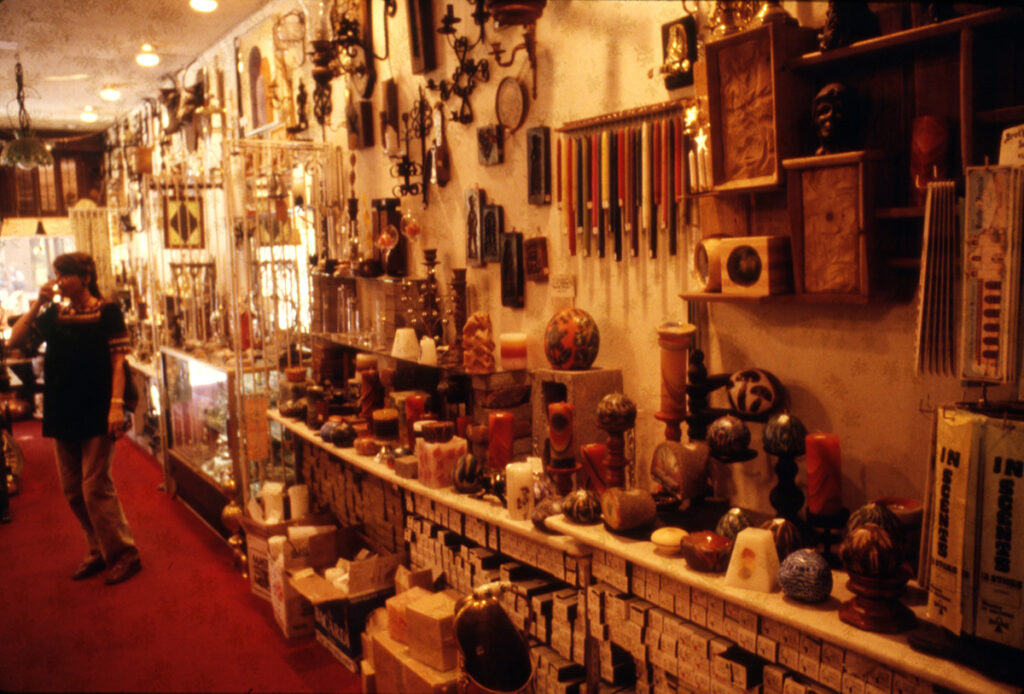
One 1 hour oral history interview with Kiefer Mendenhall by Larry Fredrick on January 4, 1996. The subject of the interview is the Keene Block where Mendenhall ran a store (Wax and Wicks @ 430 E. Hyman Ave). This interview is part of the Architectural Survey Oral History Project.
Kiefer Mendenhall
Interviewed by Larry Fredrick
January 4, 1996
C142_1996.015.0001
Larry Fredrick [00:00:04] …today with Kiefer Mendenhall. The date is January 4th, 1996. First of all, thanks, Kiefer, for coming. Appreciate your participating in this project. Would like to start with you first with just a brief biography, and when you came to Aspen.
Kiefer Mendenhall [00:00:25] Okay. I came to Aspen in 1971, in the summer of 1971. I was born in Indianapolis, Indiana and had pursued a career there in banking and law before coming here with my family of four to purchase a shop called Wax and Wicks, which was in the Keene Building, I think is what the building was. So I came here in 1971 and operated that business until about four years ago, three and a half years ago, when we closed it down.
Larry Fredrick [00:01:15] Okay. When you came in 1971, what do you remember about the core area, the businesses and the buildings?
Kiefer Mendenhall [00:01:25] Well, there were vacant lots… still some. Many of the buildings were sort of rundown. They weren’t in a very high degree of maintenance. That changed, and the interest level and the economics of being able to renovate these buildings changed just a very few years after that. But in 1971, most of them were not in very good condition, and there was not a great deal of historical awareness or appreciation of the buildings at that time. That developed, that awareness developed as we approached the 100th anniversary of the founding of the town, that kind of thing. But at least in 1971, there wasn’t a great deal of appreciation for that.
Larry Fredrick [00:02:20] Were there any older structures that stuck out in your mind as being unique or special to you?
Kiefer Mendenhall [00:02:29] Yeah, the only one that I really remember at that time, I’m going to have to refer to the list of the buildings we’re discussing here. I was aware of the one across the street, the Aspen Block. I was aware of that building. And then I was also aware of the building on the corner where the… is it the Golconda is? Where… across from, catty-corner from Aspen Drug, which building is that?
Larry Fredrick [00:03:10] Oh, the Cowenhoven, Ute City Banque.
Kiefer Mendenhall [00:03:12] The Cowenhoven. Yeah. And the real reason for the interest in that, for some reason, was the fact that the vault was still downstairs. It was utilized as a storage room for the business that was there then, which was called the Golconda, which was the oldest gift shop in town. And so I remember those two buildings and not a heck of a lot of the others. The Brand Building had only recently been sort of an auto shop and was just in the process of being changed around, and it was sort of a nondescript small-town kind of building with no particular significance and not much retail in there. I think no retail, as a matter of fact.
Larry Fredrick [00:03:58] Are there any buildings that you miss that may have been destroyed or torn down? Or any structures that you remember that are gone now?
Kiefer Mendenhall [00:04:08] Yeah, it’s sort of silly. My wife and I were talking about this preparatory to this session, and we remember in particular a building which, a little Victorian, which was in very bad shape, but it was being used as a health food store, and it was located where the Aspen Athletic Club is now, on that corner. And it was a hippie-dippie, alternative-type hangout with posters and notices stuck all over the inside or the porch of the building and that kind of thing. But it had a certain appeal, and that’s the one building that we sort of remember and miss.
Larry Fredrick [00:04:53] But what about, are there any buildings that you think might be in need of improvement today that are historic or that are possibly misused?
Kiefer Mendenhall [00:05:09] Well, we were talking about this as well. The building which houses, I think it’s Jill’s Carpet and a construction company on Main Street across from… what is it? across from Carl’s Pharmacy…. we think is not necessarily underutilized, but just sort of has the sense of being in a rundown condition. I’ve not been inside the building for years and years and years, so in fact, it may be well maintained, but the sense is that it, at least externally, isn’t cared for very much. And to some extent, although this is a building which has been substantially altered from the early days, the Floradora building out at Third and Main, on occasion, seems to be not terribly well maintained for quite a period of time, particularly after it was renovated. It was a wonderful structure and sort of stood out, and now it sort of seems to be a hodgepodge of offices that no one cares for. Inside, it’s not particularly appealing either.
Larry Fredrick [00:06:27] Okay. Are there any new buildings that you think might be considered historic in 100 years?
Kiefer Mendenhall [00:06:35] Yeah, we were talking about this as well, and it all fits into the category of substantial buildings, and substantial buildings seem to be those that are built of stone and brick versus other types of buildings. But we came up with a list. I think that the Ritz, a hundred years from now, will be a building with somewhat the same significance that the Jerome has now. The Little Nell doesn’t quite fit into that category in terms of its appeal and sense of solidness, but I think it will be fairly important. And there are some… Oh, another building which has been built with the old, with sandstone and the old look, is the new building across the street from the fire department, whatever that building is called. And again, that’s a building which seems to have substance to it and I think will acquire some sort of historical appeal. And a couple of the new, very expensive condominiums. The one that’s over by the Concept 600 building, I think that’s called Riverwalk or something like that, is a nice building. And the new one that is in the block of Durant, just east of City Market, which is a brick and stone building of quite some substance, and I think that that will have significance as well. They are buildings which, and maybe it’s old fashioned or of romantic nature, but they seem to have a staying power about them. And also they seem to fit more with the existing buildings that have historic significance.
Larry Fredrick [00:08:36] Okay. What about new residents and visitors? Do you think that they recognize these buildings as historic, or do they have a feel for it?
Kiefer Mendenhall [00:08:48] I don’t think so. I think that these buildings add to the overall ambiance which appeals to people, both visitors and new residents, but I don’t think that they have a great deal of significance to those people, at least as regards to the tourists and the residents, until they’ve been here for some period of time and start to learn about the buildings. One of the things that, for whatever it’s worth I will lobby for at this point, there was a piece on National Public Radio sometime in the last month or so about the fact that in Europe buildings where relatively famous, or not so famous, people lived for short periods of time or where they were born, etc., are enhanced with brass plaques and things like that. Small historical markers, but at least it makes even the casual passerby aware of the significance of that building. And I think that there might be some value in that kind of thing in Aspen, just a small plaque that people walking down Hyman Avenue or Durant or whatever, Cooper, could become aware that this is, in fact, despite the fact that it is in such beautiful condition because the economics now are such that the better you keep this old building, the higher rent it’s going to command. And some of them are in such fine condition that people really aren’t aware and wouldn’t immediately recognize that they are 100 plus years old. And so, a series of plaques around town giving the history of the building, just a six by eight-inch plaque or whatever that people could read, I think would have some value in enhancing the awareness of the tourists’ appreciation of them.
Larry Fredrick [00:11:07] Okay, great. Let’s move on and talk about the specific buildings now. Let’s start on Main Street with the Sardy House. How do you remember that building and how have you seen it change or not?
Kiefer Mendenhall [00:11:23] Well, I remember it when Tom Sardy lived there. And, I forget when he sold the hardware store, but I think he still even owned the hardware store for the first year or two that we were here. And I just remember it as being this wonderful house that was there, and quite frankly, I’m hardly aware that it has changed. The addition to the back is hardly visible, and to the extent that it is, why it’s in relatively good keeping with the rest of the architecture. I patronize the restaurant there, and I just think it’s a wonderful addition to Aspen, and they’ve done an excellent job of being able to expand it and utilize it. And I can’t imagine now any other use. At one time, I wondered whether it might become a business of some sort, but I don’t know what kind of business could have operated in that kind of space. So I think it was a wonderful use of that home.
Larry Fredrick [00:12:45] So I guess you answered my next question, which was: do you see any different type of use for it in the future?
Kiefer Mendenhall [00:12:54] No, it could become, I guess, an office complex, but I don’t think that it would lend itself, nor would I want to encourage it to have a retail use. But I hope that it is successful, because I think it’s quite an addition to the town and the best use of that wonderful building.
Larry Fredrick [00:13:18] Are there any stories that you might have heard about this building? Or tall tales or…?
Kiefer Mendenhall [00:13:27] No. I always knew that it was used as a mortuary, and I didn’t know until what point in time, but I never attended a funeral there. So, no. No stories.
Larry Fredrick [00:13:43] Okay, let’s move on to the Lincoln Block, which is better known as the Cantina. When you came in ’71, what was that building being used as? Do you remember?
Kiefer Mendenhall [00:13:54] There was a restaurant on the corner, which was a hippie-dippie type restaurant. I can’t remember the name of it. It was a very nice restaurant, and then, well, I suppose the back corner of that or the back portion of it was eventually the first Pour La France. I can’t remember what was around the corner, if it was anything. And I suspect upstairs was probably housing, but I really can’t remember too many of the things that transitioned before it became the Cantina.
Larry Fredrick [00:14:51] Okay. Let’s see here…
Kiefer Mendenhall [00:14:57] Before we would go on to another building, I am somewhat disturbed by the painting of that building. Also, I’m trying to think, I believe that they have, in some unappealing to me colors, put the name of the restaurant up in the corner of the building. I mean, I think they’ve done a wonderful job of restoring the building, and the interior is really quite acceptable, and most of the exterior. But there are certain elements of it that bother me a little bit.
Larry Fredrick [00:15:48] Do you see that building changing any in the next few years?
Kiefer Mendenhall [00:15:51] Well, I’m sure it’s going to have to change a number of times. I mean, restaurants don’t have a very great longevity, so I’m sure it’s going to turn over. Whether or not it would continue as a restaurant space, I suspect that it would be “okay” retailing space. The windows don’t lend themselves very well to displays and retailing, and probably it would have to be broken, it would be too large for one retailer, one might think, unless it were another national retailer, but, sure that use is going to change over a period of time.
Larry Fredrick [00:16:35] Okay, let’s move on to a more familiar building, the Collins Block, which used to be Sardy’s Hardware, and now it’s the Caribou Club and such. What was that building like when you first came? You mentioned Sardy’s hardware was there?
Kiefer Mendenhall [00:16:51] Yeah, Sardy’s was there, which was becoming or was then Aspen Hardware or whatever. It was still, when I first got here, you still talked about it as Sardy’s, despite the fact that it hadn’t been that name for quite a while. And the other building in that, or the other business in that building was Sabbatini’s, and I think that all continued until Harley Baldwin bought it and redid it. And I think that he has done an excellent job in that building. I was concerned. I mean, it was inevitable that that building was going to become retailing space and that it would become too expensive for a hardware to be able to afford that space. And I was concerned that it would become what the Brand Building was in the first years of its conversion, which was basically an interior mall or arcade with a number of little shops and kiosk kind of operations. And it was a quite unappealing. I think that he’s done an excellent job of bringing, restoring the building, utilizing the basement, which was, I think it was even a dirt floor kind of storage when it was a hardware. And I know all this drives up rents and all, but that building has been beautifully restored and has businesses in it, which obviously appealed to Harley Baldwin, and many of them are his, and perhaps because no one else can afford the rents, but at least they’re not t-shirt shops. And anyway, I think it’s an excellent use of that building.
Larry Fredrick [00:18:50] So is there anything you’d change in that building or any different uses you see for it in the future?
Kiefer Mendenhall [00:18:56] No, I think it will just be turning over as retail space, and it appeals to me at this point.
Larry Fredrick [00:19:07] Is there anything architecturally about that building that draws your attention to it?
Kiefer Mendenhall [00:19:12] No. I think that they… that building, to my eye, looks exactly like it did when I came in 1971 except that it is better maintained. It looks better, but the shape and all is the same.
Larry Fredrick [00:19:34] You mentioned dirt floors in the basement. Is there anything else you remember about that building? Any stories about it?
Kiefer Mendenhall [00:19:46] No, it was just a wonderful old-fashioned hardware store that had stuff that they had had for years and years and years. People knew where it was. And just… it’s sort of sad to lose it, but it was just a good old boys kind of approach to merchandising, and a place where people sort of congregated, and everyone knew everybody. It was an excellent hardware store for a town of this size, in terms of its offerings and all.
Larry Fredrick [00:20:26] Just to the east of that, you’ve mentioned the Brand Building already as being pretty much abandoned when you saw it in 1971.
Kiefer Mendenhall [00:20:34] Yeah, it had some… I don’t know whether it had or was just losing its use as an auto repair or something like that there. And they came in, and the use that I described a minute ago with the kiosks and little shops inside, there were just a whole bunch of them, and a couple that faced to the outside, but mainly you came inside. There was a little arcade kind of thing, and that was a better use. I was damning it a minute ago, but that was a better use than what had been there before. And again, that was the first step of Baldwin’s restoration of the building, and the second step was much better, I think. But anyway, that’s the way I remember it, and it changed soon after I got here.
Larry Fredrick [00:21:35] Is there anything you’d change in that building today?
Kiefer Mendenhall [00:21:40] No, I think they’ve done a good job of dividing it up now, much better than it was before. The shops are high-end type shops to the most extent. I understand that the short-term rental facilities upstairs are quite nice. And again, it’s an example of something that’s, I think, unique to Aspen or to towns like Aspen, which is: the more money you spend on restoration, the more value you add to your property. And in many cases, restoring buildings, you can’t get your money out of them in the long run. Aspen has always been where you add a kitchen or whatever, and you get more than that value out of the house or the building or whatever as a result. And it’s an excellent plan for doing it well.
Larry Fredrick [00:22:44] Okay, let’s move on down to Hyman Avenue and talk about the Crystal Palace. What do you remember about the Crystal Palace? Was it always the Crystal Palace?
Kiefer Mendenhall [00:22:55] It was always the Crystal Palace. Mead did some things, and I can’t really remember, but I do remember when he added his second story to the restaurant. And I can’t for the life of me remember whether that involved… I think it involved some construction going higher, but not a lot. But he added his balcony to that, and either at the same time or soon thereafter, added the building next door or whatever that sort of surrounded it and now has his offices upstairs and an art gallery downstairs. But the first Crystal Palace that I remember only had one floor of seating.
Larry Fredrick [00:23:50] Do you see that building changing anytime soon in the next years?
Kiefer Mendenhall [00:23:56] Yeah, that building’s got to change, because I don’t think that the Crystal Palace, the concept of the Crystal Palace, can go on forever. I know that it’s enjoying less patronage than it has in the past. I think it’s still successful by many standards, but whether cabaret entertainment is the kind of thing that anybody wants, or whether, or the tourist that comes to Aspen wants, is subject to question, and I don’t know how long that kind of thing could continue. I don’t know what they would do with that space. The balcony is… I suppose it might become a restaurant. I suspect that it would become two spaces; the space where the restaurant and the showroom is now would be one space, and the space where the main entrance, cloak room, bar, etcetera would be another space, because I don’t think anybody could afford all of it. At least at this point in time, it doesn’t seem to me that it would be a good retail space, but whether or not it would be a good restaurant space, I just don’t know what somebody would do with the balcony. Maybe some sort of gallery up there and something on the main floor. It’s hard to say. Hard to say.
Larry Fredrick [00:25:35] Anything significant about the building today? Do you remember anything special about it? Architecturally or…?
Kiefer Mendenhall [00:25:43] No. I just always remember what Mead has done to the inside. And I remember when, as part of the renovation or after the renovation, he bought a new phenomenal chandelier, which would not even have fit in the first building, the building before renovation. And he bought, I think he called it his “blue boy” or whatever, but a very large crystal… I mean, a very large stained-glass piece that’s up above, behind the piano. And he’s just done some wonderful things inside. I don’t think he’s done a great deal since the restoration, but he improved the inside quite a lot, just in the fixturing.
Larry Fredrick [00:26:34] Okay. I want to move another block down. I want to talk about the Aspen Block on the corner of Galena and Hyman. That building, how do you first remember that building? What was it being used as?
Kiefer Mendenhall [00:26:54] Oh, Mason and Morse was in the corner where the jewelry store is now. And next to that, where L’Equipe is now, I believe was Dottie Kelleher’s business, and I can’t remember the name of it, but she had a business there. It was a gift shop, I remember that. I can’t right now remember what was around the corner where… I see Walnut… I guess Walnut House has been there as long as I can recall. I’m not sure. And then the space where the Baggage Claim is now… oh, that space and then the space on the corner, at the alley rather, were a restaurant owned by Andre Ulrych, and I can’t remember the name of it, but it was an extremely popular restaurant that he then subsequently moved across the street when he bought the Eagles building, and that became his restaurant. And he put a disco upstairs, and it’s now the Planet Hollywood. But he had a very large restaurant in the two spaces next to the Walnut House and a very popular restaurant. It was the most popular breakfast restaurant in Aspen, and I can’t come up with the name of that right now, but that’s what was there when we first got here. I can’t go through all the transitions of that space after that.
Larry Fredrick [00:29:00] So you’ve seen a lot of businesses come and go in that space.
Kiefer Mendenhall [00:29:04] Sure, 5- or 8- or 10-year cycle.
Larry Fredrick [00:29:07] That building is painted on the outside. Was it painted back in ’71?
Kiefer Mendenhall [00:29:13] I don’t recall. I sort of think it was. And I’ve always been impressed. I mean, I see painters around there all the time, and they work very hard, particularly on the wood and restoring the wood, keeping it painted and all that. That’s another example of a beautifully maintained building. I have no idea what goes on inside, but at least the exterior is beautiful.
Larry Fredrick [00:29:42] That building is rather historic, simply by the size of it. Do you know anything about who built it originally or any stories about it? Any history?
Kiefer Mendenhall [00:29:52] No.
Larry Fredrick [00:29:53] Okay. We’re going to flip this tape over, so let’s take a break.
Larry Fredrick [00:30:08] Okay, continuing, we’re going to move from the Aspen Block to the Keene Block, which is better known as Aspen Drug. And of course, you had a business in this building, so what do you remember about the building when you first came here?
Kiefer Mendenhall [00:30:24] The building was basically the same color, and it had… very plain on the outside. It was one of the things I want to talk about here in a minute, something that I’m sort of proud of as a contribution to Aspen. Above Aspen Drug, there was nothing. There was basically no second floor there. That was added later. There was, let’s see here, I’ve made some notes here. Upstairs was Albie Kern, and…
Larry Fredrick [00:31:03] Now, you said there was nothing above Aspen Drugs, Albie was above Wax and Wicks
Kiefer Mendenhall [00:31:08] Above the Wax and Wicks. Exactly. And downstairs was a restaurant called Toro’s, and also next to Toro’s downstairs, the closest to the street, was the original location, I’m not sure it was called that, but it was the original location of a business called Country Flower, which I think may still exist in the Mill Street Station. And it was a business which was a combination. There were several people involved, but Carl Heck and his partner dealt in stained glass windows, old stained-glass windows. And there were a couple of ladies who dealt in old quilts and things made out of old quilts and leather. It was, again, we’re talking early ’70s, it was a sort of hippie-dippie kind of operation down there, and that was located in what is now the offices, the restaurant offices down there. They were the restaurant offices for Toro’s, and now the restaurant offices for Cantina. And then Toro’s was located where the Cantina… I’m sorry…
Larry Fredrick [00:32:32] Yeah, it’s… Cavalieri?
Kiefer Mendenhall [00:32:33] No.
Larry Fredrick [00:32:37] I can’t think of the name of the restaurant now.
Kiefer Mendenhall [00:32:39] Okay.
Larry Fredrick [00:32:40] The Italian restaurant today.
Kiefer Mendenhall [00:32:41] Yeah. Isn’t that awful? It’s like I want to go to a phone book and look it up. But anyway, the Italian restaurant that’s there… I’ve got a mindset here, and I can’t come up with the name. Anyway, those were downstairs, and that was it in the building. Subsequently, the second and third floor was added above the drugstore by Colonel Woods. And I want… the story… and you should ask Colonel Woods when you have him in, but the story about when they were redoing the upstairs, and they basically were going to strip or redo the exterior, and they were going to strip the brick on the Galena Street side, and they discovered an old cigar sign underneath. And they stopped immediately with the stripping. They had to find the Colonel, who was still on active duty somewhere in the Pacific at the time, and get his permission to stop the process and to allow it to be restored. And Gaard Moses, I believe, volunteered to do the restoration so that that sign was not lost. And I think the sign, from pictures that are available suggests that the sign is a hundred years old or so. And that was sort of a fun historical thing about that particular building. I know the building suffered a fire, maybe in the ’50s and was not completely rebuilt, which gave rise to… I don’t know whether it was required by open space requirements or whether it just worked out that there was a patio, I guess you would call it, an open space. The building became U-shaped as it is now. Subsequently, that was allowed to be filled in by restaurant seating, outdoor restaurant seating. In terms of the structure itself, it had been a solid building, but that patio or open space resulted from not being completely rebuilt when this fire took place. And that may have been where the worst part of the fire was, and that was just a decision of how to rebuild it.
Larry Fredrick [00:35:31] Now, you had a business in there for quite some time. Do you see that changing anytime soon?
Kiefer Mendenhall [00:35:37] No, I think that’s got to be retail space. I was approached at one point by, I guess by the owners of Toro’s who considered having our space as a microbrewery for something that would be located downstairs, and I can see that as a possible use. And when we then sold our business, I think that was explored very briefly by the people that owned the Italian restaurant. And then just recently, that lease was sold yet again. And at that point, both the drugstore and the restaurant downstairs considered using that space, the restaurant coming on around… Oh! I want to interrupt and say that that was another business that was in the building when we first got there, which was a bookstore which was located where the prescription portion of Aspen Drug is now. And Aspen Drug was just along the Galena Street side and did not wrap around. And Aspen Drug took over that space when the drug store, I mean, when the bookstore left. But going back to possible uses of the building, I’ve always sort of wondered whether having some sort of allied restaurant, associated restaurant, or maybe part of the same restaurant, at ground level might provide a better draw for the restaurant, which is downstairs. Now the current restaurant is, I think, enjoying good success and maybe doesn’t feel that anything is to be gained, and as a matter of fact, was approached by the people that have taken over our space to see whether they were interested in moving part of their operation upstairs. And they concluded that I guess it was too expensive or whatever. And Aspen Drug was approached also. But other than something associated either with Aspen Drug or the restaurant downstairs, I would say it’s going to be retail space.
Larry Fredrick [00:38:06] Now because you were in the space during the change of Hyman Avenue from a street to a mall, I want to digress a little bit.
Kiefer Mendenhall [00:38:17] Okay.
Larry Fredrick [00:38:17] What can you tell me about the mall, the pros and cons, and how do you remember the streetscape before the mall?
Kiefer Mendenhall [00:38:26] Well, some high school students had tried and been successful in getting the street closed off on a temporary basis for 1 or 2 summers. That was done with railroad ties and things like that. The nature of the street… I was against the mall… and even though it ended up, I suspect, helping our business, I still wonder about the validity of the malls. Aspen was a mining town. It wasn’t a mall. It doesn’t lend itself, or mining towns don’t lend themselves to malls, and at least in my opinion, the mall drew unpleasant aspects or aspects that really were not in keeping with the nature of the town or the nature of the town that I would most value. It sure brought a lot of musicians, and the design of the mall is a very linear design. I think that the mall might have been designed to have more rounded corners, but if you think about it, everything in the mall is sort of a straight shot, and it could have been designed to cause people to meander rather than go straight down the mall. It could have been designed in a manner that would give a couple of areas over to musicians but not have too many musicians. I can remember times back in the ’70s and early ’80s, when there might be 7 or 8 musicians at different points on the mall, and it sort of produced a cacophony of sound, and it wasn’t particularly appealing. And it still attracts the guy who juggles fire, and it attracts an element that I don’t think would be there otherwise. And to that end, I think that it’s an uncomfortable place for me to be in the summers because of the entertainers on the mall, summers in the evenings sadly. And I also wonder whether the mall has a different nature of business on it, on the mall, than it would have otherwise. Whether there aren’t more t shirt shops than there would have been if the mall had never been realized. I think that it changed the nature of downtown Aspen. It caused… whether it caused the rents to go or whatever the chicken and egg aspect of it is, it caused a change in the mix of the businesses downtown. Whether various service businesses would have been moved out of the downtown or the core area, either to the ABC or further afield, whether the nature of the shops would have been different without the mall, I don’t know. Maybe rents would have increased as quickly as well. But I think that overall, it’s not a terribly positive aspect for Aspen.
Larry Fredrick [00:42:50] Okay, good. We’ll pursue that with some of the other folks as well. It’s an interesting concept. Let’s move on to the… just off the Cooper Street Mall, by the way, the Brown and Hoag Building, which is better known as the Independence or Crossroads Drug Building. How do you remember that when you first came? What businesses were in there?
Kiefer Mendenhall [00:43:14] That had Crossroad Drugs on the first floor, and that took up the whole first floor. Upstairs was employee housing, and I think it was fairly shabby. And in the basement was a restaurant called Lum’s, which was run by Su Lum, and it was a Chinese restaurant. Before that, it had been, I think, a restaurant that had some operatic singers performing and serving, and then it became Lum’s. And then I believe, after Lum’s, it may have been another restaurant for a short while before Crossroads took it over as storage. And then following Crossroads, it became Banana Republic. And I believe that it’s much better maintained than it was in the early days. It’s a more appealing building from a visual standpoint, and it just seems much solider and much nicer.
Larry Fredrick [00:44:47] Okay, let’s move down the street to the Bowman Block, a little older building. Today that’s Les Chefs and some other businesses. Do you remember anything about those buildings early on?
Kiefer Mendenhall [00:45:03] No, at the beginning… I can’t remember very much about that building. At the beginning, I believe it had Stein Eriksen’s shop in it. He owns the building. But I really can’t remember what was there before Les Chefs, except maybe a clothing store, I think. Boy. Was McDonough’s in one of the spaces there? I think it was, a ski shop called McDonough’s, but I don’t have great recollection of that building. I think that that’s a building which has improved over the years, but it was in pretty good shape when we got here. I think that Stein Eriksen cared about that building, or at least the external portion of it, and it’s always been a beautiful building. That’s always fit in beautifully. It’s funny. That’s one of the buildings in Aspen where I’m least aware of the fact that it’s an old building, and I don’t know why. It may be a building which… this seems silly too… where the line of sight on the building is such that you really don’t look up at the building, you don’t see the whole building, and you just, you’re more often walking past it and near to it, and so I’m less aware that that’s of any historical significance as compared with the other buildings that we’ve discussed.
Larry Fredrick [00:46:44] Do you see any changes in that in the future?
Kiefer Mendenhall [00:46:48] No, it’s definitely retail space, I would think.
Larry Fredrick [00:46:52] Okay. Let’s go ahead and conclude with that. Are there any other bits of information that you would like to add or any comments that you’d like to make?
Kiefer Mendenhall [00:47:03] Yeah, I want to toot my own horn here for a minute.
Larry Fredrick [00:47:07] Go ahead.
Kiefer Mendenhall [00:47:09] When I came… I did this for merchandising reasons, I think, but when I first came to Aspen, there was one awning in Aspen, and that was a canopy which led from the curb into the entrance of the Red Onion restaurant, which was then actually three restaurants, and this led into, I think, into the gourmet restaurant or maybe into the main entrance, but that was it. It was a canopy, period, only awning in Aspen. And I decided that for a variety of reasons: one, to sort of shield from the harsh sun, and secondly, to give the customers a feeling, or browsers a feeling that as they got to my windows that they were sort of enveloped, that they weren’t against a flat surface, but they had already become drawn in by the fact that there was an awning over them. And so I decided to put an awning in. And this was, I think, before the Historic Preservation either existed or before they cared about such things, and I now understand that subsequent awnings and things have to get historic approval. But at the time, the only approval I needed was to register for it as a sign, I think, and the fact that it had to be constructed in a certain way and a certain height and all that. But I put the first awning in Aspen, and within about a year, the Thrift Shop decided that they had looked through… old-time Aspen had awnings that wouldn’t stop. Every building had awnings, and to a large extent that’s true today, and I feel somewhat responsible for getting that started again. And as I say, within a year of my doing my awning, the Thrift Shop ladies decided to restore or to put awnings on the Wheeler that were…
Larry Fredrick [00:49:44] That’s where they were located.
Kiefer Mendenhall [00:49:44] That’s where they were located at the time. And to put a bunch of awnings on the Wheeler that looked like the awnings from the old pictures of Aspen. And so they put awnings. And then other people started putting awnings. And now many, many, many buildings in Aspen have awnings. And that, I think, is good for the ambiance of the town. The other thing I want to toot my own horn, and I don’t know how much tape we’ve got…
Larry Fredrick [00:50:15] We’ve got plenty.
Kiefer Mendenhall [00:50:16] Okay. I’m going to toot my own horn, and this is a pun, I guess I realize, excuse the pun, but there was no classical music performed by students in Aspen when I got here. One minor exception was the building, the restaurant run by Dan Wiegner out at… what is now the… is it the… not the Inn at Aspen, but… it’s the building that’s going to be torn down for the golf course, just the other side of the…
Larry Fredrick [00:51:00] The Pomegranate, it’s called… or was.
Kiefer Mendenhall [00:51:02] Okay. And Dan Wiegner had a restaurant out there, and on Sundays, he would have a harpist or sometimes a string trio during the summer. And I decided… this was in defense against all of the guitars and the hippies singing along Hyman Avenue and then the Hyman Mall during the summer. And I decided that I wanted to have music in front of the shop on Saturday afternoons. And as a consequence, and as I say, nobody was playing in any of the restaurants as they are now. Nobody was playing on the streets as they are now. I’m talking about the classical musicians. And so I picked up the phone, and I called Dean Hardy at the Music School, and I said, I wondered if I might be able to put up a notice that I was interested in hiring some musicians to play in the mall on Saturday afternoons in front of my shop. And he said nobody had ever thought of that, and he thought it was a great idea, and he would put up a sign. And within a few hours, I got a call from a guy by the name of Howard Pink, who was a French horn player, and he proposed putting together a French horn quartet. Now, I had originally thought in terms of a string quartet, but I realized that a French horn quartet would basically drown out any of the guitar players around the mall, or not mall then, but along the Hyman Avenue, and at least for a while, why we’d have some classical music. And so I hired these guys, and they ended up playing at least once a year, but at the beginning, I paid them to play every Saturday afternoon for a couple of months in front of the shop. And then Howard went off and sold himself to a couple of restaurants in town to play in front of the restaurants in the evening in exchange for dinner, and a bunch of other kids put together quartets and started playing for dinner, and on occasion would play on the mall with an open instrument case to collect some money. So those two things: the awnings, I feel responsible for, and I think are quite an addition to Aspen, and the music that is played in so many of the restaurants or outside the restaurants by the students in the summertime is also something which I started, and I’m pretty proud of both of those. And I’ll pat my own back here, but I wanted to go down in history about that.
Larry Fredrick [00:54:10] Didn’t you have some of the same musicians come year after year after year?
Kiefer Mendenhall [00:54:15] The last year that we were open, the musicians… it got to the point where I couldn’t afford it, and they were still playing for the restaurants and playing elsewhere in town. And so they would come back at least once a summer to do it, and through that period of time, I think every summer at least two of the original people, and we’re talking now on the order of 20 plus years later, were still in this group. And he would put it together and they would come by for a memorial concert, just because we had sort of started the whole thing, for old time’s sake.
Larry Fredrick [00:55:00] One other thing before we leave. The one thing that I remember is you had a rather interesting marketing concept with the mulling spice.
Kiefer Mendenhall [00:55:11] Okay.
Larry Fredrick [00:55:12] How did that come about? And just sort of explain, since we’ve got you on tape, I always found that an interesting aspect.
Kiefer Mendenhall [00:55:19] The first fall that we were here, I was brand new to Aspen, I’d never skied in my life, and this will become important here in a second, but I decided to close down the store. There was no business after Labor Day anyway, so we’d open for a couple of hours a day, but I wanted to see what else was in town. And so I had not had an opportunity when we came to arrange to buy the business, and I decided to close up and go around town and introduce myself to the other merchants and all that. And so during this one September I was closed down, I went across the street to the Golconda Gift Shop, which was in the Cowenhoven Building, and introduced myself. And the guy said, “Would you like a cup of coffee?” And actually the coffee machine or the coffee pot was down inside the old vault that I mentioned earlier, and I said, “Gee, that’s a nice touch.” I said, “Do you do that all the time?” And he said, “No.” He said, “Only during the off-season and only when I’m not busy.” And my immediate mental reaction was that it seemed to me that the most important time to do that, in terms of welcoming customers, was at the height of the season when you’re the busiest. And I went back home, and we had always associated skiing or après ski with glühwein or hot spiced wine, because friends of ours… we had never skied, but when they would go on ski vacations and would bring back pictures and want to show them to us, and it was boring as hell, but… these little specks up on the white slopes… but this one friend of ours who would have us over for these boring pictures, this is back in Indianapolis, would always serve what he called glühwein, which was this concoction that he put together in a pot on the stove with cinnamon and orange and lemon slices floating in it and all of that. And so, having never skied, we associated glühwein with après ski. And so after this visit to the Golconda, I came back home wondering, “I wonder what it would cost, during the winter season, to serve a little glass of glühwein to everybody that came in?” I thought that I would accomplish a couple of things. Number one, I would create a nice atmosphere in the store. It would seem like it was hospitable. And secondly, and most importantly, I thought it would cause people to stay in the shop a little bit longer. And I figured the longer I could keep them browsing, the better the chance that they would see something that they wouldn’t have seen otherwise if they had left more readily, and they would buy on impulse. And I figured that I would enjoy increased sales, which would more than pay for the cost of this gesture of hospitality. I don’t like to use the name or the term “promotion.” We really thought of it as a gesture of hospitality. We never, ever advertised it, so people had no idea unless they had been in the shop before, and their first time in the shop, they had no idea that they were coming in and they were going to get something to drink. So they had already committed to come in the store before they would realize that we had something free for them. So we never used it as a promotion or advertising. And so… hell, I’m going to spend a little time here… I put together a combination of spices, different spices and different wines and I labeled them A, B, and C, and I went around from neighbor to neighbor in my own neighborhood at home and had them test this and see which they liked the best. And one was sort of universally the favorite. And so we started serving that in the store. And within the first half an hour of serving this, and we waited until the ski season started, within the first half an hour, I literally had two ladies try to blackmail me into selling them the mix that I had put together, which was a relatively commercial mix that we had purchased from a restaurant supply house because we had learned that in Aspen at least 2 or 3 times during the season, both Tom’s Market and City Market would sell completely out of cinnamon sticks. So if you’re going to be able to do this, you needed to have something that was sort of soluble and then didn’t have to brew it up individually. And anyway, so within the first half an hour, a couple of ladies said, “This is the best I’ve ever tasted in my life. Please sell it to me.” I said, “Well, it’s not anything I have available for sale. It’s just something I’ve got in the back room.” And I remember this one lady saying, “Look, either you sell that to me or I’m not going to buy this nice piece of pewter I’ve picked out.” And so within a week or so, we were selling this commercial product, the restaurant supply kind of product. It had a lot of artificial this and that, mainly because at the time, I don’t think that some of these flavors were available in their natural state. We’re talking 1971, ’72. So we started selling this, and it went through a whole bunch of different… {recording ends}
More Oral Histories
Oral History
Conversation between Elizabeth Paepcke and Bruce Berger, circa 1988
Oral History