Oral History
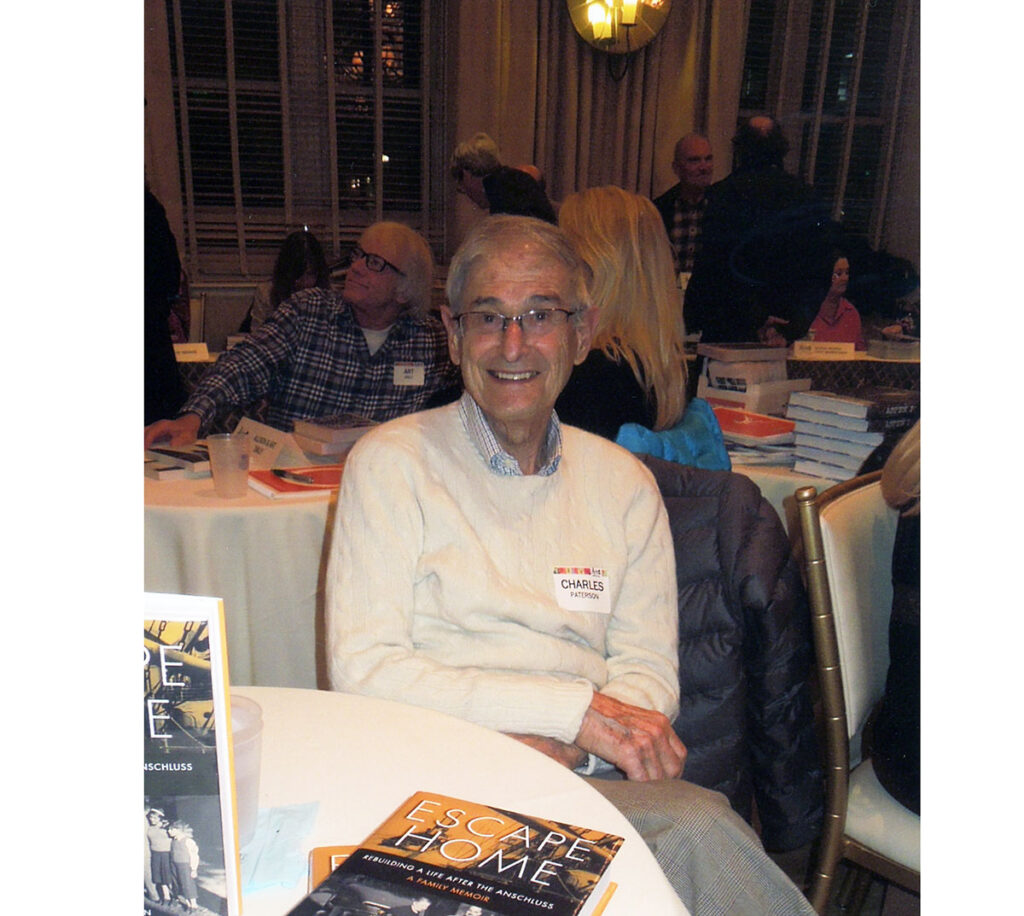
Charlie Paterson
One 1 hour oral history interview with Charlie Paterson by Larry Fredrick on December 20, 1995. The subject of the interview is buildings in Aspen and how they have changed. It is part of the Architectural Survey Oral History Project.
Charlie Paterson of the Boomerang Lodge came to Aspen as a young man and has a most colorful past. In 1938 when Hitler’s army invaded Austria, his father, Steve Schanzer, was able to take Charlie and his sister to Czechoslovakia just ahead of the troops. Then when the Germans invaded once again, they moved on to France. Charlie’s father was anxious to get the children out of Europe and found a way to have them adopted in Australia by the Paterson family (hence, the name change). His father escaped from France by way of Portugal and made his way to the U.S. after the war. Charlie and his sister joined him in New York where they lived for a couple of years. After living in Australia, Charlie decided New York was not for him, and he headed west ending up in Aspen. After only a month, Charlie bought three of the original Boomerang lots and built a log cabin on the property. In these early days (1950s) it was common to have several jobs to survive. Charlie was an employee of Jake Lewis, a miner, who hired him to help remove the 165 foot smokestack on the Marolt property, brick by brick. It seems the wind was blowing the bricks off making it a danger to the area. After Charlie and his father ran the Holiday House for a couple of years, he was convinced he should be in the lodging business and built three units on his property in 1956. As this progressed, he studied architecture under the famous Frank Lloyd Wright as evidenced throughout the Boomerang Lodge.
Charles Paterson
Interviewed by Larry Fredrick
December 20, 1995
C141_1995.062.0001
Larry Fredrick [00:00:04] This is a continuing taped interview of the series for the HPC project. Today, December 20th, 1995, we are interviewing Charlie Paterson, and the interviewer is Larry Fredrick. Uh, first of all, thank you, Charlie, for being a part of this. Could you give us just a brief biography and, uh, when you came to Aspen?
Charlie Paterson [00:00:31] All right. I came to Aspen in… thank you, Larry, by the way, I appreciate being on this… I came to Aspen in 1949, and that was, uh, about midway through the ski season, and I was 19 years old. And I was one of the so-called “ski bums” of that period. Got a job in the Hotel Jerome as a bellhop, worked as a bellhop that season with people like Roy Broom, and John Doremus was on the sports desk at that time. Pete Seibert’s mother was working for the Jerome, and she was in charge of personnel. Pete Seibert, as you know, started Vail. At that time, Pete was still a young man. I was here about a month, and I bought property, and the property that I bought was right here, on this location where The Boomerang now stands. I bought three lots in the middle of this block. The next few years, I bought up the rest of the block because I felt that somebody else was going to build a building that would ruin my view of Independence Pass, over to our east. And as you know, this is located between Fourth and Fifth Street and between Hopkins and the alley towards Main. After I was here, I went back to school and did come back… in New York, where I was living at the time… I did come back to Aspen the following summer and built a small cabin. The small cabin was right in the center of this block, Block 31. And, um, at the same time, that winter, I took a lease on Holiday House and managed that with my dad. I got my dad to come from New York and help me. We ran Holiday House for a couple of years, first for the Day family and then for Fred Braun, who had bought it from the Days. And so I got an introduction into the hotel business at that time.
Larry Fredrick [00:03:03] Uh, when were you born and where?
Charlie Paterson [00:03:06] All right. I was born in, um, in Vienna, Austria, in 1929. And I lived there my first ten years and then emigrated to Australia when the war started. I lived in Australia about eight years, and then came to the United States after the war and joined my father, who was living in New York. And I was in New York for a couple of years and decided that New York was not a good place to live. And that was back in 1949, and I came west and discovered Aspen. And I’ve been here ever since.
Larry Fredrick [00:03:54] Now, when you arrived in Aspen, what do you remember? The town, the core, the business area was like?
Charlie Paterson [00:04:01] It was very simple, and there were a lot of old buildings. In 1949, we had a population of about 500 people. The post office was on Galena Street, and I remember the old miners used to meet there for their old pension checks. And they used to, the whole town used to meet there at noon to pick up their mail. There was, of course, there was no mail delivery. The buildings were very old, and some of them were quite decrepit at that time. But you could feel, already at that time, the energy that was starting to happen for Aspen. And it felt like being a pioneer, being here in 1949. Everybody knew each other by their first names, and it was rather an interesting time because there were the very, very wealthy people like Walter Paepcke, who was buying up, who had already bought up most of the property that he was going to buy. And then there were all these ski bums and people who came here to work, and a lot of old timers from the old time, the miners, people who survived all through the ’30s and the ’20s and were still here. And I remember the story about Sardy buying the Sardy House for about $700, on Main Street, because he came here in the late ’30s, and he started the lumberyard.
Larry Fredrick [00:05:44] Now, you mentioned the post office. What other businesses were there?
Charlie Paterson [00:05:50] Uh, there was, uh, the White Kitchen, which was in the middle of the Hyman Street Mall. It was sort of a little cafe with glass blocks, as I recall. There were the miners’, old miners’ buildings, where Guido is now, Guido’s modern building. There were three little miners’ shacks where they were already selling liquor in there, but I don’t, I have a recollection they used only candles in there at that time. It was very, very simple. The Red Onion had already started. It was only the middle, middle building.
Larry Fredrick {short break in recording}
Larry Fredrick [00:06:34] Okay, continuing. You were talking about the older buildings downtown and how you remember them.
Charlie Paterson [00:06:40] One of the interesting buildings that I remember very well is the Elks’ Building. Now, the Elks’ Building meant a lot to me because my first night in Aspen, I came here during the North American Championships in 1949, and the first night, I couldn’t find a place to sleep. And I was here with a friend that I picked up in Albany, New York, on my way here on the bus. And he and I walked the streets trying to find a place to stay, and everything was filled. People were sleeping on floors of old houses. There was really no place. So we wandered around town. It was about 11 or 12:00 at night, and it was pretty cold. And we found the Elks’ Building, and we wandered upstairs. And there were, there was this, all the doors were unlocked, but there was heat in the building. So we walked down this long hallway to the end of the hallway, and we found a room at the end with a billiard table, and it was all dusty. And I remember it had a window seat in the corner, which is right above where the old Esprit was, it’s now called the Athletic Shop. And that corner window right above there had a window seat built in. And I slept on that on my first night in Aspen with my coat pulled up, and my friend, who was six foot three, he slept on the billiard table. That was how I remember it. So I have very fond memories of the Elks’ Building, which I think is a very historic building, and it stood out at that time. The Opera House was also something that I remember very well, the Wheeler Opera House, as well as the Hotel Jerome. Of course, the Hotel Jerome meant a lot to me because it was still being operated by the… what’s the name of the family?
Larry Fredrick [00:08:45] Elishas.
Charlie Paterson [00:08:46] The Elishas. The Elishas were still… Well, Laurence Elisha was the maintenance person, and he already… it was already being operated by the Aspen Company, Walter Paepcke’s company. But the Elishas were still part of the scene over there, and I have very fond memories of the Hotel Jerome of that period. And very Victorian too. And the pipes always clanked when the heat went on.
Larry Fredrick [00:09:14] Do you remember thinking of the historic significance of these buildings when you arrived?
Charlie Paterson [00:09:21] Well, since my interest is in architecture, I had a very strong interest in what was here at the time. And I was very interested in what, the few modern log buildings that that were starting to spring up. There weren’t many of them. I remember that Andy Ransom built a modern building over here opposite the skating rink, which was made out of logs, and it’s not there anymore. It’s now called the Shadow Mountain Condominiums. Of course, that was torn down and changed. But I was very cognizant of the architecture, and I was quite impressed with its Victorian significance.
Larry Fredrick [00:10:16] Is there any building in particular that you really miss that’s been lost? That was of historic significance possibly?
Charlie Paterson [00:10:25] I recall what we called “the haunted house” as one of them. The… also… and that’s the one that was on the west side and was in… it was all falling apart, but it was a very interesting building. Also Tomkins Hardware, which I recall when there was, when the roof fell in, there was a very heavy snow. The roof fell in finally and started a small avalanche on Ruthie’s, right under the lift on the lower section, because it made such a crash. I recall that. Tomkins Hardware was a very interesting building, with the lift in the center and all wooden plank floors. Very dark inside, but there was a big, huge lift that they could carry bags and heavy equipment up and down. And it was operated by an old gentleman, Mr. Tomkins. Yeah, I recall him from that time. Also, one building that I miss is, that came in right at that time was a new building, the old Tom Thumb building, which is right across from the Wheeler Opera House. They have a new building there, which I don’t think has nearly the character that the Tom Thumb had, that Fritz Benedict designed. And it was a very beautiful little building. It was in scale more with Aspen than what exists there right now. And we kind of miss that.
Larry Fredrick [00:12:04] Um, is there any building that you think is historic today that maybe is being misused or could be used better?
Charlie Paterson [00:12:16] I think one of them is the Tom Thumb location. Um, I feel very strongly that, um, that we have to try to preserve our open spaces. Now, that’s not a building, but I realize that, you know, it’s like in a symphony, the space between the notes is what creates the beauty. And the buildings, old and new, are framed by that space. And we’re starting to lose some of these special, special places. Like, for instance, you might talk about the racetrack at the Institute, which is a beautiful open space where they plan to build houses, and I’m against that. I think that will be a great loss. Another place that’s, I think, rather sacrosanct is the foot of Shadow Mountain. Uh, having lived here since ’49, at the foot of Shadow Mountain, I feel very strongly about the spaces across the street on Hopkins, which really is the terminal of Shadow Mountain. Shadow Mountain is sort of a terminal for the town. You might call it a real special place because everybody looks towards the South as much as possible in Aspen. And the Shadow Mountain, I think, is a very valuable piece of the mountain that we have here, a very valuable, uh, terminal for Aspen. So that space, I think, is very important to the town. There’s another house that I might talk about that’s old. Just down the road here on Third Street, Third and Hopkins. Terese David, from way back, had a house (it’s now owned by other people) that’s a log house, that’s an adzed building. And that was a hand-adzed building from the mining days. It’s really something that, um, that goes back to the old, real old time. There are not many buildings that are left from that period. The cabin at the Boomerang, of course, was built in 1952. It’s not historic yet, but it’s in the center of my property, and I hope… it used to be my house. It’s now a rental unit, but it’s, um, it’s a rather unusual…. it’s something from the beginning era of when Aspen started.
Larry Fredrick [00:15:03] That sort of leads to the next question. Are there any buildings that are new buildings in town that you think will be historically significant, say, 100 years from now?
Charlie Paterson [00:15:14] Well, I think that the Jerome, the Wheeler Opera House, Mrs. Paepcke’s house, which is rather an interesting building because it dates back to the mining days when the Brown family owned it, but it doesn’t have the curlicues of the Victorian era. It must have been a very modern building. So I think that house, as well as its grounds, are of great value. I think also there was a little house that, off Lake Avenue, Peggy Clifford’s old house, which is… that goes back to the misuse, that has been tripled in size. But the original house in the front was very, very cute and very nice. Judge Shaw’s house is another one. Luckily, it’s been preserved in its entirety and actually fixed up from that period. That’s also on Lake Avenue, as you know. Ten, 100 years from now, I think maybe Harris Hall will be something we’re going to be looking at as a real change in attitude and architecture, and a house, or rather a building, that is, uh, that has great value in its, um, attention to not disturbing the surrounding meadows and being so unobtrusive and yet being such a great building. Even the tent. I don’t think it will be here 100 years from now. Even the tent would be of some value if it still was around.
Larry Fredrick [00:17:09] Do you think new visitors and new residents, for that matter, have the same idea of history of Aspen? Do they appreciate what they see here?
Charlie Paterson [00:17:22] It’s a yes or no answer because there are some people… I run into a lot of them that are very, very cognizant of architecture because of my building. My guests talk to me about architecture quite a lot because they liked the Frank Lloyd Wright influence of the Boomerang. But basically, those same people are the ones that also appreciate the Victorian era. And they go over here to the West End and say, “Oh, those houses are so great that have been refurbished from the Victorian era and weren’t torn down. And it gives the town such character.” So the mix of the modern and the old architecture perhaps does give people a feeling that it’s appreciated. But there are a lot of the new people who really, they want slick and glamor, and they expect more of that slick and glamor. And there are more people, we’re getting more and more of those people, unfortunately, which is a pity. And they couldn’t… as long as they have their great service and their marble bathrooms and lots of people to take care of them, I don’t think they ever really go into the old part and appreciate that. So it’s a yes and no answer.
Larry Fredrick [00:18:43] Okay, good. Let’s talk about some specific buildings now. You’ve already mentioned the Sardy House. What do you remember the Sardy House as when you first came here?
Charlie Paterson [00:18:54] Well, I recall Tom Sardy had a mortuary there, and it wasn’t very obvious that’s what it was because he lived in the front part, it was like a house. But it really stood out as a Victorian structure on Main Street, and I liked the brickwork. Now I actually like what they did with it. There’s one instance where the architect had a lot of feeling for the house and for the building, and the addition at the back really enhances rather than takes it away from what was there. I think it’s being well used. There’s an example of something that when you walk in the front door, it’s still that wonderful Victorian atmosphere, and then you still have modern rooms, modern buildings and that bridge they built across to the new part. I think it was very well handled.
Larry Fredrick [00:19:52] Um, moving down the block, the Lincoln-Chitwood block, which now houses The Cantina. What can you tell us about that?
Charlie Paterson [00:19:59] I recall that as a very popular place, The Epicure was in the corner. Henry Stein had a water business that… he had bottled water that he sold out of there. Right next to that was… The Alpine Jeweler began his business there with a small shop. It was rather charming. Upstairs, I believe they had employee housing where the lawyers’ offices are now.
Larry Fredrick [00:20:33] Let’s go on to Hopkins Street and talk about the Collins Block, Sardy Hardware. Was that always a hardware store?
Charlie Paterson [00:20:43] I recall it as the hardware store. And downstairs, I remember, they kept all their nails. They had an earthen floor and a rickety stairway coming in from the Hopkins side. And it’s just amazing what they’ve done with that. But it was high ceilings and upstairs, again, was employee housing. It was sort of tumbled down apartments up there mostly. So I recall that quite well as a hardware store, that whole block.
Larry Fredrick [00:21:19] Just down the street from that is the Brand Building. How do you remember that building?
Charlie Paterson [00:21:25] The Brand Building was an old garage downstairs. It was a great big glass… I remember the cracked glass was fixed glass. I remember it had a big crack throughout. It was there like that for years. It was an old garage. People used to drive in there. In fact, there used to be a gas station there as well, and they fixed cars underneath. And upstairs was… I think they had bunk beds up there for the Aspen Company, and they had people who worked in the Jerome who lived up there. In fact, I recall upstairs that the bunks… because I remember staying in there one time when I was working at the Jerome. So that was about 1950, 1949, 1950.
Larry Fredrick [00:22:16] Well, that building’s changed significantly. How do you see its use in, say, ten years from now? Will it still be used the same as it is now?
Charlie Paterson [00:22:25] I have a feeling that’s correct. I remember it changed to some kind of an indoor mall with little shops for a while, and they had an ice cream store and a little, you know, soap and bath store in there and, uh, and some, uh, food, you know, like grains and… a health food store rather. And then it changed drastically as, um, as what it is now to luxury apartments upstairs, which are, I understand, quite expensive and very popular.
Larry Fredrick [00:23:05] Let’s go down to Hyman Avenue to the Clark’s Commission House, which is better known as the Crystal Palace. And how do you remember that one?
Charlie Paterson [00:23:13] Well, the Crystal Palace, what we see there now, used to be a dry cleaners, and it had… that wall facing west had some kind of a cigar advertisement on it. I don’t know if that’s still there. It might still be there. So they kept that wall pretty well. But before it was the Crystal Palace… the Crystal Palace was actually next door. And that’s where Mead Metcalf started the Crystal Palace, next door. And he had little seats from the schoolhouse with those little desks in front, and it was kind of cramped. And you sat one next to the other, and they served you food on that. And he began that. But before… when Mead Metcalf… I recall now, when Mead Metcalf moved over to what is the Crystal Palace now, Judge and Mrs. Shaw had a museum in there. And they had all their old things in there. And people used to come in and look at all the old pictures and some of the… because they collect everything, they had collected everything that you could think of. So it was rather interesting in that whole area. Another thing that that comes to mind here is that the Wheeler Opera House, being such a large scale, is really being saved by that little park. And then what is now the Mother Lode, where Mead Metcalf really started the Crystal Palace, and then that became a museum. That’s what the building we’re talking about. But the scale of the Opera House is really in nice contrast by having those small buildings in between and giving it some space and making it grander than it is. The same thing with the Jerome Block, where the Jerome is, you’ve got a park next to it, and then you’ve got that lovely little building, which is The Aspen Times, which we hope will stay there, that gives the Jerome its grand scale. So again, we talk about space that you need for these great buildings. If there was another building smack up against it that size, it would be spoiled. It would be ruined. The whole thing would not be what it is now.
Larry Fredrick [00:25:31] With respect to space, do you remember the Crystal Palace when it was only one floor instead of two floors?
Charlie Paterson [00:25:39] That is correct. Because the cleaners had… was a real high ceiling, like in the Armory.