Oral History
Carole Hershey
One 1 hour oral history interview with Carole Hershey by Larry Fredrick on January 8, 1996. The subject of the interview is buildings in Aspen and the Wheeler Opera House where Hershey works. This interview is part of the Architectural Survey Oral History Project.
Carole Hershey
Interviewed by Larry Fredrick
January 8, 1996
C143_1996.016.0001
Larry Fredrick [00:00:07] Okay. Continuing with the oral history architectural survey interviews. Today we have Carole Hershey. It is January 8th, 1996. First of all, thank you, Carole, for being here. Appreciate it. And to start off, I’d like to have just a brief biography and when you arrived in Aspen.
Carole Hershey [00:00:29] 22 years ago, for the summer, I forgot to go home. That’s everybody’s story. I was lucky enough. We were living in New York, and we both took a year off to see what it would feel like living out west. And we came here for the summer, then went to Colorado Springs, and really liked it here so much better that when an opportunity came our way to stay one place or the other, we came here with two children, one in second grade and one in fourth.
Larry Fredrick [00:01:15] So that was about 1974?
Carole Hershey ’72.
Larry Fredrick [00:01:22] When you first came to Aspen, what did the downtown look like?
Carole Hershey [00:01:28] We didn’t have the mall at that time. That’s my distinction between the new Aspen and the old Aspen are the bricks. And Carl’s Pharmacy. That was my route, was to Carl’s Pharmacy and a grilled cheese sandwich and a Coke, and the hardware store. And those were my two best memories of the earlier days.
Larry Fredrick [00:02:01] What other businesses do you remember at that time? What kind of businesses?
Carole Hershey [00:02:06] Carl’s Pharmacy. Sardy’s Hardware Store, without which I am still lost. Bullock’s, where you could get anything you needed. And the movie theater that wasn’t all chopped up into little rooms but was a nice big movie theater.
Larry Fredrick [00:02:32] What… were you aware of…?
Carole Hershey [00:02:34] And The Shaft.
Larry Fredrick [00:02:36] Oh, and The Shaft…
Carole Hershey [00:02:36] So you could eat out.
Larry Fredrick [00:02:38] Were you aware of any of the historic significance of the buildings at that time?
Carole Hershey [00:02:43] Not really. You know, coming from the east, the west is all new. I mean, when we look at a building, I lived in a 150-year-old brownstone in New York, built by the Dutch, so anything out here for me was… the old buildings were new.
Larry Fredrick [00:03:02] Okay. Are there any buildings that were here when you came that are not here today that you miss?
Carole Hershey [00:03:10] Yes. Yes.
Larry Fredrick [00:03:10] What would those be?
Carole Hershey [00:03:11] I miss the way the Brand Building was set up. I thought that was so charming, those little stores in there. And the brick floor that kind of wiggled and jiggled. And definitely, I’m going to probably mention this 500 times in the interview, Sardy House, the hardware store, and The Shaft had its Western feel to it that… So I miss all of the above. And of course, the grocery store that had the cat in the window with the geraniums. Everybody’s going to mention that one, I’m sure.
Larry Fredrick [00:03:55] Okay. Are there any buildings that are historic today that you think might be misused or have better potential?
Carole Hershey [00:04:06] Well, I certainly think the Brand Building has no flavor. I mean, I wish it did. I just don’t feel that it does. And I also don’t have a flavor for the, where the hardware store was. I mean, as good as it is, it isn’t good enough for me.
Larry Fredrick [00:04:25] Okay. Are there any modern buildings today that you think may be significant 100 years from now?
Carole Hershey [00:04:36] I hope none of them would be significant 100 years from now because I don’t think they’re significant now. And I can’t imagine they’re going to improve with age.
Larry Fredrick [00:04:47] Do you think that the residents and the visitors, for that matter, have any concept of the history when they come to Aspen today?
Carole Hershey [00:05:01] No, because there really is the strangest of histories in this place. It… you know, even just finding out when we first came, when we asked about history, kind of feel, it seemed to all start with skiing. And it seemed to me that skiing was way already into the history. But that seemed to be the starting point for everybody. “Oh, I remember when the first lift…” Well, that was not history. That was yesterday. History to me is yesterday plus.
Larry Fredrick [00:05:38] Right. Okay. Any buildings that you think might need to be improved on, that are old already, other than the Brand Building?
Carole Hershey [00:05:56] Improved on…?
Larry Fredrick [00:05:58] That need a facelift or…
Carole Hershey [00:06:02] Well, I would like to see that corner at Mill, where I used to have the toy store that’s now a t-shirt store that used to be the bus station. I would like to see that building… I mean, all it is a bunch of cement blocks, and if you’re going to restore a town to beauty and then some, somebody needs to address that, that structure That’s on one of the best corners in town.
Larry Fredrick [00:06:31] Okay. I want to move on and talk specifically about the nine structures that we’ve picked out. You’ve already mentioned the…
Carole Hershey [00:06:40] That’s a hard list. I don’t know about some of those. I’m embarrassed.
Larry Fredrick [00:06:44] Well, that’s okay. I’ll give you a couple of hints here as we go along. The Sardy House, how was that when you first came?
Carole Hershey [00:06:50] That was the mortuary, correct? And fortunately for me, I never went in. The outside was exquisite then, and I think it’s pretty exquisite now. I think if anybody is to get credit for doing one good thing, that should be it.
Larry Fredrick [00:07:08] Do you see, since now it’s used as a bed and breakfast inn and a restaurant, do you see that use changing any, say in ten years, 20 years?
Carole Hershey [00:07:21] Other than the dead not having a place to walk? {laughter} I don’t know. I don’t understand the question. You mean as opposed to a bed and breakfast?
Larry Fredrick [00:07:30] Yeah. As opposed to, would it change?
Carole Hershey [00:07:32] I mean, it’s a perfectly suitable plan for that building. I would hope it doesn’t change, get condo’ed up or chopped up or something. I think it’s reached its limit, what it is.
Larry Fredrick [00:07:47] Since that building is old and was a mortuary, are there any stories? Do you know any stories about that building?
Carole Hershey [00:07:56] One.
Larry Fredrick [00:07:57] Okay.
Carole Hershey [00:07:59] A friend of mine, not a close friend and that’s why I could tell the story, was cremated in Glenwood, and the ashes were UPS’ed to the Sardy House because the family was going to pick them up there. And somewhere between Glenwood and the Sardy House, they have not yet shown up. And that was maybe 15 years ago. So I’ve got this feeling that Brenda is sitting somewhere in the basement there, unattended.
Larry Fredrick [00:08:43] Okay. Let’s move down the street a little bit to the Lincoln Block, or the Lincoln-Chitwood. It’s better known today as the Cantina Restaurant. What did that look like when you first remember it?
Carole Hershey [00:08:54] Oh, that was wonderful. With the clock that never worked in front of the… what was the place that used to have breakfast? What was that nice breakfast place? You walked up the few steps and into…
Larry Fredrick [00:09:08] Near the corner.
Carole Hershey [00:09:09] Yeah, into the corner. And you could have wonderful breakfast and a big joiner’s table. I can’t think of the name of it.
Larry Fredrick [00:09:15] And there was a clock that didn’t work?
Carole Hershey [00:09:18] A clock on that building…
Larry Fredrick [00:09:20] On the outside?
Carole Hershey [00:09:20] …that never, ever worked. Wasn’t even close.
Larry Fredrick [00:09:25] Was it on the outside?
Carole Hershey [00:09:27] Mhm. That was a lovely corner.
Larry Fredrick [00:09:30] Now that’s gone through quite a few changes. What other businesses have been in there?
Carole Hershey [00:09:34] Well, that was the one that I remember the most. But I can’t think of the name of it. It began maybe with an F, I can’t remember. It was a lovely restaurant.
Larry Fredrick [00:09:46] And today, of course, it’s changed a bit. What do you think of the uses of it today?
Carole Hershey [00:09:52] I think, you know, for the interior space it could have been a lot worse, I think. It’s certainly not going to be a saver or a keeper as time goes by, but it’s not an eyesore. See, I have a different standard for ugliness, you know? How bad? Not so bad, rather than beautiful.
Larry Fredrick [00:10:17] Mhm. It’s painted today, whereas it wasn’t before. Do you think that detracts from that?
Carole Hershey [00:10:27] No, I like the colors. I like colors to the buildings. I think that’s picking up an old thing and using it nicely.
Larry Fredrick [00:10:36] Once again, do you know of any old stories about that building or any of its old uses?
Carole Hershey [00:10:41] Ate a lot of breakfasts. I’m wearing a lot of those meals.
Larry Fredrick [00:10:47] Okay.
Carole Hershey [00:10:47] It was the first sort of restaurant that actually did something healthy-wise.
Larry Fredrick [00:10:54] And about what time was that? Well, that was when you arrived.
Carole Hershey [00:10:57] Yeah. A good 20 years ago, 18 years.
Larry Fredrick [00:11:00] Well, let’s go ahead and move on to the Collins Block. You’ve referred to it as Sardy Hardware, and that’s the way most people know it. When it was the hardware, when you came, what did it look like?
Carole Hershey [00:11:14] It looked like you’d better buy what you needed and get right out, because it’s going to fall down on your head. And I have a wonderful story about that. I went to the back part to pick up plants, pots. They had the pots out in the cold storage part of the back and he said, “Be careful, the floor is very weak back there.” And I thought, “Yeah, right.” Well, he was right. These two boards separated, and I went in this hole, and it’s just sort of like I was lowered to my knees. And I climbed back out and he says, “Told you.” It was pretty… and it was always freezing in there. If you didn’t know what you wanted, you had to get it quick because it was always so cold in the back. And it was… everything you had in that hardware store, in the back, was a find. It was a jewel. It was a jewel of jewels of a hardware store. I’d go in and ask for a thingy or a bolt or a this or a that, and everybody always knew what you were talking about. It’s my greatest loss in this community, is that hardware store.
Larry Fredrick [00:12:18] Now, it has changed quite a bit. Do you think the building has changed integrity wise or…?
Carole Hershey [00:12:24] I think the kinds of stores that are in there now could be a lot worse. The design in the front does maintain… I’m not, I don’t like the way they fixed that corner up with that rail there. It’s kind of ugly, but as bad as it could have been, I think it was salvaged within reason.
Larry Fredrick [00:12:47] Okay. Just east of that is the Collins Block, or, excuse me, the Brand Building which you’ve referred to, Now, was that the funky mall when you came in?
Carole Hershey [00:12:59] Right. That was the mall. You could get coffee there. You could actually, at one point, there was a pasta restaurant in there. There was a man in there with a blowtorch who made brass jewelry, and there was a photographer who dressed you in old Western clothes and took photographs. It was just a wonderful place to take visitors to, and it was the only entrepreneurial part of Aspen, that little stop. There was a place in front that did health shakes. Remember that one? Right there at the door part?
Larry Fredrick [00:13:38] Was there anything upstairs at that time?
Carole Hershey [00:13:43] Mostly offices. I think a graphic studio and a lawyer. I remember going upstairs. It creaked so nicely.
Larry Fredrick [00:13:56] Had you ever gone upstairs?
Carole Hershey [00:13:57] Yes.
Larry Fredrick [00:13:58] Were there any big rooms up there?
Carole Hershey [00:14:00] They were kind of barren, cold office spaces. The door didn’t quite close, and the floor smelled funny, but it was wonderful.
Larry Fredrick [00:14:13] And when did they change from a mall? Do you remember that?
Carole Hershey [00:14:17] No, I don’t. I don’t. It was a mystery meat to me.
Larry Fredrick [00:14:21] It just happened.
Carole Hershey [00:14:23] It disappeared, you know.
Larry Fredrick [00:14:26] Let’s go on down to Hyman Avenue, to the Crystal Palace, which is the Clark’s Commission House originally. Was that…?
Carole Hershey [00:14:37] You know, I was just in there recently, and I think they’ve kept the integrity of the interior, and I can’t recall the exterior, but it isn’t too bad. I think they’ve kind of held on to… Oh, I could do without that little wagon in front with the pots in it or something, where he tries to make an old miner. It’s too silly.
Larry Fredrick [00:15:06] But the building itself from the outside, is it…?
Carole Hershey [00:15:10] Yeah, it’s tolerable. It’s tolerable. You know, the word integrity is a tough one.
Larry Fredrick [00:15:16] Did they remodel that at all on the outside?
Carole Hershey [00:15:19] I think when they built up on it, if I recall, and did put some sort of plastery stuff on the outside.
Larry Fredrick [00:15:28] What about the outside? Anything that’s remarkable about it from the outside?
Carole Hershey [00:15:34] Well, that it’s less remarkable than it was. It was sort of a piece unto itself, and now it kind of became part of the building somehow.
Larry Fredrick [00:15:43] Yeah, there’s sort of an add-on there to the east. Okay. And it’s always been the Crystal Palace. Do you see that still… if the Crystal Palace were to go, what would go in there?
Carole Hershey [00:15:56] What would I want or what will go in there?
Larry Fredrick [00:15:58] What would you think would go in?
Carole Hershey [00:15:59] Offices.
Larry Fredrick [00:16:01] Even on the first floor?
Carole Hershey [00:16:03] Yeah. Because I still… it depends on when, because I still think the business core has not changed its focus, although I have thought it would, but it doesn’t seem to. I mean, I really, even as a business person, I really thought when the rents went up that the traffic of businesses and retail would move between Mill and the Ritz, as opposed to Mill in the other direction, but it doesn’t seem to have happened.
Larry Fredrick [00:16:36] Talking about retail now, we’re going to move down the block to the east to the Aspen Block and the Keene Block. But you had a business on the mall.
Carole Hershey [00:16:47] Right, in old bus stop.
Larry Fredrick [00:16:49] And you mentioned that the mall wasn’t here when you first came.
Carole Hershey [00:16:53] Correct.
Larry Fredrick [00:16:53] Can you kind of give us a background on the mall and how you feel it worked out?
Carole Hershey [00:16:57] Well, I’m ashamed, in retrospect, to tell you that 20 years from now, when you listen to this, I’ll probably regret or won’t be able to hear it because I’ll be 80. But I didn’t want them to mall that mall in, no way, no how. I saw those bricks coming in… had I been younger and more aggressive, I probably would have stood in front of them. I just thought “malling in” was going to be a disaster. Looking back, it’s quite lovely.
Larry Fredrick [00:17:31] Was it pretty…?
Carole Hershey [00:17:31] I wish they had heated the damn… you know, we had…whoops, I used the word “damn” on this, but… They were planning at the time, which made a lot of sense, to run hot water pipes under the bricks so that it would constantly be clean and warm in the winter, and you could walk around and… but for some reason they shortchanged themselves and didn’t do it. And it was a big mistake, once you’re going to do it. And now I think they should do it a block more in each direction, or two blocks more in each direction. It’s quite lovely. It’s gotten trashy lately, but when… it’s nice not to have the vehicles in your face.
Larry Fredrick [00:18:13] Was it pretty controversial when it went in?
Carole Hershey [00:18:15] Yes, very. I mean, it was the only thing discussed at dinner is “mall or no mall.” And the word mall, m-a-l-l, wasn’t really bricking or not bricking, it was mall. And the thought of a mall was so horrifying to me.
Larry Fredrick [00:18:31] What… do you think it benefited retail or did not benefit retail?
Carole Hershey [00:18:37] You know, I don’t know the answer to that. It’s been the American experience, as soon as they mall something up and people park outside, then along comes something of a chained thing that you can park in front of and go into. The Americans, we are attached to our vehicles, and we want to get as close as possible. So, I can’t imagine that it’s helped business any. I think it’s created in us an ambiance. I don’t think anybody benefited from it, other than maybe a person or two not getting hit by a vehicle.
Larry Fredrick [00:19:20] Okay, well, let’s move to the east end of the Hyman Avenue Mall, to the Aspen Block, the tall, painted corner building on the east side, or on the south side, which has the Walnut House in it. What was that building like?
Carole Hershey [00:19:42] I have… I can’t recall that. That was sort of uptown. I don’t think I walked that far. I can’t remember.
Larry Fredrick [00:19:56] Don’t remember any businesses?
Carole Hershey [00:19:57] There was Jake’s or some sort of a steak place there, I think, but I can’t remember.
Larry Fredrick [00:20:04] It’s pretty classy today. I mean, it’s well maintained, and there are some pretty nice long-term businesses in there. When did that come about?
Carole Hershey [00:20:16] It surprised me. I go to bed at night, and I wake up in the morning, and it’s there. That’s about how this last 20 years of history has flown by. Other than keeping things from getting worse, instead of really bad taste, that building has survived, I think. I like looking up at it.
Larry Fredrick [00:20:39] The other building, right across the street (Hyman) from it, is known as Aspen Drug or the Keene Block. And that occupies all the way from…
Carole Hershey [00:20:48] Ute City Banque?
Larry Fredrick [00:20:50] No, no, no. The Aspen Drug is the Keene Block. Now, that is quite a bit different than the Aspen Block in that it’s got some modern parts to it. Do you remember them adding anything to it?
Carole Hershey [00:21:04] It’s a hodgepodge. They went up on the, you know, the Aspen Drug somehow got a top to it in the last 10 to 15 years.
Larry Fredrick [00:21:15] So when you came, it didn’t have a top?
Carole Hershey [00:21:17] I don’t think there was anything above Aspen Drug.
Larry Fredrick [00:21:19] Was there anything next door to Aspen Drug? There was a…
Carole Hershey [00:21:22] I don’t think so.
Larry Fredrick [00:21:26] When did the…. there was a restaurant downstairs. There is today, as well.
Carole Hershey [00:21:34] That could have been where Jake’s was. Somewhere around there.
Larry Fredrick [00:21:38] And then next to that, there was, like, a candle shop?
Carole Hershey [00:21:41] Oh, Wax and Wicks? No, Wax and Wicks was actually on… {break in recording}
Larry Fredrick [00:22:03] Okay. Continuing on, side two, we were talking about the Aspen Drug building and businesses that might have been in there.
Carole Hershey [00:22:11] Careful how you say that. {laughter}
Larry Fredrick [00:22:13] Yes. It’s always been a drug store?
Carole Hershey [00:22:18] To my knowledge.
Larry Fredrick [00:22:20] And what about other businesses? Anything else that you remember?
Carole Hershey [00:22:23] There was Wax and Wicks, the candle shop. A couple of lawyers on top. I think Albie Kern is still sitting up there. I think also, prior to this, there was an old beauty parlor up there, but I can’t remember for sure. I think so, I know there was one on the Hyman Avenue mall for a while.
Larry Fredrick [00:22:49] Now, you mentioned that they added a floor to that.
Carole Hershey [00:22:52] I think so. I think so. I remember the balcony, but I don’t remember anything being above it. All the rooftops seem to have gained a building. I don’t know how this has happened.
Larry Fredrick [00:23:04] Was anybody concerned at that time when they were working on this older building?
Carole Hershey [00:23:08] You know, nobody saw it coming. Those of us that were from the city just figured, well, ten story was better than 20 story, but never thinking that one story was going to be okay and stay around. And the people who lived here were cashing in and making big bucks on some of those properties, and one story didn’t make the same kind of money as two stories. Like the Little Annie building somehow got… the one next to it where O’Leary’s is somehow got another floor on it. The art gallery next to that also. So, I don’t know where the second stories came from. It’s just like topsy.
Larry Fredrick [00:23:56] Was there any period of time when the community became historically oriented?
Carole Hershey [00:24:02] You know, I think the mall was the first real major contribution that people made because it was going to change the downtown core. And that was really a big thing because it affected traffic, it affected businesses, it affected construction. Yeah, I think that was the turning point. That’s when people started to wake up and when… and also when it became health issues, that there was a gas station on the corner where Paradise Bakery is now.
Larry Fredrick [00:24:42] Well, now just across the street from the Paradise Bakery is the next building to talk about. That’s the Brown and Hoag Building, which is, you might know as Crossroads or Banana Republic today, known as the Independence Building. Was that… I already mentioned a couple of businesses… what kind of businesses…
Carole Hershey [00:25:01] Crossroads Drugs was in there. Drugstore. And you could get anything in that… it wasn’t just drugs. It was t-shirts and tinker stuff.
Larry Fredrick [00:25:09] Were there any other businesses in there?
Carole Hershey [00:25:12] I don’t think it’s any loss. I think it’s more, it’s probably more attractive now than it was then.
Larry Fredrick [00:25:17] Any other businesses in there?
Carole Hershey [00:25:19] They were all sort of in the same thing with Crossroads.
Larry Fredrick [00:25:24] Was there anything upstairs?
Carole Hershey [00:25:27] You know, again, I don’t remember there being an upstairs. I don’t know how to slip that one in.
Larry Fredrick [00:25:32] Okay. Okay. That’s recently gone through quite a few changes. Do you see that remaining retail?
Carole Hershey [00:25:39] Oh, yeah. That’s a primo corner. I think if I were in retail and had to drop a bucket on one spot, and I think the Banana Republic did a tasteful job.
Larry Fredrick [00:25:54] Let’s move east again to the LaFave-Bowman Block. That’s where Les Chefs is today. Was that always Les Chefs?
Carole Hershey [00:26:11] I don’t remember.
Larry Fredrick [00:26:12] What did that building look like?
Carole Hershey [00:26:14] Pretty well the way just now. I think somebody’s going to hit that corner and knock it down and redo it. But… because it’s crinkly.
Larry Fredrick [00:26:32] There’s sort of three facades right there.
Carole Hershey [00:26:35] Right. It’s kind of a mishmash. It either needs to be redone the way it was or just knock it down and redo it nicely.
Larry Fredrick [00:26:43] Were there…
Carole Hershey [00:26:44] It’s an ugly corner.
Larry Fredrick [00:26:45] …lots of changes? Les Chefs we mentioned.
Carole Hershey [00:26:47] Well, around the corner from that was the Country Store, the general store. I guess that’s in that Ajax Building. It’s all brick now. And that was a great store. That was a fun, fun spot. It was right across from the mountain. And you kind of hung out there a lot because you came off from skiing and…
Larry Fredrick [00:27:04] And so traffic-wise, you came off the mountain and then passed…
Carole Hershey [00:27:08] And went into the Country Store and the… what do you call those?… A-frames were there. You got your hamburger or a taco thing. There were a couple of the A-frames there.
Larry Fredrick [00:27:22] And then did you come down around them?
Carole Hershey [00:27:23] I think the change in those A-frames really changed almost the social life of the community, because that’s where you would meet after skiing, was the A-frames. You’d meet your kids there, you’d meet your dates, you’d meet…
Larry Fredrick [00:27:37] Did you walk then down to Durant to the Independence Building, or did you walk around the Bowman Block? Would that be a traffic pattern back then?
Carole Hershey [00:27:50] I’m not sure.
Larry Fredrick [00:27:51] That’s painted kind of a bright pink. Was that always painted pink?
Carole Hershey [00:27:56] I think it was probably pretty tacky then too. Yeah.
Larry Fredrick [00:28:01] So was there anything upstairs or do you know anybody that had a business there?
Carole Hershey [00:28:06] No. Downstairs there was a… when the A-frames closed, they opened up some sort of a hamburger place and that didn’t work. And then they opened up a place called the Bagel Nosh. And that was sort of the first big-time city type… I remember going there, and people didn’t know what the word bagel… they would say “bajel…I’ll have a bajel.” You know, New York and California and Florida had not yet hit this town.
Larry Fredrick [00:28:41] Okay. Well, that concludes the survey, as such. Is there anything that you would want to add? Your own comments or anything that I might have overlooked that you might want to put in?
Carole Hershey [00:28:53] Well, the part that was not good, and, you know, being a mother of young children then, there was no place to congregate, no place, really, for the kids to hang out. There still isn’t. But I do see the kids hanging out in the mall. I do see them hanging around the park. Unfortunately, I see them hanging around McDonald’s. But, you know, for people like us, the only place, and the only night out really, to take the kids was to Carl’s Pharmacy, have a grilled cheese sandwich, which was all they… they unwrapped the little plastic piece of cheese, or to go to The Shaft or to the movies. So, there wasn’t much then, but you know the truth, there isn’t much now for the kids. There’s no bowling alley. There’s no real place for the teenagers to hang out. So it’s a town without a place for the young children, and that disturbs me.
Larry Fredrick [00:29:54] There is a teen center today, and there was a teen center tried…
Carole Hershey [00:29:58] Teen center has become, and I worked on that from day one and walked away from it because I’m not… It’s more of a babysitting service for down valley kids now, and places for them to hang out until they go home. I had viewed it, in the earlier years, as something a lot more.
Larry Fredrick [00:30:23] Well, they tried a teen center years and years earlier. Was that before you were around?
Carole Hershey [00:30:27] Teen centers never worked. They never worked. I mean, who would go to a teen center? Certainly not a teen, that would be not cool. But I’m just saying that a kid wants to go for an ice cream soda after school. Carl’s Pharmacy, you could do that. Now there isn’t a place. There’s no real ice cream parlor. There’s no… The town is more geared for tourists than it is… Even a local hangout, there just isn’t, you know, a Red Onion anymore. The Onion’s like a tourist place. There’s not… I mean, oddly enough, Boogie’s is a local hangout, which is surprising because that’s one of the newer places. So…
Larry Fredrick [00:31:12] That’s where The Shaft used to be.
Carole Hershey Right. Mhm.
Larry Fredrick [00:31:14] And that was a locals’…
Carole Hershey [00:31:16] Very local… and tourists. It was a nice blend. That’s maybe the word I could have used earlier. I wish that more of these places would be a blend, so that they wouldn’t just be seasonal in nature… a restaurant like Syzygy, where nobody local would probably go to ever. But something like, and I have no problem with the Hard Rock being here… I think it’s added another nice place to eat and it’s tasteful. I’m sorry that it’s a chain, but so what? So I’m not against change. I’m just against places that are just totally seasonal and just totally for tourist use that offer no availability at all to anybody else who lives here. That’s not using things wisely.
Larry Fredrick [00:32:09] So you think maybe the extremes are such that if you’re a local, you can’t participate?
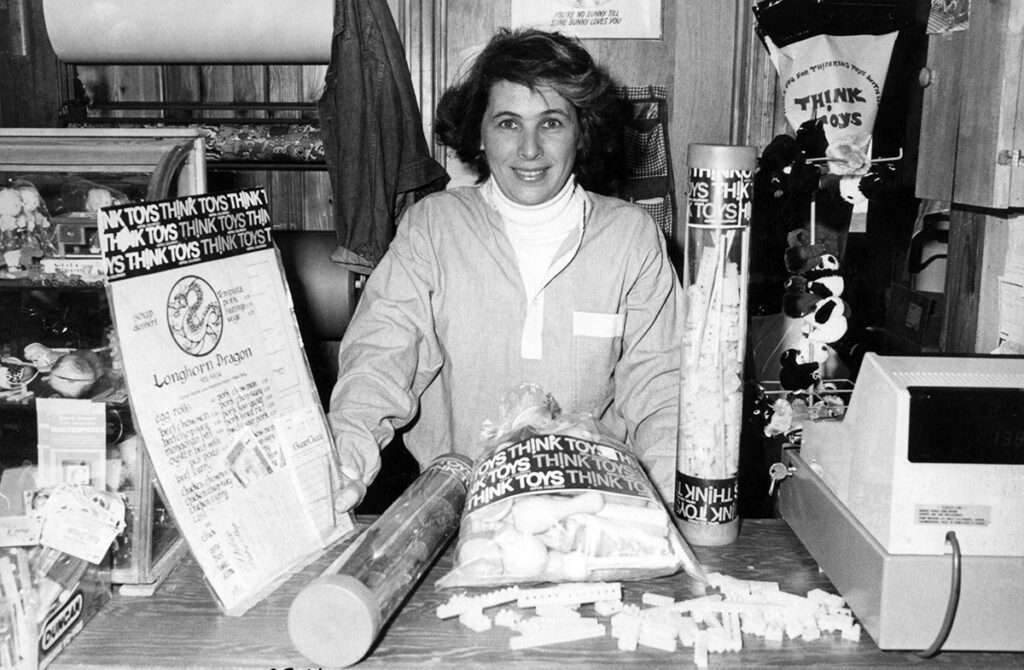
Carole Hershey [00:32:15] Economic extremes, economic extremes. But if you’ve noticed, and I noticed it last spring and fall and I think we’ll see it again this spring and fall, a lot of the restaurants that have totally geared themselves to visitors, are now, in the off-season, gearing themselves to locals, changing their prices, making the prix fixe dinner that locals can afford, making specials if you go in early. So I think there is a return, to some degree, to the local population, which is minuscule. I mean, you can’t build a… I was in the toy business. You can’t build a business around a population of 5000, maybe less than a thousand children, certainly 500 in the age group a toy store would deal. You can’t run a business on that. It’s impossible.
Larry Fredrick [00:33:05] Now, when you… you’re talking seasonal, when you were running retail, wasn’t the off-season back then really closing the town down? There wasn’t much open, was there?
Carole Hershey [00:33:15] Yes, except for me because I needed to make a living. So I stayed open 365 days a year. And when kids had nothing to do in the off-season, they would buy models, airplane models. And now, of course, they buy Nintendo and click on the TV and rent movies. But even adults would come in to buy games because in the off-season, they would go crazy. They’d buy checkers, chess. I would do great business in the off-season.
Larry Fredrick [00:33:43] So that’s somewhat filled in then.
Carole Hershey [00:33:45] It’s gone. It’s gone. Walmart has replaced the rest of it.
Larry Fredrick [00:33:52] Okay, well, I think that’s enough data for today. Once again, I want to thank you.
Carole Hershey [00:33:57] You’re welcome.