Oral History
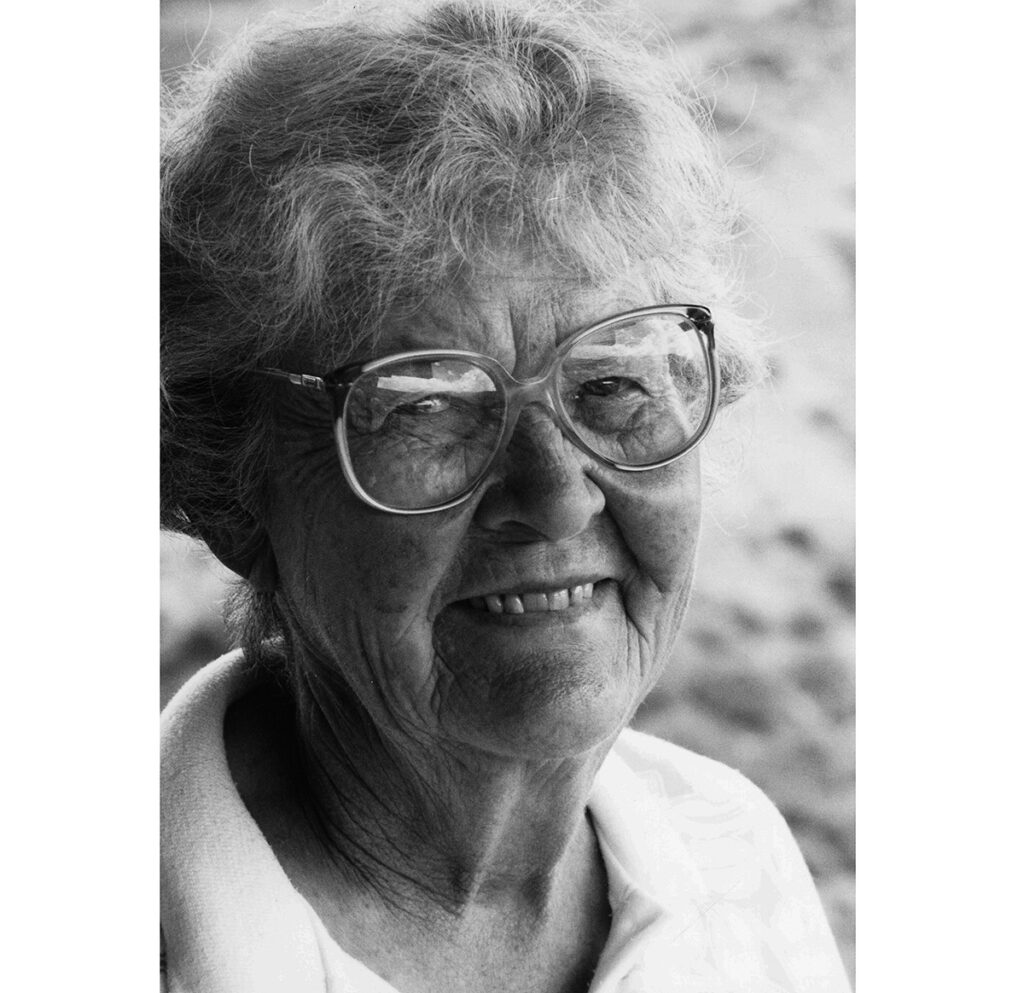
Alice Rachel Sardy
One 60 minute oral history interview with Alice Rachel Sardy by Larry Fredrick on January 9, 1996. The subject of the interview is the Sardy House. This interview is part of the Architectural Survey Oral History Project
Alice Rachel Sardy
Interviewed by Larry Fredrick
January 9, 1996
C145_1996.037.0002
Alice Rachel Sardy [00:00:02] You can eliminate a lot. You have to.
Larry Fredrick [00:00:06] Yeah. Yeah. This is the continuing series of the Architectural Survey tapes, and now I’m interviewing Alice Rachel Sardy, and it is January 9th, 1996. So first of all, thank you, Alice. Enjoy having you here.
Alice Rachel Sardy [00:00:25] My pleasure.
Larry Fredrick [00:00:26] Could you first give us a brief biography of yourself and when you first came to Aspen?
Alice Rachel Sardy [00:00:34] I was born September the 6th, 1908, in Circleville, Ohio. My parents moved to Colorado when I was two years old. We lived in the San Luis Valley. Later we moved to Gunnison. I went to high school in Gunnison. Western State College in Gunnison, graduated from Western. I taught history and business in Ouray High School for four years after I graduated. I met my husband, Tom Sardy. We were married in 1936, moved to Monte Vista, Colorado, where Tom managed a mortuary. In 1938, March 1938, we bought from L.L. Wilkes, Mortuary and Hardware Store, which were in the Collins Block.
Larry Fredrick [00:01:55] Okay, that’s wonderful. 1938… what did the downtown look like in 1938?
Alice Rachel Sardy [00:02:05] Probably didn’t look as bad to other people as it did to me. March the 19th was not a very pretty time of year to come to Aspen. Aspen had not had, we had heard, a new building in 50 years. So it did. And there were many unoccupied homes and buildings, and the town looked old.
Larry Fredrick [00:02:39] What kind of businesses were there that were open?
Alice Rachel Sardy [00:02:45] There were three grocery stores. There was another hardware store, the Jerome Hotel. There was a fair amount of good small business in Aspen in 1938.
Larry Fredrick [00:03:08] What were the buildings like? Were there any particular buildings or businesses that you remember as a first impression?
Alice Rachel Sardy [00:03:17] Of course, the Hotel Jerome first, and the Collins Block, which we had just bought. The Elks Building was a nice building. The Wheeler Opera House had then just a grocery store on the first floor, but it was a great old building. The windows were all out upstairs. But that’s a building one would notice immediately coming into Aspen.
Larry Fredrick [00:03:53] Were the buildings that were occupied at that time…. did you pay any particular attention? Did you know that they were historic in nature or any of the history of Aspen?
Alice Rachel Sardy [00:04:06] I don’t think I was interested in that. I don’t think so.
Larry Fredrick [00:04:12] Over the years, Aspen has changed quite a bit. Are there some buildings or structures that are now gone that you particularly remember? Wish were still here, perhaps?
Alice Rachel Sardy [00:04:25] Yes. The old high school, which was the old Darcy Brown residence, which later became the high school. Beautiful old building. I was impressed when I visited the classes in the high school. It was a beautiful, beautiful building. It’s gone.
Larry Fredrick [00:04:47] Are there any other buildings that you might remember?
Alice Rachel Sardy [00:04:55] No, no, I think of that one especially.
Larry Fredrick [00:04:57] That they weren’t real significant.
Alice Rachel Sardy [00:05:00] Yes.
Larry Fredrick [00:05:04] Okay. Are there any buildings that are historic that you think should be used better than they are today, or might need some work done?
Alice Rachel Sardy [00:05:14] So much has been done since I have been here. So many wonderful improvements and restorations of old buildings. I can’t think of…
Larry Fredrick [00:05:29] Is there a building today that’s your favorite building? That might have changed from the Opera House?
Alice Rachel Sardy [00:05:42] I suppose the Opera House would be my favorite.
Larry Fredrick [00:05:48] What about the new buildings? There are so many new buildings that have in-filled, a lot of modern buildings. Is there any new building that you think might, say 100 years from now, we’d be talking about? As being historic or special or pretty or…?
Alice Rachel Sardy [00:06:11] Well, I suppose out at the Institute, the buildings there would be important.
Larry Fredrick [00:06:20] Now, none of that was built in 1938. That came much later.
Alice Rachel Sardy [00:06:24] Yes. Yes. None of that.
Larry Fredrick [00:06:30] Now we seem to be a little bit interested in the history of these buildings and of Aspen. Do you think… first of all, when do you think people became aware of their significance? Was there a time when they suddenly became aware of it?
Alice Rachel Sardy [00:06:53] I believe that the people who lived in Aspen when we came, many of them were aware of the significance of the buildings in Aspen. Many of them had lived through the period of prosperity, then depression, but they had an utter respect for many of the old buildings in town.
Larry Fredrick [00:07:26] So when the newcomers came, how did they learn about it? Or did they? Did they understand the historic nature of the community?
Alice Rachel Sardy [00:07:41] Well, I’m not so sure. I think that they were interested. They knew that the town had been a very progressive town back in the first ten years. And then, of course, after the silver crash, and people left. But there were those old buildings that had been well built, and the outsiders who came in saw that.
Larry Fredrick [00:08:22] Now, today, do you think people have the opportunity to understand the history? Do the visitors understand it when they come?
Alice Rachel Sardy [00:08:34] No.
Larry Fredrick [00:08:36] Good. Why not? I mean, is there… are they here for some other reason?
Alice Rachel Sardy [00:08:42] They’re here to ski. They’re here for what’s going on at the present time. I don’t think many of them… a few of us are, but I don’t think as a general rule. They’re not particularly interested in the history.
Larry Fredrick [00:09:02] Do you think the residents, the newer residents, will catch on to the history or have the same feel for it as the old timers did? {break in recording} Continuing with the history of the Sardy House, you were going to tell us…
Alice Rachel Sardy [00:09:18] Yes, I understand that back in the early 1890s, or maybe before that even, Jack Atkinson and his wife purchased, I think, about eight blocks. Eight lots. They built the house in 1892. That’s the date that is considered the date when the house was built. They sold after… the silver crash was in 1893, and prices went down, value of property decreased. After some 10 or 11 years, I believe it was… I’m not sure about that date… they sold the house for less than what they had paid for the lots. Manfred Smith bought it. He was an attorney. He lived there with his family for a number of years, seven, eight, nine, moved to San Francisco. When he left, he didn’t pay the taxes, and after a period of about seven years, I believe it was, whatever the regulation, it was taken over by the county. And so then Doctor Twining bid in the taxes and acquired the house, and we bought it then from Doctor Twining in 1945.
Larry Fredrick [00:11:25] So you had been in town for a number of years?
Alice Rachel Sardy [00:11:28] Yes. We were seven years in Aspen before we bought the Sardy House.
Larry Fredrick [00:11:36] Was it in pretty good condition when you bought it?
Alice Rachel Sardy [00:11:39] Well, the house was well-built and had never been just vacated and unattended. So structurally, it was always good. When we bought it, we needed a new furnace. We needed a new roof. Needed repair on the foundation. Such things as that.
Larry Fredrick [00:12:08] And then when you owned it, it eventually became the mortuary.
Alice Rachel Sardy [00:12:13] Yes. It did. When we bought it, the downstairs was converted. We moved the mortuary from the Collins Block to the Sardy House, and we lived upstairs.
Larry Fredrick [00:12:29] And that’s probably the most notable story about it today. Are there any ghosts or any… do you know of any…?
Alice Rachel Sardy [00:12:37] I’ve heard about ghosts after I had spent 40 years in the house. I don’t know. I had never heard about them, and I lived there.
Larry Fredrick [00:12:47] Now, when you sold it in about, what?
Alice Rachel Sardy [00:12:52] ’85.
Larry Fredrick [00:12:53] ’85. It became a bed and breakfast inn and restaurant.
Alice Rachel Sardy [00:12:58] Yes.
Larry Fredrick [00:12:59] And they added quite a bit to it. What do you think about the way it’s being used today?
Alice Rachel Sardy [00:13:04] Tom and I were very pleased with what they did with it. They changed some of the back rooms, but most of the front part of the house remained the same as it was built. There were some changes, but essentially…. and then, of course, across the alley they added the other additions.
Larry Fredrick [00:13:32] Mhm. Now that it’s a bed and breakfast, can you imagine it being used as anything else? Would that ever change its use in the future?
Alice Rachel Sardy [00:13:45] I think the present use is ideal.
Larry Fredrick [00:13:52] Okay. Well, I think that’s probably enough about the Sardy House. Let’s move down Main Street a little bit. Catty-corner from the Hotel Jerome is the Lincoln-Chitwood block, which is better known as the Cantina restaurant today. What did that look like when you first came? You mentioned the Hotel Jerome. Did you even know there was a building on that corner?
Alice Rachel Sardy [00:14:17] Yes. We knew about the Chitwood Block. For one thing, it was a garage downstairs. Benny Smith had a garage, and the daughter of Mr. and Mrs. Chitwood, Lena Van Loon, was one of the early ones that I had met, and I knew about the Chitwood house because they, her parents, had a rooming house upstairs there, and the garage was downstairs.
Larry Fredrick [00:14:54] Now, that changed from a garage. What went in after the garage?
Alice Rachel Sardy [00:15:01] Then it was remodeled, and I believe that’s when the Nielsens had a little bakery and pastry shop on the corner.
Larry Fredrick [00:15:18] Now that building’s been really refurbished quite a bit recently.
Alice Rachel Sardy [00:15:23] Oh, yes.
Larry Fredrick [00:15:25] Any ideas? Does it look better now or worse or…?
Alice Rachel Sardy [00:15:28] Well, probably better. Yes, it was old. It needed a lot.
Larry Fredrick [00:15:35] That was bare brick. Now it’s painted. What do you think about painting the old brick?
Alice Rachel Sardy [00:15:42] Well, usually I prefer that it remain brick.
Larry Fredrick [00:15:52] Mhm. You mentioned rooms upstairs. Was it furnished rooms, or were they rented by the night or by the week or the month or…?
Alice Rachel Sardy [00:16:03] Well, I remember there were two high school girls, whose parents lived down valley, rented rooms there for the nine months they were in school. I think they rented to some working people. I don’t know that they… I don’t believe they rented by the day or night.
Larry Fredrick [00:16:28] Now the time from the Epicure Restaurant to the Cantina, what other types of businesses might have been in there? Do you remember any?
Alice Rachel Sardy [00:16:41] No. The Epicure was, changed hands a few times, but still remained the little sandwich shop and bakery.
Larry Fredrick [00:16:55] Well, let’s move over to another important property. Let’s go up to Hopkins Street to the Collins Block, which we fondly refer to as Sardy Hardware. You also purchased that in 1938. You said you purchased it and came to Aspen. Did you come to Aspen first? Or did you just buy this and then move? Or how did that come about?
Alice Rachel Sardy [00:17:21] We were looking for a business of our own. Tom was managing a mortuary in Monte Vista. We’d been married a year and a half. We wanted a business of our own. So he started looking, through salesmen who told him… mortuary, he was looking for mortuary… and there were not very many mortuaries for sale in Colorado or towns that needed a mortuary. But Aspen was for sale. So we came over, looked it over, decided (it was a) good place to get a start, maybe we’d stay here five years and move on.
Larry Fredrick [00:18:06] Now, you didn’t purchase the Sardy House until later, so where did you live? Did you live…?
Alice Rachel Sardy [00:18:10] We lived upstairs. Upstairs in the Collins Block. At the top. Downstairs, half was mortuary, half hardware. Upstairs were seven apartments. Most of them little two-room apartments. I think we rented them for something like $15 a month. So we moved into one of the apartments upstairs.
Larry Fredrick [00:18:35] Now the hardware business became so successful you had to move the mortuary to the Sardy House.
Alice Rachel Sardy [00:18:43] No, actually… well, it was, it was successful. But the real reason was Mr. Paepcke came to town. He came in the store. He and Tom got along very well. He was interested in an interest in the store. He didn’t want the mortuary. So finally they agreed that Tom, if he could purchase the present Sardy House, would move the mortuary down there. We would move there and then convert what was mortuary into hardware store.
Larry Fredrick [00:19:26] What was the building like when you first purchased it? Was it in good shape or did it need work?
Alice Rachel Sardy [00:19:35] Well, like I think most of the buildings in Aspen, it was in fair shape. It needed redecorating. It was old. Basically it was a good building.
Larry Fredrick [00:19:57] A substantial structure.
Alice Rachel Sardy [00:19:59] Yes.
Larry Fredrick [00:20:00] Now it’s gone through some pretty major renovations.
Alice Rachel Sardy [00:20:04] Indeed.
Larry Fredrick [00:20:05] What do you think about that?
Alice Rachel Sardy [00:20:08] It’s beautiful. Yes. Yes. When we had… Tom sold an interest in the building and the store to Mr. Paepcke in 1945. Then, it became a part of the Aspen Company. Then later, they decided they needed a lumber yard. So they bought a vacant lot across the street, and it became Aspen Lumber and Supply. There’s an interesting story about that. That lot that they wanted, they wanted to build a building there. Friedl Pfeifer had come to town, and he’d gotten acquainted with Tom. So he then, I guess, was with the 10th Mountain. And he asked Tom… this was when people begin to bid in taxes and buy a property, vacant lots and so forth. So he asked Tom, he said, “Would you buy some lots for me?” So Tom purchased some, purchased, oh I don’t know, 3 or 4 or 5 for about $80 – $100. And those lots across the street, I think they were just two of them, were among the ones that he had bid in the taxes for. Well, then the next year, the Aspen Company decided they needed that for a lumber yard. So they approached Friedl to see if they could buy those back. Well, he eventually sold them back for $1,000.
Larry Fredrick [00:22:02] So the economic times…
Alice Rachel Sardy [00:22:03] So Friedl never heard the end of that.
Larry Fredrick [00:22:07] So economic times were changing pretty rapidly then. So you saw a lot of changes around the hardware store?
Alice Rachel Sardy [00:22:14] Oh, yes.
Larry Fredrick [00:22:16] Just to the east of the hardware store, via at that time a vacant lot, is the Brand Building. Now, they were sort of your next-door neighbors. What was the Brand Building like when you moved into Aspen?
Alice Rachel Sardy [00:22:33] There was a garage downstairs. There was an apartment. I think the upstairs was just vacant.
Larry Fredrick [00:22:46] Do you remember when the garage moved out?
Alice Rachel Sardy [00:22:51] No, I don’t. Probably about the same time we moved.
Larry Fredrick [00:22:56] What went in to the Brand Building, or when did something go in besides the garage?
Alice Rachel Sardy [00:23:06] Then they remodeled it and made shops in the building there.
Larry Fredrick [00:23:13] What kind of shops were there?
Alice Rachel Sardy [00:23:17] There have been various ones, and there’s been… The Smuggler was one of the first, I think, to go in when the building was remodeled.
Larry Fredrick [00:23:27] The latest remodel?
Alice Rachel Sardy [00:23:28] Uh huh. I don’t remember a whole lot about it.
Larry Fredrick [00:23:33] Has it always been… other than the garage then, it was just retail and 1 or 2 apartments upstairs?
Alice Rachel Sardy [00:23:40] Mhm. Mhm.
Larry Fredrick [00:23:43] Okay. And so it really wasn’t used a lot until just recently?
Alice Rachel Sardy [00:23:49] Well, it was continuously used. It was occupied when we came here, and some of the buildings weren’t.
Larry Fredrick [00:23:55] But as a garage.
Alice Rachel Sardy [00:23:57] Oh, as a garage, I suppose, for about… Albert Bishop had a garage there at one time. Bob Kopp was in there at one time. I don’t know, they may have been there sometime after we moved down to the Sardy House.
Larry Fredrick [00:24:16] Okay. Well, let’s go down to Hyman Avenue, and off to the fringe a bit is the Crystal Palace, or what we call the Crystal Palace today. What was that when you first moved here?
Alice Rachel Sardy [00:24:34] Francis Willoughby Herron’s father was mayor, and he was president, I guess you’d say, of the Midnight Mine. And he had his offices in that building. Later, after he passed away, his offices were moved. The Aspen Supply used that building as a storage building for their lumber. And then after that, I think it was sold and remodeled, and it became Crystal Palace.
Larry Fredrick [00:25:22] It was remodeled, and you remember the remodeling? What did they do to it?
Alice Rachel Sardy [00:25:28] I don’t remember the details on that.
Larry Fredrick [00:25:33] I’m curious. It’s been the Crystal Palace for so long, we don’t know of it as anything else. What do you think might happen to that building if it’s not the Crystal Palace? What kind of businesses might move in there?
Alice Rachel Sardy [00:25:48] Hmm… I can’t imagine.
Larry Fredrick [00:25:53] I was just curious. Well, as I said, that’s sort of out on the fringes. Let’s go right to the center of the business core, and to Galena and Hyman is the Aspen Block, which is across the street from Aspen Drug, the big painted building. What was that like when you first came in?
Alice Rachel Sardy [00:26:25] I think it was a garage in the corner of that building. And I think there were some little apartments or rooms upstairs that were rented.
Larry Fredrick [00:26:40] Was that building painted then, or was it bare rock? When did the… do you have any idea when the garage left and what went in after it?
Alice Rachel Sardy [00:26:58] No. I can tell you a little bit about across the street, the big fire.
Larry Fredrick [00:27:02] Okay. That’s where we’re going next, is the Keene Block, which is today known as Aspen Drug.
Alice Rachel Sardy [00:27:08] Oh, is that the Keene?
Larry Fredrick [00:27:09] That’s the Keene Block.
Alice Rachel Sardy [00:27:11] Oh, yes.
Larry Fredrick [00:27:12] And that’s a rather substantial-sized building. But you just mentioned the fire, so… What did that look like when you first came?
Alice Rachel Sardy [00:27:21] There were little shops and stores in that whole block, from the Aspen Drug down to the end, west end of that block. On the west end was a beauty shop. And a lady lived there, and she had her beauty shop. Then there was a restaurant, somewhere in the middle of that block. Then there was Al Lamb’s Drugstore, Peggy Rowland’s grandfather had a drugstore. I think it was closed at the time of the fire. Then, um, the name escapes me. Blind man had a little tobacco store right next to the drugstore. There were 4 or 5 little stores… oh, and, uh, let’s see… Van Loons had a clothing store in there. It was called… it wasn’t called Van Loon, it was called… I can’t think what it was called.
Larry Fredrick [00:28:42] That’s all right.
Alice Rachel Sardy [00:28:43] But anyway, we were living in the apartment upstairs in the Collins Block, which was in the same block, just across the alley. And so then that, the fire started, I don’t know, 9:00 maybe in the evening, late in the evening.
Larry Fredrick [00:29:01] And you’re talking about opposite corner of the Aspen Drug, aren’t you? Across from the Opera House, where the Tom Thumb…? Is that the fire you’re talking about?
Alice Rachel Sardy [00:29:11] The fire was between the Aspen Drug and the other corner, the west corner.
Larry Fredrick [00:29:19] Oh, okay. Okay.
Alice Rachel Sardy [00:29:19] A lot of those… all those shops in there. The Kalmes building clothing store was damaged by a lot of smoke, and many of the other shops felt the same. It was the restaurant that was mostly damaged. But all those little shops in between were damaged.
Larry Fredrick [00:29:46] What about the Aspen Drug Building itself? Do you remember…?
Alice Rachel Sardy [00:29:50] It had very little damage from that fire. I don’t remember how much. Maybe some smoke, but it couldn’t have been any more than that, I don’t think.
Larry Fredrick [00:29:59] Today it has a second and third floor that’s rather modern. Do you remember them putting that in?
Alice Rachel Sardy [00:30:06] Yes. Yes. They did not have… at least they didn’t have the… I don’t think they had the second floor. I know they didn’t have a third.
Larry Fredrick [00:30:16] Do you remember when they put that in?
Alice Rachel Sardy [00:30:23] Another thing about what… see, this is irrelevant, but when I think of things like this… Tom had the mortuary, had the funeral coach. We also had the only ambulance service. The fire whistle was not working, or at least they didn’t, they couldn’t get around to all the people. He got the ambulance out and went driving around town with the siren blowing to warn people that there was a fire.
Larry Fredrick [00:30:56] That’s great. {break in recording} …and I was discussing the Keene Block and the Aspen Block. You mentioned in the Aspen Block and the lawyers…? A Manford Smith. Did you want to…? His office was in there. Is that right?
Alice Rachel Sardy [00:31:21] I understand that he had an office there and had lived, had purchased the Sardy House.
Larry Fredrick [00:31:33] So that’s the connection.
Alice Rachel Sardy [00:31:35] Mhm.
Larry Fredrick [00:31:36] Okay. I think we’ve concluded with the Aspen Drug Building, or the Keene Block. But I want to step aside for just a minute. That is the Hyman Avenue Mall, and that was converted into a mall in the 1970s. What do you remember about that? Was that controversial? Was it a good idea or was it a bad idea? Has it worked?
Alice Rachel Sardy [00:32:04] It was a very controversial at the time. However, I think it has worked.
Larry Fredrick [00:32:15] Was it good for business or bad or…?
Alice Rachel Sardy [00:32:20] The businesses, the small businesses there on that block felt that it was bad for them. They were the ones who originally were opposed to it. But I don’t think that it… it eventually worked out, I think.
Larry Fredrick [00:32:42] Well, let’s move down. We’ve got two more buildings to discuss and then some other questions. Let’s move to the Brown and Hoag Building, which most people know as Independence Square or Independence Building, which today houses the Banana Republic. When you came in 1938, what kind of shape was that building in?
Alice Rachel Sardy [00:33:08] Mostly vacant. Then when… after the Skiing Company came here, they did do some remodeling and rented rooms in there. Later a shop was opened up downstairs. Before that, the post office had been in that building, before it moved to the Elks Building.
Larry Fredrick [00:33:40] But it wasn’t a post office…?
Alice Rachel Sardy [00:33:42] No, it was, it had already…
Larry Fredrick [00:33:44] But it was originally a post office.
Alice Rachel Sardy [00:33:45] Well, sometime before 1938. I don’t know how long the post office had been in the Elks Building when we came, but before that, the post office had been in that building.
Larry Fredrick [00:33:59] But in 1938, it was probably abandoned.
Alice Rachel Sardy [00:34:03] Yes, practically. Yes, I think maybe it was. I think it was. I don’t believe there was anything in it then.
Larry Fredrick [00:34:12] So then it was converted to housing upstairs and some businesses down below. And today it still is pretty much businesses. Has it changed much on the outside?
Alice Rachel Sardy [00:34:27] No, no.
Larry Fredrick [00:34:29] It’s pretty much the way it was. There isn’t a great deal on that block. About the only thing on that block is… or on that Cooper Street is, of course, the Red Onion, which is down the street and…
Alice Rachel Sardy [00:34:45] The Bowman Block.
Larry Fredrick [00:34:46] The Bowman Block. And that’s the next one that I’d like to talk about.
Alice Rachel Sardy [00:34:50] I don’t remember much about it. I know that Fritz Benedict acquired it and had offices there for a while.
Larry Fredrick [00:35:00] Did he remodel it or did he…?
Alice Rachel Sardy [00:35:02] Mhm.
Larry Fredrick [00:35:02] He fixed it up, and then he apparently sold it to, I believe, Stein Eriksen.
Alice Rachel Sardy [00:35:11] I don’t know.
Larry Fredrick [00:35:12] When did it become painted? The bright pink?
Alice Rachel Sardy [00:35:22] It was called the Bowman. Mr. Bowman was the postmaster.
Larry Fredrick [00:35:30] Yeah. Actually, we’re talking about three buildings right there. They’re sort of together.
Alice Rachel Sardy [00:35:35] Oh, yes. That’s right.
Larry Fredrick [00:35:36] And they’re all sort of painted today. So Mr. Bowman had a business in there, as I recall.
Alice Rachel Sardy [00:35:42] Oh, yes. Photography, was it? I don’t remember.
Larry Fredrick [00:35:45] I don’t remember.
Alice Rachel Sardy [00:35:46] I don’t remember.
Larry Fredrick [00:35:47] Well, I sort of led you to the paint because we’ve pretty much finished with the buildings. But I want to continue this interview for a minute or two. The paint. The story of Walter Paepcke coming and painting the town is always associated with Tom Sardy selling the paint. Can you tell us a little bit about the paint business after Walter Paepcke came?
Alice Rachel Sardy [00:36:17] The only thing particularly that I remember was that he offered to furnish the paint to anyone who wanted to paint their houses, and I believe that he had something to do with the color of the paint. Well, the people were up in arms. They didn’t want anybody coming in and telling them how to paint their houses. But I don’t… of course, the hardware stores, I don’t remember any connection there except that probably Walter Paepcke by that time had an interest in the Aspen Supply, and they sold paint.
Larry Fredrick [00:36:57] Mhm. So it probably helped the business.
Alice Rachel Sardy [00:37:01] Well, I don’t think it helped much because they didn’t do much painting.
Larry Fredrick [00:37:06] Well, I’d like to go a step further to… Tom Sardy is associated as being a county commissioner.
Alice Rachel Sardy [00:37:14] Yes.
Larry Fredrick [00:37:14] And he and Walter Paepcke worked very hard to put in an airport. Could you tell us how that came about? Or do you remember any of that? I mean, it’s called Sardy Field, so…
Alice Rachel Sardy [00:37:28] I have a scrapbook on the airport if you’d like to look at that.
Larry Fredrick [00:37:33] Yeah, I might want to review it to catch up my notes. But was this something that Tom took on or…?
Alice Rachel Sardy [00:37:42] Tom worked very hard for an airport for many, many, many years. He was dedicated to it because he felt that it was needed, that Aspen needed the airport. And as county commissioner, he did a lot to… And another thing that he did, he approached people. They had no money. So people, visitors who came to the Hotel Jerome, came to visit as skiers, he would meet most of them, and he would approach them and say, “We need an airport. Don’t you think we need an airport? Can you help us out? Give us a little money?” And he collected a lot of money that way because he didn’t hesitate to ask anyone.
Larry Fredrick [00:38:37] Well, he sounds kind of like he was a town booster. He really wanted the town to…
Alice Rachel Sardy [00:38:41] He was dedicated. Yes, he was.
Larry Fredrick [00:38:45] Now, the streets in town were not paved until 1967 or ’68. Did he have any part in that?
Alice Rachel Sardy [00:38:54] Well, that was city, of course. He was county commissioner. Of course he believed in paved streets. I suppose that he…
Larry Fredrick [00:39:03] I’ve often… some people said that in the very old days, Highway 82 was paved to Sardy Hardware, and that’s where it stopped. Now I think that’s a bit far-fetched.
Alice Rachel Sardy [00:39:15] Oh, I hadn’t heard that before.
Larry Fredrick [00:39:17] Well, I’ve heard that mentioned a few times. I was just curious if you wanted to verify that or not.
Alice Rachel Sardy [00:39:22] {laughter} I hadn’t heard that. Some of the funny things…
Larry Fredrick [00:39:25] Do you remember where the highway did go? I mean, it wasn’t paved over Independence Pass.
Alice Rachel Sardy [00:39:31] No, just through the city. Just through Main Street.
Larry Fredrick [00:39:38] And it ended where the Original curves are probably?
Alice Rachel Sardy [00:39:41] Yes. I think so.
Larry Fredrick [00:39:43] That’s where the pavement stopped. That’s pretty much what I thought. That was just one of those stories I wanted to lay to rest. A county commissioner story.
Alice Rachel Sardy [00:39:54] {more laughter} Yes.
Larry Fredrick [00:39:56] Were the streets, though, I mean, were they really muddy or were they sort of oil covered or was that a problem?
Alice Rachel Sardy [00:40:05] Well, they were graveled streets. I suppose in a way they were a problem. They… the side streets would be muddy, some of them. But the core, in the core of the city, they weren’t bad.
Larry Fredrick [00:40:29] I was just curious.
Alice Rachel Sardy [00:40:29] Dusty, you know.
Larry Fredrick [00:40:32] I just was curious about that. I’m going to go ahead and conclude this interview, but I want to give you the chance. Is there anything that I missed or anything that you want to make sure is put on tape so that we get it straight? Any comments that you’d like to add?
Alice Rachel Sardy [00:40:53] I have some sort of interesting stories, but I don’t believe they apply here. I would like to tell you about when we were living upstairs in the apartment over the store. This was in the early ’40s. Aspen felt an earthquake. There was a fault up Castle Creek. At the time, we were living in the apartment upstairs. It was about closing time in the store, but I… At that time, too, there was some mining. Some of the families would lease a mine, and there were several mines that were being worked by families. They had big trucks, and I thought a big truck was going by the building and made a noise. Sounded like a big truck. And I thought, “My, that’s a big truck!” Well, then, the pictures on my wall shook a little bit. The dishes in my cupboard shook a little bit. Just a little while, Tom came upstairs and he said, “You know, that was an earthquake.” We had swinging doors into the stairway going upstairs, and he thought someone was coming down. The doors were swinging like that. But it was an earthquake.
Larry Fredrick [00:42:23] So it was substantial enough to actually shake and rattle and move things.
Alice Rachel Sardy [00:42:27] Yes, it was.
Larry Fredrick [00:42:29] That’s interesting, Talking about stories, you told me about almost blowing up the garage with fireworks one time. I remember that story.
Alice Rachel Sardy [00:42:39] Yes, it was about the… well, we… that vacant lot back of the store was just a mess. I think that…
Larry Fredrick [00:42:49] Between the Sardy House, or Sardy Hardware and the Brand.
Alice Rachel Sardy [00:42:53] Right, right. I think they had had sheep in there at one time. And they’d bring them, you know, they brought sheep through to take them up to graze on the mountain. So we… Tom and… Bernie Popish started working for Tom, and they cleaned that up and put a lawn in there, and we fenced it, and we had sweet peas around the edge. It was very nice, a very nice yard back there. And when our children arrived, we had some place for them. But anyway, my sister and her husband and a little boy from Gunnison came over to see us on the Fourth of July. We were out in that back yard and had fireworks, Roman candles and skyrockets, I suppose. One of them landed right close to the gas pump over there at the Brand Building. I don’t know. I don’t remember how they knew it. Maybe they, maybe the men saw it land right over there and ran over to see.
Larry Fredrick [00:44:04] That could have been that pretty spectacular fireworks.
Alice Rachel Sardy [00:44:07] That could have been. Yes, yes.
Larry Fredrick [00:44:09] Little more than what you expected.
Alice Rachel Sardy [00:44:10] Exactly.
Larry Fredrick [00:44:11] So the town was pretty easygoing then?
Alice Rachel Sardy [00:44:16] Oh, yes, yes. 770 people, according to the last census. And most of them are…. you probably have heard this, too. When we came in 1938… well, I got this information from the Empire Magazine in the Denver Post a long time ago. They had written an article, probably around the ’60s. I’m sorry I didn’t save the article. But anyway, they were saying that in the ’30s, when we came, there were more old-age pensioners in Pitkin County than any other county in the state. 20 years later, when this article came out in the Empire Magazine, it had completely reversed. More young people in Pitkin County than any other county in the state.
Larry Fredrick [00:45:23] I think I have come across that data. Did the population… the population supposedly peaked out in the ’30s? But what about World War II? Did that take away even more?
Alice Rachel Sardy [00:45:36] Yes, that did take some. It may have gone down to 500. Of course, the reason Aspen had so many old-age pensioners, there wasn’t anything for the young people to do, and they would leave. But the older people had their homes, and they stayed.
Larry Fredrick [00:45:59] Now, you mentioned there was still some mining going on?
Alice Rachel Sardy [00:46:02] Yes.
Larry Fredrick [00:46:02] When did that finally just come to a halt? Was there a specific time?
Alice Rachel Sardy [00:46:09] Probably during the war.
Larry Fredrick [00:46:13] Well, that makes sense. But they were mining what? At Smuggler, maybe?
Alice Rachel Sardy [00:46:20] Mhm. There were… various ones were leased, mostly by these Austrian families, and then, the whole family would work the mine and make a living.
Larry Fredrick [00:46:37] I think the Herron brothers and the Willoughbys come to mind as being…
Alice Rachel Sardy [00:46:42] Oh, yes. Yes, the Midnight Mine. That’s right. They had the Midnight, and Johnny Herron had had interest in the mines for years and years and years.
Larry Fredrick [00:46:54] Those are the names I’ve run across.
Alice Rachel Sardy [00:46:59] Mhm. Now, I think some of the old families like the Loushins, the Popishes, the… I think the older generation, they had worked in the little mines around here. Do you know Bernie Popish?
Larry Fredrick [00:47:18] Sure. He’s the first clerk I met in the Sardy Hardware.
Alice Rachel Sardy [00:47:23] Oh, yes.
Larry Fredrick [00:47:24] I remember forgetting my billfold one day, which I never do. And he says, “Oh, I’ll just see you later,” and I came back later and squared it up with him.
Alice Rachel Sardy [00:47:36] He lives in Carbondale, you know. He might be a source of information.
Larry Fredrick [00:47:42] He was a wonderful character.
Alice Rachel Sardy [00:47:44] Oh, yes. Yes.
Larry Fredrick [00:47:46] He was so helpful in the hardware store.
Alice Rachel Sardy [00:47:48] Nice, nice, nice little man. Very nice.
Larry Fredrick [00:47:52] And the hardware store. I have very fond memories of the hardware store as well.
Alice Rachel Sardy [00:47:57] Oh, good. Good.
Larry Fredrick [00:47:59] Well, if you don’t have any… Or do you have anything else that you want to put…?
Alice Rachel Sardy [00:48:03] Let me see. I think I wrote something down.
Larry Fredrick [00:48:28] As always, everybody seems to remember something after we conclude. The day after.
Alice Rachel Sardy [00:48:34] Oh, I’m sure.
Larry Fredrick [00:48:35] That’s just human nature.
Alice Rachel Sardy [00:48:40] Oh, I did mention here… you asked the question, “Are there any new buildings in town you think will be historically significant?” I suppose the Little Nell and the Ritz will be. I think I’ve got some other notes in here.
Larry Fredrick [00:48:55] Okay. {break in recording}
Alice Rachel Sardy [00:48:58] …Aspen Supply when we were buying it. A man by the name of Walt Acheson. He had a little house there. Then he left, and the house was moved, and the lot was vacant. And that’s what is now the Mill Street Station.
Larry Fredrick [00:49:21] Yes. It’s changed quite a bit. Was the ISIS theater pretty active. That was right across the street from the hardware store.
Alice Rachel Sardy [00:49:31] Right, right. Well, they had had that theater. It was there when we came. And it has never closed, I don’t think.
Larry Fredrick [00:49:43] Was it the only theater in town?
Alice Rachel Sardy [00:49:46] Yes.
Larry Fredrick [00:49:47] For quite some time.
Alice Rachel Sardy [00:49:48] Parsons owned it.
Larry Fredrick [00:49:54] Before… I can’t think of the person’s…?
Alice Rachel Sardy [00:49:57] Linza.
Larry Fredrick [00:49:57] Yeah. Linza owns it now. I was just curious.
Alice Rachel Sardy [00:49:59] I see in the paper that somebody wants to buy it and make it four…
Larry Fredrick [00:50:08] That’s what I understand. Yeah. Things are always changing.
Alice Rachel Sardy [00:50:14] Well, they’ve been there a long time, the Linzas have. I think they want to retire. I think they want to sell.
Larry Fredrick [00:50:23] Do you think it would be a good idea to fix it up and…?
Alice Rachel Sardy [00:50:26] {unintelligible}
Larry Fredrick [00:50:28] It would probably help the building survive.
Alice Rachel Sardy [00:50:33] I can see nothing wrong.
Larry Fredrick [00:50:35] Okay, well…
Alice Rachel Sardy [00:50:37] When I remember that, I think of my… Tom and I had the corner apartment upstairs, and my daughter had a little room that looked out over the ISIS theater. And so Tom and I sometimes would go to a movie, and maybe one of the girls that lived in one of the apartments would come and babysit, but Sylvia was not supposed… she’d get up there, they’d open the window. She’d wait just as soon as we got out there, and she’d start yelling at us.
Larry Fredrick [00:51:17] So she knew where you were all the time. That’s great. Well, I think we’ll go ahead and conclude this interview. We can talk for…
Alice Rachel Sardy [00:51:27] I could talk with you all day.
Larry Fredrick [00:51:29] Well, I would love to if we had the time.
More Oral Histories
Oral History
Conversation between Elizabeth Paepcke and Bruce Berger, circa 1988
Oral History